
Devproaudio Reverside makes 3D reverb more than stereo width because it treats space as a relationship between a source, a listener, early reflections, late reflections, room geometry, tone, and movement. For RobSonic readers who work with electronic production, cinematic ambience, game-audio-inspired spaces, sound design, and mix depth, the release matters because it challenges the simple idea that a “wide” reverb is automatically a spatial reverb.
Devproaudio released Reverside 1.0 on July 24, 2026, as a dual-engine fully algorithmic reverb and 3D spatial placement tool for macOS and Windows in VST3, CLAP, and AudioUnit v2 formats. KVR Audio’s July 24 report described Reverside as a plugin that gives separate control over early reflections and the reverb tail, while also using source/listener placement and virtual-room geometry to shape the directional character of the space. That is the key idea: Reverside is not only widening a signal. It is trying to place sound inside a structured virtual environment.
Why Stereo Width Is Not The Same As 3D Space
Stereo width can be useful, but it is only one dimension of spatial perception. A widened synth can feel larger. A stereo reverb can make a vocal feel less dry. A ping-pong delay can move a percussion hit across the left and right channels. Those tools can make a mix more exciting, but they do not automatically create believable depth, front-back placement, or a shared acoustic environment.
3D space depends on more than left and right spread. The listener needs cues about distance, direction, reflection timing, tonal damping, room shape, and how a sound interacts with surfaces. Early reflections help communicate where the source sits. The late tail helps communicate the larger acoustic field. If those pieces do not agree, a reverb can sound wide but disconnected.
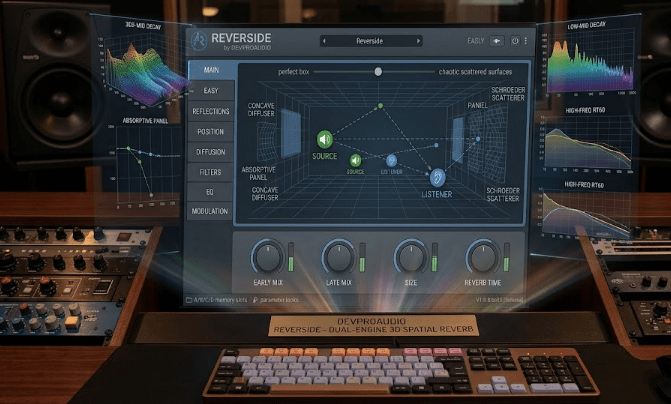
That is where Reverside’s design becomes interesting. The plugin separates early reflections and late reflections into two highly tunable engines. It also places the source and listener inside a virtual room, so direction and depth come from the structure of the modeled space rather than a simple stereo-width control.
Sonic State’s July 27 coverage of Reverside 1.0 emphasized that the plugin uses 3D source and listener positioning to build a coherent shared mix space. That phrase matters for producers. A coherent shared space is different from putting a different reverb preset on every track and hoping the mix feels deep.
How Dual-Engine Reverb Changes The Workflow
Most one-block reverbs present the producer with a single space. There may be controls for size, decay, pre-delay, damping, mix, and modulation, but early reflections and late decay often feel like parts of one blended object. Reverside’s dual-engine design gives producers more control over how space forms.
The early reflection engine handles the first directional bounces that help the ear understand source placement. These reflections can suggest whether the sound is close, distant, centered, offset, narrow, or interacting with nearby surfaces. The late reflection engine handles the longer tail that gives the space its body, decay, envelopment, and atmosphere.
KVR’s release report on Devproaudio Reverside said the plugin gives separate control over space, depth, stereo width, tone, and decay in more detail than a typical one-block reverb. It also noted that early and late engines each include their own 3-band filters, 3-band EQ, stereo tools, modulation, and mini diffusers.
For a producer, that separation is useful because a sound may need clear placement but a smooth tail. A snare might need short early reflections and a controlled late decay. A pad might need a wide tail but less obvious early reflection detail. A cinematic hit might need directional early reflections and a long, stylized tail. Reverside lets those decisions happen separately.
Why Source And Listener Placement Matter
The strongest part of Reverside’s concept is its source/listener model. Instead of treating reverb as a wash added after a sound, the plugin lets the user place a virtual sound source and listener inside a simulated acoustic space. The room geometry then changes how the direct path, early reflections, and late reflections behave.
This is useful because spatial placement should affect more than volume and pan. A source near a wall should not feel the same as a source in the middle of a room. A listener closer to one side of the space should hear directional reflections differently. A room with different dimensions should create different timing and density behavior.
Rekkerd’s July 25 report on Reverside’s algorithmic reverb release described the result as more than a stereo spread or generic reverb wash, because the 3D positioning system is shaped by both source/listener placement and virtual-room geometry. That is exactly why the plugin fits a RobSonic sound-design angle. It encourages producers to think like they are staging sound inside a space, not only adding width.
This matters for game-audio-style thinking too. Even when a producer is not building an interactive game mix, the idea of placing sources inside a shared environment can make music feel more dimensional. A synth can sit behind the vocal. A percussion loop can feel closer to the listener. A drone can wrap around the sides without swallowing the center.
How Early Reflections Create Depth Before The Tail
Early reflections are one of the most important spatial cues in a mix. They arrive quickly after the direct sound, often before the listener consciously hears a “reverb tail.” Those first reflections can make a sound feel close, far, boxed in, open, narrow, or placed inside a particular geometry.
Reverside’s early reflection engine is therefore central to the plugin’s identity. The KVR report lists 200+ early reflection patterns and automatic modes for reflection count and reverb time derived from virtual geometry. That gives producers more than a decorative reverb layer. It gives them a way to shape the first spatial impression of a sound.
This is especially useful for drums and vocals. A vocal can stay intelligible while early reflections create depth. A snare can gain room identity without needing a huge tail. A percussion loop can feel as if it belongs in the same space as other instruments. A short synth stab can be placed in a virtual room before any long ambience appears.
The practical lesson is simple. Depth should begin before the tail becomes obvious. Producers often use long reverb to create space, but early reflections can do more precise work with less mix clutter.
Why Late Reflections Still Need Independent Control
Late reflections shape the emotional size of a space. They create the bloom, tail, wash, and atmosphere most listeners associate with reverb. In Reverside, the late engine can be shaped separately from early reflections, which gives producers more control over how a space feels after the initial placement cue.
This matters because the late tail can be realistic, cinematic, ambient, stylized, or experimental. A natural room might need a short, dense tail. A cinematic pad might need a long, smooth decay. A transition might need resonant, echo-like behavior. A sound-design layer might need a wide late tail while the dry source stays focused.
Reverside includes 14 diffusion models, dedicated mini diffusers, pitch-preserving modulation, flexible pre-delay, density controls, and special wide behavior for the late tail. Those tools let producers decide whether the late field should feel smooth, scattered, resonant, rhythmic, or enveloping.
The plugin’s ability to move toward resonant, echo-like delay territory is also important. A modern reverb does not have to stop at room simulation. It can become rhythmic space. A producer can use late reflections to create tempo-related movement, delay-like resonance, or abstract cinematic depth without leaving the reverb environment.
How Pitch-Preserving Modulation Supports Cleaner Motion
Reverb modulation can make a space feel alive, but it can also smear pitch. Many lush reverbs use modulation to prevent static tails, but aggressive modulation can blur harmonies, soften transients, or make sustained parts feel unstable in a bad way. Reverside’s pitch-preserving modulation system is designed to animate the algorithm while retaining harmonic detail.
KVR reported that Reverside includes more than 100 internal LFOs for animating many parts of the algorithm while preserving harmonic detail in the tail. Sonic State also highlighted this system as a way to avoid pitch smear often associated with conventional delay-based or FM-style reverb modulation.
That is useful for modern producers because many reverb-heavy tracks still need pitch clarity. Pads, vocals, piano, guitars, and synth chords can all lose definition when a tail wobbles too much. Reverside’s approach gives producers motion without automatically turning the harmony into fog.
This makes the plugin relevant for ambient and cinematic music, but also for more controlled mixes. A producer can add subtle movement to a vocal space, create evolving depth around a synth, or animate percussion ambience without making the tail feel detached from the track’s key.
Why Mid/Side And Separate Stereo Tools Matter
Reverside’s spatial workflow also includes separate stereo controls for the early and late engines, plus Mid/Side behavior. That matters because stereo image and 3D depth are related but not identical. A sound can be wide without feeling deep. It can be centered but distant. It can have narrow early reflections and a wide tail. It can have a stable center with movement around the edges.
Separate stereo control lets producers shape those relationships. A vocal might need controlled early reflections in the center and a wider late tail. A pad might need wide late reflections but a less directional early stage. A percussion loop might need a narrower reverb so it does not compete with vocals or lead synths.
Mid/Side mode opens more creative options. Reverside can use different reverb times, extended envelope settings, and decay filter gains across left/right or Mid/Side behavior. That means the sides can bloom differently from the center, or the spatial tail can be shaped in ways that feel more expressive than a normal stereo reverb.
This connects naturally with RobSonic’s guide to creative effects chains, because space becomes more useful when it has a defined role in the chain. A reverb should not only sound impressive in solo. It should leave room for drums, bass, vocals, and the main musical idea.
How Reverside Fits Cinematic And Game-Audio-Style Production
Reverside’s 3D approach fits cinematic and game-audio-style production because those workflows often think about sound as objects in space. A user interface hit, impact, drone, mechanical loop, vocal phrase, or synth texture may need a specific sense of position. It may need to feel close, behind, above, enclosed, distant, or part of a shared fictional environment.
Traditional stereo reverb can create mood, but it may not create clear placement. Reverside’s interactive Position Display and source/listener placement model help producers think more visually. A sound can be staged before it is mixed. That can make a track feel designed rather than simply washed in ambience.
This is useful even outside film and games. Electronic producers can use the same logic to arrange layers. Put the vocal or lead close. Place a pad farther back. Give percussion a small room. Use a wide late tail for a transition. Put atmospheric effects in a shared space so the track feels less like stacked presets and more like one environment.
The strongest benefit is coherence. When multiple elements share a spatial logic, the mix can feel deeper without needing every track to be louder, brighter, or wider.
Why Easy And Deep Pages Both Matter
A plugin with this many controls can become intimidating. Reverside answers that with a layered editing system. KVR and Sonic State both described Easy and Main pages as central hubs, while deeper pages handle Reflections, Position, Reverb, Filters, EQ, Stereo, Diffusers, and Modulation. That structure matters because not every session needs deep editing from the first minute.
The Easy page helps producers move quickly. Choose a preset, adjust essential controls, and hear the space in context. That is important for songwriting, production, and fast mix decisions. The deeper pages matter when the reverb becomes a defining sound-design element. Then the producer can refine early reflections, late tails, density, EQ, filters, modulation, stereo behavior, and positioning.
The preset library also helps. KVR reported that Reverside includes hundreds of presets, with contributions from RumbaCodex and Nirto of NSONICS, and that more third-party libraries are planned. Presets are useful here not because they replace learning, but because they show how a complex spatial engine can be organized.
For RobSonic readers, the practical workflow is to start simple, then go deep only when the reverb needs to become part of the track’s identity.
How Producers Should Use Reverside In A Real Mix
Reverside is powerful enough to create huge spaces, but it will work best when producers give it a clear job. A 3D reverb can become messy if every track uses deep positioning, long tails, wide stereo behavior, and animated modulation. The goal is not to spatialize everything aggressively. The goal is to create depth that supports the arrangement.
A practical first workflow could look like this:
- Use one Reverside instance as a shared room for several instruments.
- Place the source and listener to create depth before increasing tail length.
- Shape early reflections first when a sound needs placement.
- Shape late reflections next when a sound needs emotional size.
- Use filters, EQ, and density controls to keep the reverb from masking vocals, drums, and bass.
- Automate Position or Mix controls only when the movement supports the song.
This approach keeps Reverside musical. A producer can make one shared acoustic environment, then use additional creative instances for special moments such as risers, impacts, breakdowns, or cinematic transitions.
Why Pricing And Legacy Access Matter
Reverside also has a notable availability story. KVR reported that the plugin is available at a regular price of $135 USD / €120 EUR, with fully functioning demo versions available from Devproaudio. It is free for SpinAudio users and for 2CAudio customers who purchased before November 1, 2021, while later 2CAudio customers can buy it at a discounted price with proof of purchase.
That legacy access matters because Devproaudio’s release clearly speaks to users who value deep algorithmic reverb design. SpinAudio and 2CAudio users are likely to understand why a highly editable reverb is different from a quick preset effect. The free license path also gives the release a community-support angle rather than a standard new-product launch only.
For new producers, the main question is whether they need this level of control. Reverside is not the fastest way to add a simple vocal plate or quick slap room. It is more relevant when space itself matters: cinematic depth, shared rooms, 3D placement, animated tails, stylized ambience, or precise early/late reflection shaping.
Why Reverside Makes 3D Reverb More Than Stereo Width
Reverside makes 3D reverb more than stereo width because it treats space as structure. The plugin’s dual-engine architecture separates early reflections from the late tail. Its 3D source/listener model ties depth and direction to virtual-room geometry. Its filters, EQ, diffusers, stereo tools, modulation, density controls, and visual displays give producers a way to shape space as an arrangement element rather than a generic effect.
For RobSonic readers, the useful lesson is practical. A wide reverb can make a sound bigger, but a spatial reverb can help a mix feel staged. Reverside gives producers tools to decide where a sound sits, how it reflects, how the tail blooms, how the room behaves, and how the stereo field supports depth instead of only size.
That is why the plugin is worth watching in 2026. Modern production does not need more width for its own sake. It needs more believable depth, more intentional space, and more ways to make sounds share an environment. Reverside shows how a reverb plugin can become a spatial design tool when early reflections, late reflections, room geometry, and listener position work together.