
Amp-model libraries create a strange comparison problem. Two captures can represent very different amplifiers, gain structures, cabinets, and recording chains, but the louder one can seem more exciting before the listener has really judged its tone.
Platinum Samples’ Boudoir addresses that problem before the comparison begins.
Released on October 19, 2026, Boudoir combines a modeled wah, one or two Neural Amp Modeler slots, cabinet impulse responses, delay, tone shaping, and direct access to the TONE3000 catalog. Its less flashy feature may be the most useful: NAM captures are analyzed as they enter the library and driven from a fixed internal reference so switching models changes their character without producing the same large level jumps that can distort an A/B judgment.
That turns level matching from a manual setup task into part of the amp-model workflow.
Louder Amp Models Can Win A Comparison For The Wrong Reason
A guitarist comparing two amp captures is rarely judging gain structure alone.
They may be listening for low-end firmness, pick attack, upper-mid aggression, compression, saturation, note separation, or how the model reacts to a wah or cabinet impulse response.
Volume can interfere with all of those judgments.
A louder signal often feels more immediate and substantial. That can make one model seem richer or more exciting even when the real difference is simply output level.
Boudoir tries to reduce that variable.
According to KVR Audio’s October 19 release report, Boudoir analyzes each imported NAM capture and drives models from a fixed internal reference.
The practical goal is straightforward: changing amps should change tone more than loudness.
That makes quick comparisons much easier to interpret.
Level Matching Changes What A/B Testing Actually Tells You
Boudoir includes A/B comparison, but A/B buttons alone do not make a comparison fair.
If state A is significantly louder than state B, switching back and forth still leaves the listener judging two different sound-pressure experiences.
Automatic normalization around a fixed internal reference gives those comparisons a more stable baseline.
A high-gain model can still sound more compressed.
A clean amp can still have more transient range.
One capture may retain more low end.
Another may push the upper mids harder.
Those tonal and dynamic traits remain.
The point is not to make every model identical. It is to reduce unrelated level differences that can disguise what makes each capture distinctive.
For producers auditioning many models in sequence, that can make the selection process faster and less misleading.
Boudoir Treats NAM Captures As A Library, Not Isolated Files
Neural Amp Modeler has encouraged a large ecosystem of shared amp captures.
That abundance creates another issue: every capture may have been created under slightly different conditions.
Input levels can vary.
Capture creators may use different hardware chains.
Some models are intended for cleaner input signals, while others are designed around driven amplifier settings.
Boudoir’s library system analyzes models as they enter the plugin and gives them a common operating reference.
That matters because the user is no longer thinking about one standalone NAM file.
They may be moving through dozens of captures during one session.
A library becomes more useful when model changes feel predictable.
Presets also benefit. Platinum Samples says models are driven consistently enough that presets built around one system should behave more reliably on another.
The result is closer to browsing one coherent instrument than opening a collection of unrelated amp files.
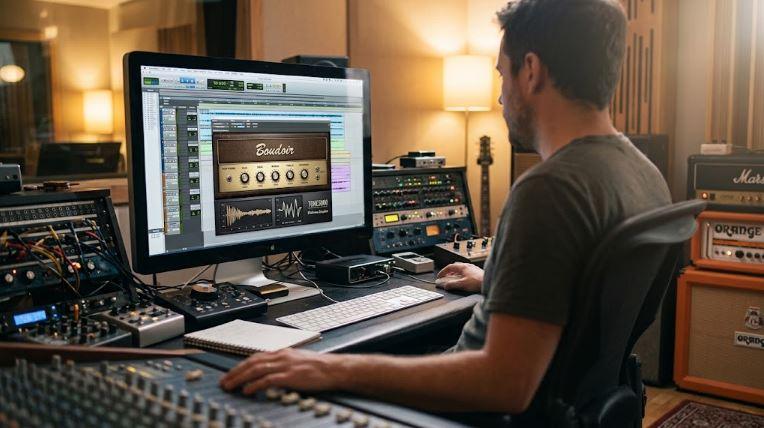
TONE3000 Integration Makes Fast Comparison Central To The Workflow
Boudoir is powered by TONE3000 integration.
Users can search community-created NAM captures and impulse responses from inside the plugin, audition models through their current chain, and then add useful choices to the local library.
That turns model discovery into part of the sound-design process.
A guitarist does not have to download a group of captures first, leave the plugin, organize files, import them individually, then discover which ones fit the session.
Boudoir allows the search and audition cycle to happen from the same environment.
A free TONE3000 account is required for the integrated catalog.
This makes level consistency even more relevant.
Fast browsing only works well if every model switch does not force the user to reach for an output trim before making a judgment.
The broader the library becomes, the more valuable consistent auditioning becomes.
Two NAM Slots Make Comparison Turn Into Combination
Boudoir can run one or two NAM slots.
Those slots can operate in series or parallel.
Each slot includes drive, output trim, pan, mute, and EQ, with two cabinet IR positions available per slot.
That creates several uses beyond simple model auditioning.
Parallel operation can combine two different amp characteristics.
One side might provide low-frequency body while the other adds midrange attack.
Panning can separate the models spatially.
Different cabinet IRs can make the contrast more pronounced.
Series operation creates another route, where one modeled stage can feed another.
Level matching becomes useful here too because it creates a more controlled starting point before the user intentionally changes the relative balance.
Boudoir does not remove gain staging from the creative process.
It simply tries to prevent random capture loudness from deciding that gain staging before the producer does.
The Wah Section Has Its Own Level-Control Problem To Solve
Boudoir is also a wah plugin, and its design applies similar thinking to that stage.
The wah is based on measurements of two classic pedal responses captured across their travel.
The Inductor control moves between a smoother BUD voicing and a broader, more aggressive CRY character.
A MAGNETO option is also included.
Sweep range, response shape, feel, and a live frequency-response display give the player control over the movement.
Most relevant to the comparison theme is a constant-gain option.
Wah filters can create pronounced resonant peaks. Those peaks can make some positions feel louder even when the intended comparison is about frequency emphasis.
A constant-gain mode helps separate tonal movement from simple output increase.
That follows the same philosophy as the NAM library: remove avoidable level surprises so character becomes easier to hear.
Boudoir Can Function As A Wah, Amp Rig, Or Both
Each major section can be turned off independently.
That means Boudoir does not require users to adopt the entire chain.
It can function as a wah feeding another amp simulator.
It can operate as a NAM host without the wah.
The full chain can combine the wah, amp slots, cabinets, delay, and final EQ.
The delay can run in tempo-synchronized or free modes and can sit before or after the amp section.
Three EQ modes—Basic, Classic, and Modern—provide final tonal adjustment.
This modularity makes the level-matched amp system useful even for players who already have another preferred wah or effect chain.
The plugin’s main value does not depend on using every stage.
Ninety Included Captures Give The Level-Matching System A Large Test Bed
Boudoir ships with 90 NAM captures and 15 cabinet impulse responses.
The supplied captures include models based on amplifiers such as the EVH 5150III, Hughes & Kettner Coreblade, Marshall JCM800, Vox AC50, and Fender Hot Rod Deville.
The included cabinet material also covers a Victory Kraken 2×12 V30 setup.
Those names cover very different amplifier personalities.
A JCM800-derived capture is not supposed to behave like an AC50-derived capture.
Level matching does not erase those differences.
It makes them easier to compare without output level dominating the first impression.
That distinction matters.
Boudoir is not trying to standardize tone.
It is standardizing part of the listening condition.
A2 Lite Tries To Keep CPU Cost From Affecting The Choice
Boudoir also includes an A2 Lite mode.
KVR reports that the lighter mode can run most A2 captures at roughly half the CPU cost while remaining level-matched to the full model.
That introduces another useful comparison scenario.
A producer can judge whether the heavier model provides a meaningful sonic improvement without first compensating for a different output level.
If the difference is subtle, the lower-CPU mode may be more practical in a dense session.
If the full model produces an audible benefit, the producer can keep it where resources allow.
Again, the workflow attempts to isolate the variable being judged.
In this case, that variable is model complexity rather than loudness.
Level Matching Does Not Mean All Captures Will Feel Equally Loud
Automatic matching has limits.
Two signals with the same measured output can still have different perceived loudness.
A mid-focused amp may cut through a mix more aggressively.
A compressed high-gain model may feel denser than a clean one.
Cabinet IRs can change spectral balance enough to alter apparent loudness.
Different playing dynamics also affect the result.
Boudoir’s fixed reference cannot eliminate those perceptual differences, nor should it.
The purpose is to create a more consistent starting point.
Producers still need to listen in context and adjust gain according to the arrangement.
RobSonic’s existing article on creative effects chains makes a related point: processing decisions matter most as parts of a complete signal path. An amp model that wins a solo comparison may not be the one that fits the song once pedals, cabinets, EQ, delay, and the rest of the mix are active.
Built-In TONE3000 Browsing Changes How Amp Models Are Discovered
The second major source covering Boudoir, Noizefield’s Boudoir release report, also highlights direct TONE3000 browsing and live auditioning through the user’s active chain.
That is important because model selection becomes contextual.
A NAM capture is not being heard in isolation on a website.
It can be auditioned through the same wah settings, cabinet configuration, EQ, and downstream processing the player intends to use.
That gives the comparison a more practical meaning.
The question changes from “Which capture sounds best by itself?” to “Which capture works best inside this rig?”
Level matching supports that process by preventing every audition from becoming a separate gain-staging exercise.
Why Boudoir Makes Fairer Amp Comparisons More Practical
Boudoir contains plenty of features that attract attention faster than level normalization.
There is the measured wah.
There are dual NAM slots.
TONE3000 is integrated directly into the plugin.
Cabinet IRs, delay, EQ, A2 Lite, MIDI expression control, and included captures make it a broad guitar-processing environment.
Yet the fixed-reference approach may be the feature that improves daily use the most.
Amp-model libraries keep getting larger.
More choice makes browsing valuable, but it also makes inconsistent audition conditions more frustrating.
Boudoir analyzes incoming NAM captures, drives them from a shared reference, and gives users A/B tools inside the same environment where those models are discovered and combined.
That does not tell the guitarist which amp is better.
It removes one reason the wrong amp might appear better.
When a model wins the comparison, the goal is for its tone, feel, response, and place in the chain to make the case—not an unexpected jump in volume.