
Expressive E Noisy 2.6 turns gesture into multi-engine sound design because it treats pressure, movement, velocity, aftertouch, modulation, and automation as part of the sound engine rather than decoration after the patch is built. For RobSonic readers who work with synths, MPE controllers, cinematic textures, electronic production, ambient movement, sound design, and performance-based MIDI, the update matters because it expands Noisy from a noise-through-resonance instrument into a broader expressive synth environment.
Expressive E describes Noisy 2.6 as a noise-through-resonance synthesizer designed for expressive performance. The company says the 2.6 update expands the synth across acoustic, analog, FM, harmonic, and wavetable-style territory while keeping gesture at the center. That phrase matters because Noisy is not only asking what engine produces the sound. It asks how the sound should respond when the player pushes, releases, moves, automates, or performs the note differently.
Why Gesture Matters More Than Another Preset Library
Many synth updates compete by adding more presets, effects, or oscillator types. Those additions can be useful, but they do not automatically change how producers play the instrument. Noisy 2.6 is more interesting because the update connects new sound engines to expressive control. The player’s movement becomes part of the timbre.
That makes a major difference for producers who are tired of static synth patches. A pad can brighten as pressure increases. A pluck can shift into a more complex harmonic state. A cinematic texture can swell with automation rather than only volume. A digital patch can become unstable through movement. A noise source can excite resonators differently depending on how the note is performed.
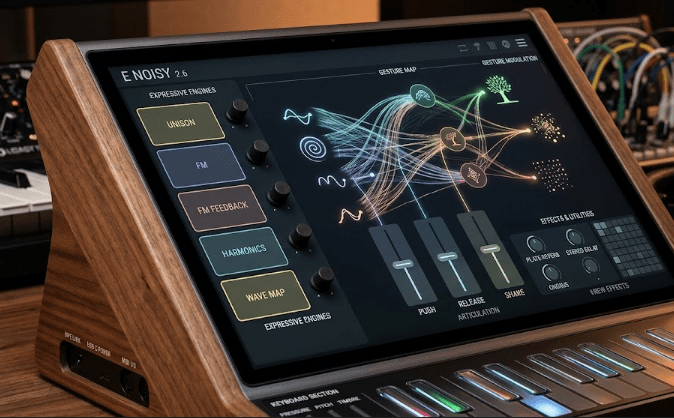
Sound On Sound reported on July 23, 2026, that Expressive E Noisy 2.6 adds five new synthesis engines and resonator types: Unison, FM, FM Feedback, Harmonics, and Wave Map. The same report noted that the update includes nine additional built-in effects, five new noise sources, a new LFO shape, and a preset library of 1,400 sounds, split between 650 MPE presets and 750 standard MIDI patches.
Those numbers matter, but the workflow matters more. Noisy 2.6 gives producers more engines, then asks those engines to react to performance.
How Noise-Through-Resonance Defines Noisy’s Identity
Noisy’s core idea is different from a standard subtractive synth. Instead of starting only from oscillators and filtering them, it begins with noise sources that excite resonators. Expressive E’s product page says users can pick a noise source, combine up to three resonators, and shape the result. That makes Noisy feel closer to a struck, bowed, scraped, or excited physical object than a traditional oscillator stack.
This is why gesture fits the instrument so naturally. A real object does not respond the same way every time it is struck or pressed. A string, bell, membrane, or resonant body changes with force, contact, damping, and motion. Noisy translates that idea into software synthesis by letting performance data reshape texture, resonance, and effects.
The 2.6 update makes that concept wider. The instrument no longer only covers organic resonance and acoustic-style textures. It now extends into analog unison, FM brightness, FM feedback grit, harmonic evolution, and wavetable-style morphing. That gives producers more material to animate.
For RobSonic’s audience, this is the useful angle: Noisy 2.6 is not simply a new synth update. It is an example of how sound design changes when the “how you play it” becomes as important as the waveform.
Why The Five New Engines Expand The Creative Range
The five new Noisy 2.6 engines each expand a different production role. Unison gives producers wide analog-style textures. That makes it useful for leads, pads, stacked synth tones, and modern electronic layers that need movement without sounding flat.
FM adds bright and harmonically complex timbres. It can help create bells, glassy tones, sharp plucks, digital keys, and percussive accents. FM Feedback pushes further into grit, density, and evolving roughness, which makes it useful for darker sound design, aggressive textures, and metallic movement.
Harmonics opens additive-style territory, where evolving spectra can become pads, drones, animated leads, or strange tonal beds. Wave Map introduces fluid wavetable-style morphing, using an X/Y-style approach to movement through timbral space. Bedroom Producers Blog’s July 24 report on Noisy 2.6 described Wave Map as a 2D wavetable-style resonator for fluid digital morphing.
That range matters because expressive performance needs contrast. A pressure gesture on an analog unison layer should not feel the same as a pressure gesture on an FM feedback texture. Noisy 2.6 gives producers several sonic worlds where the same controller movement can mean different things.
Why MPE Is Central But Not Mandatory
Expressive E is closely associated with expressive controllers such as Osmose and Touché, so it makes sense that Noisy 2.6 is built with MPE performance in mind. MPE, or MIDI Polyphonic Expression, allows each note to carry its own expressive data, such as pitch, pressure, and timbre. That lets one note in a chord bend, brighten, or swell differently from another.
Sonic State’s July 23 coverage of Noisy 2.6 highlighted that Noisy’s presets are built to react to gesture, aftertouch, MPE, and automation rather than sitting static in a mix. That is the key point. MPE gives Noisy its deepest expressive path, but the instrument still works with traditional MIDI keyboards.
Expressive E’s own page says Noisy adapts to Osmose, Touché, MPE controllers, and classic MIDI keyboards. For standard MIDI users, expressive dimensions can still be reached through velocity, aftertouch, modulation, and automation. That matters because not every producer owns an MPE controller. A plugin should not become useless without one.
The best way to think about Noisy 2.6 is layered access. A standard keyboard can play the presets and automate expression. A keyboard with aftertouch can add more movement. An MPE controller can unlock per-note behavior. Osmose and Touché users can go deeper into the hardware-to-software relationship.
How Four Expressive Dimensions Shape A Patch
Noisy’s product page says the synth uses four expression modules that let users reshape preset texture and effects. It also says every preset is designed to transform pressure, movement, and touch into evolving sound. That workflow turns patch design into a performance map.
This matters because macro control is often the difference between a patch that sounds good and a patch that becomes playable. A producer might build a strong texture, but if the only way to animate it is through dozens of tiny parameters, the sound may never become musical. Expression modules simplify that movement.
A useful expressive patch gives the player meaningful zones. Light pressure might keep a tone soft. More pressure might add harmonic bite. Lateral movement might shift resonance. Modulation might bring in effects or noise. Automation might move a preset from intimate to cinematic across a section.
This connects naturally with RobSonic’s guide to creative effects chains, because sound design becomes stronger when movement is planned. Noisy 2.6 does that inside the synth itself: engines, resonators, noise sources, effects, and expression are connected before the audio reaches external processing.
Why New Effects Matter In An Expressive Synth
Noisy 2.6 adds nine new effects, bringing the total to 21 effects according to Expressive E’s product page. Bedroom Producers Blog reported that the new effects were optimized for smooth real-time modulation, which matters for an instrument built around expressive movement. The same report named new effects such as Galactic Vibe, Amp Sim 2, Tube Distortion, LoFi Combo, Dirty Room, Medium Space, LoFi Bitcrush, and Little Space.
That detail matters because effects can be expressive too. In many synths, effects are a finishing stage: add delay, add reverb, add chorus, save the preset. Noisy treats effects as part of the gesture system. A reverb can swell with pressure. Distortion can appear as intensity rises. A bitcrush texture can become a performance accent. A modulation effect can turn a held note into movement.
This makes Noisy useful for sound design beyond normal synth parts. A producer can create risers, drones, impacts, transitions, evolving pads, gestural stabs, and cinematic beds that respond as if the effects and tone were one instrument.
The caution is mix control. Expressive effects can become huge quickly. Producers should print the best gestures to audio, trim the strongest moments, and avoid leaving every patch in constant maximum motion.
How Noisy 2.6 Fits Modern Cinematic And Electronic Production
Noisy 2.6 fits cinematic and electronic production because those styles often need sounds that evolve without becoming too obvious. A static pad can feel flat. A simple pluck can feel predictable. A reverb tail can feel generic. Gesture-based synthesis creates movement from the source outward.
For cinematic scoring, Noisy can create bowed-like textures, bell-like resonances, glassy FM tones, evolving harmonic pads, and strange impacts. For ambient music, it can create slow transformations that respond to pressure and automation. For electronic production, it can create expressive leads, hybrid bass layers, morphing digital sequences, and noise-driven percussive tones.
Synth Anatomy’s July 2026 coverage of Noisy 2.6 noted that the update adds FM synthesis, harmonic synthesis, Wave Map, new expressive effects, and 150 new presets, bringing the total to 1,400. The article also emphasized that Noisy 2 is bi-timbral, allowing two independent layers, each with multiple resonators.
That bi-timbral design is important. Producers can layer organic resonance with FM bite, analog unison with harmonic motion, or acoustic-style tone with digital wavetable movement. The result can feel more like a hybrid instrument than a single-engine synth.
Why Gesture Helps Producers Avoid Static Sound Design
Static sound design can happen even with powerful tools. A producer loads a preset, writes notes, automates a filter, and moves on. The sound may work, but it may not feel performed. Noisy 2.6 pushes against that by making gesture central from the beginning.
This is especially useful for producers who build tracks from loops and MIDI clips. A loop can become repetitive if every note behaves the same way. Gesture adds variation within repetition. A repeated phrase can feel alive when pressure, velocity, aftertouch, MPE movement, or automation changes the internal texture of each note.
That matters for modern DAW production because many sounds are perfectly aligned and perfectly edited. Gesture reintroduces small differences. It gives a note a physical arc. It lets a pad breathe. It lets a lead react. It lets a digital texture move as if the performer is shaping the material under the fingers.
The best use of Noisy 2.6 is not to make every note dramatic. It is to give producers a way to choose where expression matters. A chorus lead may need pressure movement. A background pad may need slow automation. A cinematic hit may need a single expressive swell. The tool becomes powerful when the movement serves the arrangement.
How Standard MIDI Users Can Still Benefit
Noisy 2.6 is clearly designed for expressive controllers, but standard MIDI users should not dismiss it. Expressive E says the synth works with classic MIDI keyboards, and Sound On Sound reported that users without MPE controllers can access expressive settings through velocity, aftertouch, modulation, and automation.
That opens useful workflows. A producer can draw automation lanes for expression modules. They can use mod wheel movement to morph timbre. They can map macro controls to a MIDI controller. They can use velocity-sensitive playing to shape attack, brightness, or effects. They can record automation passes after the MIDI notes are written.
This means Noisy 2.6 can work in a mouse-and-keyboard DAW setup as long as the producer treats expression as part of the arrangement. The limitation is that standard MIDI cannot match true per-note MPE behavior. A whole chord may respond together rather than letting each note move independently. Still, many musical results do not require per-note control.
The practical advice is simple: start with MIDI presets if using a normal keyboard, then map one or two expression dimensions to controls that are easy to perform. Do not try to automate everything at once. One meaningful movement is often more musical than four busy gestures.
Why The Preset Library Is Useful If Producers Treat It As A Map
Noisy 2.6 includes more than 1,400 presets, with 650 MPE presets and 750 MIDI-focused presets according to Expressive E’s product page. Large preset libraries can be helpful, but they can also become a trap if producers only browse for finished sounds.
The better approach is to treat the library as a map of expressive behavior. Load a preset and test how it responds. Does pressure add brightness? Does movement bring in effects? Does velocity change the strike? Does aftertouch trigger a new articulation? Does the sound feel better when played softly or aggressively?
A preset in Noisy 2.6 should be judged by response, not only tone. A patch that sounds simple on one held note may become powerful when pressure, release, or automation changes it. A patch that sounds too dramatic in solo may work perfectly as a short transition or background layer.
This is where Noisy differs from a normal preset instrument. The point is not only to find the right sound. It is to find the right relationship between the player and the sound.
How Producers Can Use Noisy 2.6 In A Real Session
Noisy 2.6 works best when producers give each patch a clear role. An expressive synth can quickly become dense if every layer moves, every effect animates, and every note changes too much. Start with the function of the sound.
A simple workflow could look like this:
- Use Unison for wide analog-style pads, leads, and stacked electronic layers.
- Use FM for glassy plucks, bells, metallic accents, and bright digital keys.
- Use FM Feedback for gritty textures, darker movement, and aggressive sound design.
- Use Harmonics for evolving pads, additive-style motion, and cinematic beds.
- Use Wave Map for morphing digital timbres and X/Y-style movement.
After choosing the engine, map or record one expressive gesture. Pressure might open the sound. Mod wheel might move effects. Aftertouch might bring in a harmonic layer. Automation might push a texture into a chorus or breakdown.
Then print the best passes. Expressive instruments often produce small variations that are easier to arrange as audio. A producer can record a few performance passes, cut the strongest moments, and use them as hooks, transitions, or atmosphere.
Why Noisy 2.6 Is Not Just An MPE Showcase
Noisy 2.6 could easily be described as an MPE synth update, but that misses the larger point. MPE is a control method. The deeper story is how the synth connects control to sound design. The new engines, effects, noise sources, and presets all support that relationship.
KVR Audio’s July 2026 report on Noisy 2.6 framed expression as the through-line across the update, noting that presets respond to MPE controllers, Osmose, Touché, or standard MIDI input through velocity, aftertouch, modulation, and automation. That is the right way to understand the release. Noisy 2.6 is not only for one hardware ecosystem. It is a synth built around responsive sound.
That matters because many producers are still deciding whether expressive controllers are worth adding to their studio. Noisy 2.6 gives a reason to care: not because pressure data is technically impressive, but because it can change the sound in ways that feel musical.
A controller matters only if the instrument responds meaningfully. Noisy’s update strengthens that response by expanding what the synth can become when the player moves.
What Producers Should Watch Before Using It Everywhere
Noisy 2.6 is powerful, but producers should still use it with restraint. Expressive synths can take up a lot of emotional and frequency space. A patch with evolving resonance, effects, modulation, and gesture may dominate a mix even if it is not loud.
The first thing to watch is arrangement density. If a Noisy patch already contains motion, the surrounding parts may need to stay simpler. The second thing is frequency buildup. Resonators, harmonic engines, FM textures, and effects can create sharp peaks or dense mids, especially when layered. Producers should use EQ and automation to keep the patch in its lane.
The third thing is performance discipline. Gesture should serve a phrase. Constant maximum movement can feel less expressive, not more. A sound that reacts to every touch should still have moments of stillness.
Finally, producers should be aware of format and compatibility. Expressive E lists macOS 11 through macOS 15 support, Windows 10 and higher, VST2, VST3, and AU formats. Sound On Sound noted that there is no AAX version, so Pro Tools is not supported directly. Expressive E also lists PACE iLok licensing with no hardware dongle required and up to three activations.
Why Gesture Is Becoming A Core Sound-Design Tool
Noisy 2.6 matters because it reflects a wider shift in synth design. Producers no longer want every patch to behave like a fixed recording triggered by MIDI notes. They want sounds that react to pressure, movement, timing, automation, release, and controller data. That is especially true in a production culture where many tracks begin from loops, grids, and presets.
Gesture makes a sound feel less static. Multi-engine design gives that gesture more places to go. In Noisy 2.6, a movement can affect analog-style unison, FM brightness, feedback grit, harmonic evolution, wavetable morphing, noise texture, effects, and layered resonance. That turns the synth into a performance surface.
For RobSonic readers, the practical takeaway is clear. Noisy 2.6 is useful not only because it has more engines or more presets. It is useful because those engines and presets are built to move. The update shows how modern synth design can make performance data part of the patch, even inside a DAW.
A producer still needs taste. They still need arrangement, mix control, and restraint. Noisy 2.6 simply gives them a richer way to turn a gesture into sound.