
Wattis Soundscapes is a useful lens for reading CCA Wattis Institute’s fall 2026 programming because the season places sound beside film, installation, performance, data, and studio learning. I am using the phrase as a producer’s shorthand, not as an official program title. The supported facts point to a fall program where listening is not treated as background mood. It appears as a material question: how can an exhibition, course, screening, or artist talk ask audiences to feel space through vibration, sound, and time?
As of September 24, 2026, several items in the program were already underway. CFGNY’s September to November 2026 residency was ongoing. Caguiat Delacruz: The Tramp, which opened on June 10, 2026 and runs through November 21, 2026, was still on view. Alexandre Estrela: RedSkyFalls was also ongoing through November 21, 2026. CCA’s announcement identifies these fall 2026 exhibitions, residencies, and public programs, including CFGNY’s research-based practice and Estrela’s installation that makes tectonic activity visually and aurally perceptible through seismic response CCA fall 2026 announcement.
Wattis Soundscapes In Fall 2026 Context
Wattis Soundscapes And The Listening Question
The first analytical point is simple: not every artwork that includes audio is best understood as sound design, yet sound-design thinking can still help us hear what is happening. In music production, I ask what triggers a sound, what shapes its envelope, where it sits in space, and how it changes a listener’s sense of time. The fall program at Wattis gives similar questions to visual art. Film sound, reactive installation, garment and performance research, and invented instruments all sit near each other without collapsing into one medium.
The value of Wattis Soundscapes is that the phrase keeps the emphasis on relationships. A film soundtrack has a different job from an installation that reacts to seismic data. A student-built sound sculpture has a different scale from a public screening at The Roxie Theater. Still, each case asks how sound can structure attention. That is where producers can learn from exhibition practice: the strongest sonic idea may be the one that clarifies a situation rather than fills every gap.
What The Sources Support
The available research supports a cautious reading. It does not provide microphone lists, speaker counts, patch diagrams, synthesis settings, or artist statements about specific audio processes. So I would not claim that any exhibition uses a named synthesis method unless the institution says so. What can be said is narrower and more useful: RedSkyFalls connects seismic activity to audible and visual response; The Tramp includes a newly commissioned film with sound alongside installation, painting, prints, deconstructed production sets, storyboards, costumes, and ephemera; and CCA’s Sound Sculpture course asks students to design sound sculptures or invented instruments using audio electronics and basic fabrication skills.
That level of evidence is enough to support a practical studio reading. For producers, these programs point toward sound as a system of cues, surfaces, triggers, and bodies in rooms. Readers comparing this with other exhibition contexts may find RobSonic’s related piece on sound design across U.S. art shows useful, as it considers how generative systems, embodied listening, analog objects, and cautious AI use have appeared in 2026 art settings. Additionally, exploring connected content in the network can lead readers to visit Kay Granger, which offers more insights.
Film, Seismic Data, And Installation Sound
The Tramp As Film Sound And Set Memory
Caguiat Delacruz: The Tramp is especially interesting from a production perspective because it does not appear to isolate film from the traces of making film. The CCA portal describes the exhibition as the artists’ first institutional West Coast exhibition and notes that it includes a newly commissioned film with sound, installation, painting, and prints, with deconstructed production sets, storyboards, costumes, and ephemera in the setup The Tramp event page. That matters because production sound is often treated as something to clean, hide, or correct. Here, the environment around the film appears to keep the production process present.
As a producer, I read that as an invitation to think beyond the finished mix. A storyboard, costume, or deconstructed set can change how a listener receives a voice, room tone, Foley gesture, or musical cue. The sound does not arrive alone; it arrives with evidence of staging. That does not mean the exhibition is about studio technique in a narrow sense. It means that sound can carry memory of process. For artists making audiovisual work, this is a strong reminder that the frame around the audio can alter the sound’s meaning before a note or noise is even heard.
RedSkyFalls And Data As Audible Pressure
RedSkyFalls offers a different model. Based on CCA’s description, Alexandre Estrela’s multi-part installation reacts to seismic activity around the world, making the earth’s tectonic movements visually and aurally perceptible. From a synthesis standpoint, the supported fact is the reaction to seismic activity, not the exact signal chain. Still, the artistic implication is clear enough: the work links a planetary event scale to perception inside an exhibition space.
This is not the same as using an earthquake sound effect. The research points to a responsive installation, which suggests a relation between external data and sensory output. In studio terms, that distinction matters. A sample represents an event after the fact; a responsive system can let a changing input shape the work. Producers can translate that lesson without copying the artwork: instead of asking how to imitate a natural force, ask which variable in a composition should act as the force. It could be amplitude, density, filter motion, spatial placement, or silence.
Studio Practice And Invented Instruments
Sound Sculpture As A Production Exercise
CCA’s Sound Sculpture course, UDIST-3000-7, ran from September 2 to December 15, 2026, according to the research, and was ongoing on September 24, 2026. It was a 3-unit undergraduate interdisciplinary studio course taught by Alex Baumgardt. Students designed sound sculptures or invented instruments using audio electronics and basic fabrication skills, while engaging theoretical histories of sound art. The enrollment listed in the research was full at 16 out of 16.
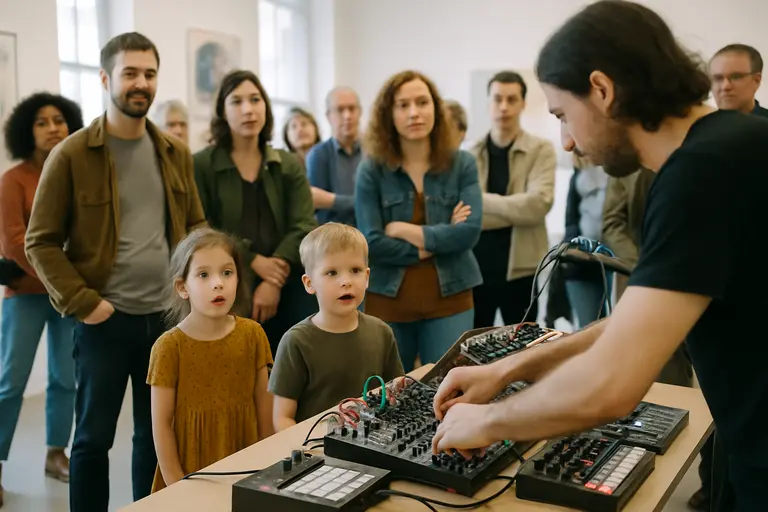
That course detail connects directly to Wattis Soundscapes because it places sound-making in the hands, not only in software. Invented instruments ask different questions from presets. Where does the performer touch the object? What material resonates? How does a circuit fail or drift? How much of the sound is controlled, and how much is negotiated with the physical object? These questions are healthy for electronic musicians because they push us away from treating sound as a menu item.
A Producer’s Reading Of Material Choices
For artists building tracks, scores, or installations, the course-exhibition overlap suggests a disciplined way to work. Start with a material condition, then let the sound follow from it. If the work is about seismic activity, the sound should probably respond to pressure, movement, interruption, or scale. If the work is about production sets and filmic construction, the sound might benefit from exposed edits, room traces, or the audible edge between performance and artifact.
A practical translation for the studio could look like this:
- Choose one non-musical input, such as motion, touch, light, or recorded room noise, and let it control one musical parameter.
- Print several passes of the result, then listen for moments where the system reveals meaning rather than novelty.
- Keep a visual or physical trace of the process, such as a sketch, object, set fragment, or instrument body, so the sound does not feel detached from its source.
- Use silence as a structural material, especially when the concept already carries physical weight.
None of those steps requires an artist to mimic a Wattis project. They simply translate a supported curatorial pattern into a production method: sound gains force when its behavior is tied to the work’s conditions.
Public Programs Around The Exhibitions
Events Already Held By September 24, 2026
Temporal accuracy matters here. The research listed Learning Alongside Artists with CFGNY as September 17, 2026. Because the current date is September 24, 2026, that program date had passed. The event was described as a talk and Q&A between CFGNY and Daisy Nam, co-organized with the CCA Fine Arts Division. Without a transcript or recording in the provided research, it would be speculative to assign specific sound-design claims to that conversation. What can be said is that CFGNY’s residency was ongoing and that their practice spans image-making, installation, garment making, and performance while examining racialization and subjectivity.
For sound artists, that mix of forms matters because performance and garment practices often involve bodily movement, surface, friction, and space. I would treat that as a conceptual invitation rather than a technical claim. Sound can be used respectfully in such contexts only when it supports the work’s social and material questions rather than flattening them into atmosphere.
Dates Still Ahead In 2026
Several public programs were still scheduled after September 24, 2026. This is the Afterparty for Hiwa K was scheduled for Tuesday, October 20, 2026, and was described as inaugurating What is highly unlikely but not impossible?, an anthology themed around artist Hiwa K. Leaving out the Luminaries: Students, collaboration, and the farm at Black Mountain College was scheduled for Wednesday, November 4, 2026, with David Silver, hosted jointly by CCA Humanities & Sciences and Interdisciplinary Studio. Thinking through Film: Selections from the Kramlich was scheduled for Wednesday, November 18, 2026, at The Roxie Theater, co-presented with the Kramlich Collection.
These programs widen the frame around the exhibitions. They point toward publishing, education, collaboration, film, video, and institutional history. For sound designers, that is useful because it resists the idea that sound work lives only inside tools. The choice of context can be part of the composition. A screening at a theater carries different expectations from a gallery installation. A lecture about education and collaboration shapes how we think about shared authorship in studio practice. An anthology launch around an artist changes how text, memory, and event structure the reception of work.
Wattis Soundscapes As A Studio Listening Model
Wattis Soundscapes works best as a listening model rather than a slogan. It asks producers to study how sound behaves inside art systems: film with installation, seismic response with perception, handmade objects with circuits, public programs with education, and screenings with institutional memory. The supported facts do not prove a single fall 2026 trend, and they do not tell us the exact technical build of each audio element. They do show a program where sound appears as form, content, and method.
For producers, Wattis Soundscapes offers a grounded prompt: design sound that has a reason to behave the way it behaves. If a system reacts, define what it reacts to. If an object makes sound, let its material presence matter. If a film includes sound, consider how sets, costumes, storyboards, and ephemera change the listening frame. If a public program surrounds the work, listen for how speech, education, and social context affect the sonic reading.
That is the motivational part I would offer artists without overpromising. You do not need a huge system to make meaningful sound art. You need a clear relationship between source, process, space, and listener. The fall 2026 Wattis program, as documented in the available research, gives a careful set of examples for that kind of practice.