
Microtonal synthesis often begins with numbers. Ratios, cents, equal divisions of the octave, reference frequencies, and tuning tables describe relationships that can be precise on paper yet difficult to grasp while actually designing a sound. AcusMagic’s Sonicrama V2 takes a different approach: it lets producers build unusual tuning relationships across a keyboard, then connects those frequencies to a real-time visual physics engine that produces Chladni-style figures and other geometric responses.
AcusMagic released Sonicrama V2 in September 2026 as a wavetable synthesizer for macOS and Windows. The instrument combines four oscillators, per-key tuning across all 128 MIDI notes, .scl and .tun support, multiple modulation systems, a GPU-driven cymatics engine, and a three-dimensional Lissajous display. KVR Audio reported an introductory price of €89 through October 4, 2026, with a regular price of €129.
The unusual part is not that Sonicrama displays pretty graphics while music plays. Its visual engine calculates how a modeled plate or liquid surface responds to frequency. Change the tuning and the physical response can change with it.
Meta-Tuning Makes Every MIDI Key Its Own Design Problem
Most synthesizers treat tuning as a global rule.
A user selects 12-tone equal temperament, imports a Scala file, changes the master tuning reference, or applies one alternate temperament across the instrument. Every note then follows that system.
Sonicrama V2 can go much further.
AcusMagic’s official Sonicrama V2 page describes what developer Paolo calls “meta-tuning”: each of the 128 MIDI keys can carry its own frequency and synthesis settings. A key can have its own oscillator frequency, waveform, morph position, level, pan, phase relationship, stereo offset, and other properties.
Leave a key untouched and it follows the default patch. Edit one note and that change can remain isolated to that key.
The result is more flexible than loading one non-standard scale.
A keyboard can contain conventional notes in one region and ratio-based pitches elsewhere. Another range might use a different tuning structure entirely. Four oscillators can even use separate tuning tables, creating polytonal relationships inside the same patch.
Sonicrama supports .scl and .tun import and export, so established microtonal scale files remain useful. A free root system lets a user define any MIDI key around a chosen frequency instead of assuming A4 must always sit at 440 Hz.
That turns the keyboard from a fixed pitch grid into a programmable frequency map.
Ratios And Equal Divisions Become Playable Relationships
Microtonality is sometimes framed as a collection of exotic scales. Sonicrama’s structure encourages a more direct view: tuning is a relationship between frequencies.
A pitch can follow another key by ratio.
A scale can use an equal division such as 31-EDO.
Individual frequencies can be entered manually.
Separate oscillators can follow different tuning tables.
Those options allow the producer to move between several tuning ideas without treating each one as a separate instrument.
KVR Audio’s Sonicrama V2 release report highlights the same per-key structure, describing a system where all 128 MIDI keys can carry independent tuning information.
That matters creatively because microtonal relationships do not have to be spread evenly across the whole keyboard.
A composer might create a stable tonal center using familiar intervals, then reserve selected keys for pitches generated from pure ratios. Another patch could assign a different equal division to one oscillator and let the remaining oscillators follow more conventional tuning.
The result can be a single playable instrument containing several tuning logics at once.
That is more difficult to describe with a traditional scale name, which is exactly why Sonicrama’s visual side becomes relevant.
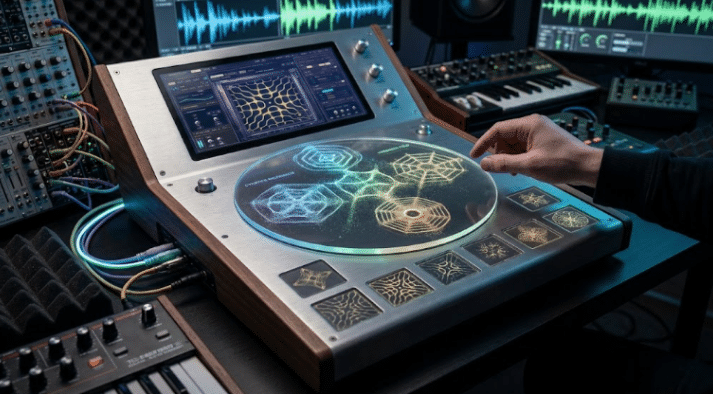
The Cymatics Engine Does Not Simply Draw The Audio Spectrum
The most important distinction in Sonicrama V2 is what its visualizer is actually calculating.
It is not just an FFT display, waveform scope, or decorative animation reacting to volume.
AcusMagic says its cymatics engine solves the modal response of a vibrating plate on the GPU. The current implementation moves 400,000 particles and updates the system at up to 60 frames per second.
For the sand-plate mode, the software calculates nodal patterns associated with plate vibration. AcusMagic says the modeled frequencies and spatial scale are based on the physics of the virtual plate rather than on an arbitrary visual preset.
The visual concept comes from the experiments associated with Ernst Chladni. The Smithsonian’s Chladni plate history explains how sand placed on a vibrating plate moves away from strongly vibrating regions and collects along nodal lines, producing visible patterns associated with different resonant modes.
Sonicrama models that idea computationally.
Feed a frequency into the virtual plate and the visual system calculates its response. Change the plate properties and the figure can change even if the note stays the same.
That limitation is important: a displayed pattern is not simply a visual label for a musical pitch.
It represents the interaction between frequency and the modeled physical system.
Seeing A Tuning Means Seeing Its Physical Consequences
The article title needs one qualification.
Sonicrama does not convert “31-EDO” into one universally correct geometric logo. Nor does a just-intonation ratio possess one fixed Chladni image independent of context.
The connection is more interesting.
A tuning determines frequencies. Those frequencies excite modes in the modeled plate. The plate’s size, material assumptions, tension, thickness, and related properties influence which modes respond and how the resulting pattern develops.
Scientific research on Chladni plate resonances has shown how different resonant frequencies correspond to different nodal structures in vibrating plates and how those patterns can be reconstructed through physical models.
Sonicrama turns that relationship into a creative interface.
Change a note and the input frequency changes.
Alter a ratio and the relationship between notes changes.
Move to another equal division and new frequencies appear.
Switch the physical plate and the response changes again.
This makes tuning visible indirectly, through its consequences inside a modeled acoustic system.
For a producer who normally experiences microtonality as cents values or frequency tables, that can provide another form of intuition.
The ear still decides whether the tuning works musically. The screen provides another way to inspect what those frequencies are doing.
Four Wavetable Oscillators Keep The Instrument From Becoming A Science Demo
A tuning visualizer alone would have limited use inside a production session.
Sonicrama V2 is also a four-oscillator wavetable synthesizer.
Each oscillator can use its own tuning table, and user WAV wavetables can be loaded into the instrument. AcusMagic lists seven-voice unison per oscillator, multiple filter types, four Bézier envelopes, a modulation matrix, and additional stereo-frequency tools.
That architecture matters because unusual tuning relationships become part of a normal synthesis workflow rather than a separate theoretical experiment.
A producer can create a custom tuning, place different frequency systems on separate oscillators, then shape the combined result through envelopes, filtering, unison, wavetable motion, and modulation.
The synth also includes a NEXUS modulation system with Math, Ratio, and BWE follow modes.
Ratio following is especially relevant to the tuning concept. A modulation or oscillator relationship can remain mathematically connected rather than being reduced to a fixed offset.
BWE mode creates a controlled difference between stereo frequencies, giving the left and right channels another mathematical relationship.
That places tuning, modulation, stereo motion, and waveform design inside the same frequency-centered workflow.
For sound designers interested in unconventional pitch structures, the synthesis engine is what makes the visual physics useful beyond demonstration.
Lissajous Geometry Gives Intervals Another Visual Language
The Chladni engine is not Sonicrama’s only visual system.
Sonicrama V2 includes a three-dimensional Lissajous display for examining relationships between oscillations.
Lissajous figures arise when periodic signals interact across perpendicular axes. Their geometry changes according to frequency ratios and phase relationships, which makes them particularly relevant to tuning.
Simple ratios can produce stable repeating forms. More complicated relationships create denser trajectories.
Inside Sonicrama, this gives interval structures a different kind of visual feedback from the Chladni plate.
The plate asks how frequencies excite a modeled physical surface.
The Lissajous view emphasizes relationships between periodic motions.
For microtonal work, those are complementary perspectives.
Two tunings that sound subtly different may produce noticeably different geometric behavior. A ratio-based interval can create a more obviously repeating relationship than two frequencies with a more complex numerical ratio.
The display should not be treated as a quality meter. Symmetry does not mean a tuning is musically “better,” and visual complexity does not make an interval less useful.
Its value is descriptive.
The producer gets another way to recognize that changing tuning is changing relationships, not merely moving notes slightly sharp or flat.
Sonicrama Connects Visual Sound Design With A Broader Interface Shift
Sonicrama V2 fits a larger movement in experimental music software: abstract audio structures are increasingly becoming objects producers can manipulate or inspect visually.
RobSonic has explored a related shift in its Iota II sampling workflow. Dillon Bastan’s Iota II lets a producer interact directly with a spectrogram rather than treating a sample only as a linear waveform.
Sonicrama applies that philosophy to a different problem.
Instead of making spectral regions drawable, it gives pitch relationships visible physical consequences.
This can be valuable for musicians who understand sound by interaction rather than by equations alone.
A ratio such as 7:4 is precise, but precision does not automatically create intuition. Hearing it helps. Seeing how related frequencies behave in a visual system adds another reference point.
The visual layer can also support performance.
AcusMagic allows the cymatics environment to respond while the instrument is being played. Physical properties can be changed in real time, so the same note can produce different figures as the virtual plate changes.
That means the visual output is not only explanatory.
It can become part of the instrument’s performance identity.
GPU Processing Keeps Visual Physics Away From The Main Audio Thread
Moving 400,000 particles while solving a plate model is a very different computing task from generating four oscillators.
AcusMagic places much of the visual work on the GPU.
The developer discussed this architecture publicly during pre-release testing, describing a compute-shader system that updates the particle field while leaving audio processing on its own thread.
That separation is necessary for a practical plugin.
An elaborate animation is not useful if it causes audio interruptions, timing instability, or unreliable DAW performance.
The official Sonicrama page currently lists macOS 11 or newer and Windows 10/11 support. On Windows, the visual system requires DirectX 12-capable graphics. Formats include VST3, CLAP, Audio Unit on macOS, and standalone operation.
The plugin can export visual material too.
AcusMagic lists PNG output and MP4 rendering at resolutions reaching 4096 by 4096 for still images, with video available at 30 or 60 frames per second and embedded audio.
That pushes Sonicrama into territory beyond synthesis.
A patch can become both a sound source and a visual source for a performance, music video, social clip, or audiovisual installation.
The Visuals Do Not Make Microtonality Automatically Easier
Microtonal tuning still requires listening.
A 31-EDO scale does not become immediately understandable simply because a plate displays a complicated figure. A just-intonation ratio does not become musically useful merely because its Lissajous trace appears orderly.
Sonicrama’s visual engine offers another source of feedback, not a replacement for pitch perception or musical judgment.
There is another limitation.
Chladni figures depend on the properties of the modeled plate, so the same musical frequency does not always produce the same picture when the physical model changes. That is expected physics rather than an error.
The instrument can therefore teach an important lesson indirectly: sound and physical resonance are relational.
Frequency alone does not determine every aspect of a vibrating system. Material, dimensions, boundary conditions, tension, and other properties matter too.
That makes Sonicrama more interesting than a scale visualizer.
It does not claim that music has one hidden sacred geometry waiting to be revealed. Its stronger idea is that audible frequency relationships can interact with modeled physical systems in ways that are mathematically visible.
That is a much more useful foundation for creative experimentation.
Why Sonicrama V2 Makes Tuning Feel Less Abstract
Microtonal software has become increasingly capable, yet the interface is often still dominated by tables.
That works for musicians who already think comfortably in cents, ratios, Scala files, and equal divisions.
Sonicrama V2 adds another route.
Per-key meta-tuning lets every MIDI note become an independent frequency decision. Four oscillators can carry different tuning systems. Ratio relationships can connect parts of the synthesis engine. The Lissajous display turns frequency ratios into geometry.
Then the cymatics engine gives those frequencies a simulated physical environment in which to act.
That last step is what makes Sonicrama distinctive.
The visual pattern is not the tuning itself. It is a calculated response to the frequency inside a particular modeled system.
For sound designers, that can be more useful than a decorative visualization.
Change the tuning and the response can change.
Change the virtual material and the same note can behave differently.
Alter several oscillators and the geometry becomes another way to examine their relationship.
Microtonality stops being confined to a tuning file hidden behind the synthesizer.
It becomes something a producer can play, hear, adjust, compare, and watch respond in real time.