
Text prompts have become familiar in AI-assisted creative tools, but audio production often turns that convenience into a cloud workflow: describe something, upload or transmit a request, wait for a remote model, consume credits, then download the result. Sampleson’s Backgrounds takes a different route. Released on September 14, 2026, the plugin lets producers describe atmospheres with words while keeping the actual soundscape-building process on their own computer.
Backgrounds is not a text-to-audio generator operating a large model every time a producer types a prompt. Sampleson describes it as a Semantic Audio Retrieval system built around more than 11,000 local embeddings and a curated collection of over 22,000 audio cells. Words such as “Strings,” “Rain,” “Analog Bass,” or “Thunder” become search and arrangement concepts that help the software retrieve compatible material from that local library.
That distinction makes Backgrounds especially relevant for sound designers. It combines the immediacy of language-based searching with the predictability of a curated sound source, while avoiding cloud uploads, token limits, and server queues during the creative process.
Backgrounds Uses Words To Retrieve Sound Rather Than Generate It From Scratch
The central technical distinction is easy to miss because the interface looks like the kind of workflow associated with generative AI.
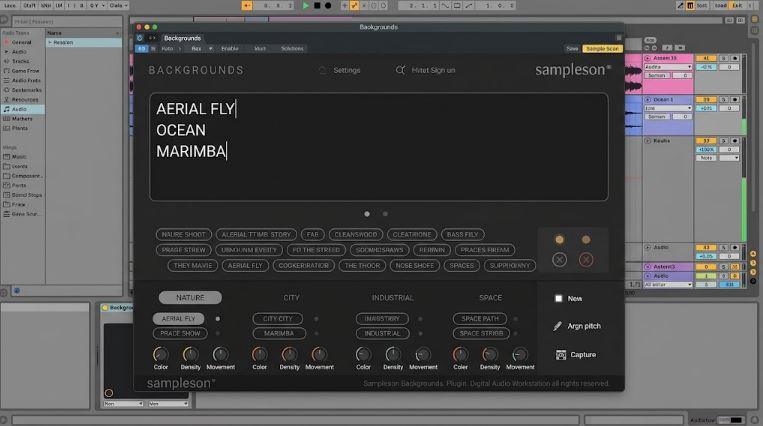
Users drag words onto a canvas. Backgrounds interprets those concepts, finds relevant material, and combines the results into evolving atmospheres. Sampleson’s Backgrounds sound-design engine describes the underlying system as Semantic Audio Retrieval rather than a cloud text-to-audio model.
Semantic retrieval works by representing meaning in numerical form. Backgrounds maintains more than 11,000 embeddings that allow words and stored sounds to be matched according to conceptual similarity.
A request for rain does not need to correspond to a filename literally called “rain.wav.” The system can use the semantic representation of the word to locate sound material associated with that idea.
Sampleson then draws from a bank of more than 22,000 audio cells.
That means the software is choosing and combining existing curated material rather than synthesizing a brand-new waveform from a remote model for every request.
For producers, the result resembles prompt-driven sound design without requiring the usual prompt-generation pipeline. The words guide selection, while the local audio collection supplies the material.
The Canvas Makes Search Terms Behave Like Musical Objects
Backgrounds does more than provide a text box followed by a Generate button.
Its words live on a visual canvas.
KVR Audio’s Backgrounds release report describes a three-stage workflow: drag concepts onto the canvas, generate a blended atmosphere, then animate the result by moving those concepts.
This matters because positioning a word becomes part of the performance rather than merely the initial search.
A producer might combine Strings with Rain, Bassoon with Thunder, or another set of musical and environmental concepts. Individual elements can be regenerated without rebuilding the entire scene.
Movement can alter the way those layers are mixed and panned over time. Parameters can be automated inside a DAW, while the built-in recorder can capture a live performance of the evolving soundscape.
That turns language into something closer to a control surface.
The word initially identifies a category of sound, but after it enters the canvas, its placement and movement affect the resulting atmosphere.
Finished material can be captured as WAV audio and moved directly into a production session.
Five Keyword Families Keep The Workflow From Becoming An Empty Prompt Box
One problem with completely open prompting is that a blank text field can create as much indecision as freedom.
Backgrounds gives the workflow some structure through five keyword families reported at launch: Orchestra-based material, Synth-based material, Bass-Rumbles, Places, and Custom.
The first four provide recognizable starting territories for cinematic sound design. Custom allows users to type their own concepts and rely on semantic matching.
This balance is important.
A film composer who needs a dark background layer can begin with orchestral or environmental ideas instead of inventing elaborate descriptions. A game sound designer might combine a place with a low-frequency texture. An ambient producer can start with synthesizer material and then introduce environmental terms.
The Custom category keeps the system open enough for more unusual associations.
That makes Backgrounds feel closer to browsing a reorganized sound library than communicating with an opaque remote model.
Traditional sample browsing begins with folders, filenames, tags, or search terms. Backgrounds changes that relationship by allowing several concepts to coexist spatially and contribute to one result.
The library is still finite, but the combinations can change continually.
Local Processing Changes The Economics Of Experimentation
Sampleson makes the local architecture a major part of the product’s identity.
Backgrounds does not meter generation with tokens or credits. The soundscape engine operates on the user’s machine rather than sending every creative request to a remote service.
That changes how experimentation feels.
With a token-based system, every regeneration can carry a small economic cost. Users may become more selective about trying deliberately strange combinations when each attempt consumes credits.
A local system removes that pressure from the creative loop.
A producer can regenerate one element repeatedly, try conflicting concepts, rearrange the canvas, record several versions, or leave the software running while testing ideas without watching a credit balance.
Sampleson lists Backgrounds at an introductory price of $39, with a regular price of $59. It is sold as a one-time purchase rather than a recurring subscription.
There is one important qualification: Sampleson’s specifications state that online activation is required.
“Local” therefore describes the soundscape processing and retrieval workflow, not an entirely disconnected installation process. Once activated, Sampleson says the creative engine itself runs on the computer with no cloud uploads or server queue.
The Small Installation Size Explains What Is And Is Not Happening
Backgrounds requires approximately 200 MB of disk space and 4 GB of RAM according to Sampleson’s current specifications.
That footprint is another clue that the plugin is not running a giant general-purpose text-to-audio system locally.
Its job is narrower.
The software has a curated collection of compact audio cells and a semantic system for deciding which material corresponds to words and how those selections can contribute to a soundscape.
That specialization can be useful in professional audio.
A general model may theoretically produce a much broader range of outputs, but broader capability can introduce longer generation times, unpredictable results, and larger computational requirements.
Backgrounds aims at a defined task: evolving cinematic beds, environmental layers, drones, underscoring textures, and related atmospheric material.
Sampleson identifies film and television scoring, game audio, trailers, production, ambient music, sound design, and live performance as intended uses.
The narrow purpose also makes the interface understandable. Producers are not being asked to describe an entire finished song in prose. They are assembling
atmosphere from concepts.
The Audio Library Has An AI Origin, Even Though Runtime Generation Is Local Retrieval
Calling Backgrounds a local retrieval tool does not mean AI-generated audio is absent from the product’s history.
Sampleson states that part of the included audio content was created using Stability AI’s Stable Audio Open. The company’s Backgrounds licensing terms say that Sampleson generated material with AI tools and then edited and processed that material before including it in the product.
The Stable Audio Open model itself is not distributed with Backgrounds.
That creates an important distinction between content creation and runtime operation.
Some source material used to build the library had an AI-assisted origin. When a customer later uses Backgrounds, the plugin is not sending a prompt to Stable Audio Open and asking it to generate new audio.
Instead, the semantic retrieval system works with the curated material already supplied.
Sampleson grants users a royalty-free license to incorporate the included content into projects such as music, films, games, podcasts, videos, and advertising, subject to its EULA. The company separately notes uncertainty around copyright protection for AI-generated content in some jurisdictions, so those licensing statements should not be read as a universal legal ruling about AI authorship.
Local Semantic Retrieval Can Be Faster Than Searching Sample Folders
Sound designers often spend substantial time looking for material rather than manipulating it.
A conventional library workflow may involve opening folders, auditioning dozens of files, filtering tags, loading candidates into a session, and discovering that none quite fit the scene.
Semantic retrieval tries to shorten the search stage.
Instead of requiring the producer to know how a sound was labeled by the library designer, it starts with the concept the producer already has in mind.
“Dark drone” is closer to creative intention than navigating a hierarchy such as Pads > Atmospheric > Tonal > Low.
Combining multiple ideas extends the advantage.
The producer can ask for an instrumental quality and an environmental quality at the same time, then change their relationship on the canvas.
This kind of interaction has parallels with other recent sound-design interfaces covered by RobSonic. Dillon Bastan’s Iota II sampling workflow likewise replaces conventional browser-and-parameter interaction with a more direct visual relationship to source material.
Iota II works through spectral paths and sample manipulation. Backgrounds uses semantic relationships between words and curated sounds. Both reflect a move away from treating the sample browser as a passive list of files.
Backgrounds Still Depends On Curation
The phrase “semantic audio” can sound as if the software understands every possible description in the same way a human sound designer would.
Its library places a practical boundary around that idea.
Backgrounds can only retrieve and combine material available to its system. Its 22,000-plus audio cells provide considerable variety, but the output remains connected to the character and coverage of that collection.
That limitation may actually help.
Sampleson says the bank was curated by musicians and sound designers for musical usefulness. Curation reduces the unpredictability associated with asking a broad generative model to invent a sound from nothing.
If the supplied material is stylistically coherent, semantic combinations are more likely to result in usable atmospheres.
The tradeoff is that Backgrounds cannot promise arbitrary sonic invention.
A highly specific real-world recording, unusual instrument articulation, or precise production request may still require a dedicated sample library, synthesis, field recording, or manual sound design.
The best use case is therefore not “replace every source of audio with words.”
It is “make finding and combining atmospheric material feel more like describing the scene.”
Standalone And DAW Versions Keep The Workflow Flexible
Backgrounds is available as a standalone application for macOS and Windows. It also runs as VST3 on both platforms and as an Audio Unit on macOS.
Sampleson lists macOS 10.13 or later and Windows 10 or later as current minimum operating-system requirements. Intel and Apple Silicon Macs are supported natively.
Pro Tools is not currently supported because the product does not include an AAX version.
The standalone option makes sense for concept development. A composer can build an atmosphere without opening a full session, record it, and export the resulting WAV.
Inside a compatible DAW, automation becomes more useful.
Keyword positions and other available controls can form part of an arrangement. An atmosphere can change with a scene rather than being rendered as one static background.
This is where the word-based workflow becomes more musically interesting.
The producer is not finished after finding the right semantic match. The selected sounds can still be moved, layered, recorded, edited, processed, and incorporated into a larger composition.
Language gets the producer to useful material more quickly; it does not replace the rest of production.
Why Backgrounds Makes Local AI Audio Feel More Practical
Backgrounds sits in an unusual category.
It uses the interface language of contemporary AI tools: type an idea, connect words with media, and receive a meaningful creative result. Yet it avoids making every interaction a request to a remote generative system.
That choice gives it several practical characteristics.
Results arrive from known local material. Experimentation is not governed by a token balance. Audio is not uploaded for each soundscape request. The software works as a plugin inside a production environment. Individual concepts can be regenerated and moved rather than forcing the entire output to be recreated after every change.
The architecture also makes the role of AI easier to separate.
AI-assisted tools helped create some of the included source material. Semantic embeddings help connect language to audio. The runtime creative process then relies on locally stored, curated sound cells rather than cloud generation.
That distinction matters as music software adopts more machine-learning terminology.
Not every word-driven tool needs to be a giant text-to-audio model.
For a composer who wants an atmosphere for a forest, hangar, ocean scene, dark trailer cue, or abstract ambient piece, retrieval may be more useful than unlimited generation if it produces appropriate material quickly and predictably.
Sampleson Backgrounds turns that proposition into a production interface.
The user supplies language.
The semantic system finds relationships.
The curated library provides the sound.
The canvas turns those results into something performable.
For word-based sound design, that may be a more practical local workflow than sending every creative decision to the cloud.