
Smart Audio Plugins released Timbral Box on September 16, 2026 with an unusual proposition for mixers: instead of reaching immediately for EQ boosts or heavier compression when a sound needs more presence, generate harmonics beside the original signal and use those harmonics to rebalance how the source is perceived.
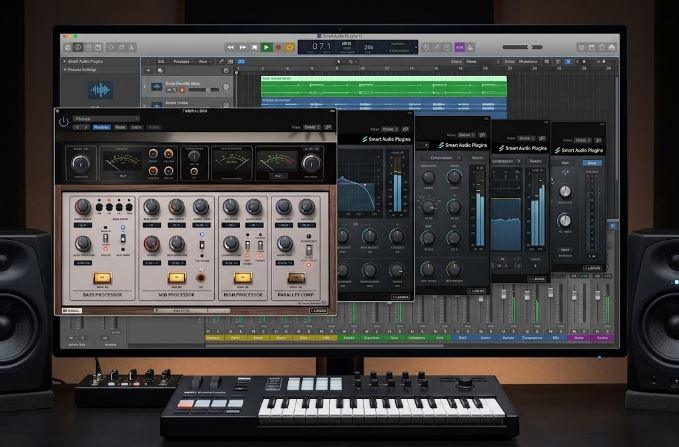
The developer calls Timbral Box a “parallel harmonics EQ / enhancer.” That description gets closer to its architecture than simply calling it a saturation plugin. Bass, Mid, and High processors work in parallel with the incoming audio, creating filtered signal components and harmonic content without replacing the dry source. A separate parallel dynamics section and transformer stage extend the same idea into movement and coloration.
As of September 22, Smart Audio Plugins lists Timbral Box at an introductory €48.30, reduced from €69 through September 30, 2026. It supports AAX, AU, and VST3 on 64-bit macOS and Windows systems. The more interesting question for producers is why its parallel architecture can behave like an alternative form of EQ at all.
Harmonics Can Change Presence Without A Conventional Boost
A normal equalizer changes the level of frequencies already present in a signal. Raise an EQ band around the upper mids and existing energy in that range becomes louder. Cut a low-frequency band and that part of the source becomes quieter.
Harmonic processing can create new spectral energy instead.
Nonlinear processing changes the shape of a waveform and generates frequency components related to the original signal. Sound On Sound’s explanation of harmonic distortion and saturation describes how saturation can add harmonics and alter dynamics at the same time. Frequency-selective saturation can then act like an enhancer by generating harmonic information in chosen regions instead of merely increasing existing frequencies.
Smart Audio Plugins’ Timbral Box architecture divides the processing into Bass, Mid, and High sections. Each contributes material beside the dry signal rather than sending the full source through one serial tone-shaping chain.
That explains the “parallel EQ” description. Turning up one section does not mean the plugin is simply applying a bell or shelf filter. It creates a processed layer focused around a chosen spectral region.
The result can still be perceived as more bass, more midrange focus, or more top-end presence. The route to that result is different.
Parallel Processing Protects More Of The Original Attack
Saturation can make a source feel denser and more present, but aggressive nonlinear processing can reshape transients. A snare attack, acoustic-guitar pick, piano strike, or kick transient may soften when the entire signal is driven heavily through saturation.
Parallel processing creates another option.
The clean signal remains present while the processed layer contributes harmonics, sustain, density, or altered dynamics beside it. That relationship helps preserve some of the original attack while still adding tonal weight.
This is one reason parallel distortion and saturation are common studio techniques. The dry path keeps part of the source’s transient structure, and the processed path supplies additional tone.
Timbral Box makes that relationship its default architecture instead of asking users to build several auxiliary buses manually.
Smart Audio Plugins says each frequency section contributes both filtered signal and harmonics. The balance is therefore more complex than a simple dry signal mixed with a duplicate saturator.
Independent coverage from AudioTechnology’s Timbral Box report identifies its defining feature as parallel harmonic processing across Bass, Mid, and High modules.
That can matter on material where transient identity is central. A drum bus may need more body without flattening kick and snare attacks. An acoustic guitar may need harmonic density to stay forward without becoming obviously brighter.
The Bass Section Creates Weight Through More Than Gain
The Bass Processor makes the plugin’s philosophy easy to hear.
Users can position its processing around 34, 55, 89, or 144 Hz. Smart Audio Plugins says those values were selected by ear and correspond to numbers in the Fibonacci sequence.
The important control is Bass Shape.
Negative settings loosen the processing. According to the developer, the bass becomes more prominent, the transient remains freer, and generated harmonics can resonate for longer, which can make the low end feel deeper.
Positive Shape values tighten the response.
This gives the Bass module a behavior that a static low shelf cannot easily reproduce. A low shelf changes amplitude, while Bass Shape changes how the harmonic and dynamic layer behaves around the original low-frequency signal.
Two saturation modes create another distinction. Mode A is the lighter option and leans more toward clipping behavior. Mode B combines clipping and saturation with a more involved relationship to the Shape control.
Phase can be switched between natural and linear modes. The developer suggests natural phase can suit individual sources, with linear phase being useful when phase preservation is a higher priority on buses or complete mixes.
The Bass section therefore acts less like a basic boost and more like a parallel low-frequency tone generator.
The Mid Processor Shows Why “Parallel EQ” Is More Than Marketing
Midrange is where the Timbral Box concept becomes more revealing.
The Mid Processor includes Mid Focus, Mid Freq, Shape, Blend, two saturation modes, and a 3D control. Those parameters determine where newly generated character sits relative to the source.
Smart Audio Plugins suggests starting Mode A with Blend at zero when a subtler parallel-EQ-style result is wanted. In that configuration, the section can supply midrange presence without making saturation itself the dominant effect.
Blend changes the harmonic curve in Mode A. Mid Focus and Mid Freq shift the tonal center around which that processing operates.
This is different from selecting a 2 kHz bell, increasing it by 2 dB, and adjusting Q.
A conventional EQ boost preserves the basic spectral relationships inside the selected range. Timbral Box can generate additional harmonics and filtered parallel content there. That can change density and perceived proximity rather than merely raising level.
Shape adds a dynamic component, while the 3D control is intended to add perceived depth without changing phase.
That combination makes the middle section useful when a source occupies the right frequencies on a spectrum analyzer but still feels too distant, thin, or disconnected from the mix.
High-Frequency Presence Can Come From New Harmonics
The High Processor follows the same parallel principle with controls calibrated for the upper spectrum.
Hi Shape changes how the section responds dynamically and harmonically. Two saturation modes alter the character, and Hi Sparkle supplies an extra parallel contribution in the high frequencies.
The developer warns that Hi Sparkle is easy to overuse. That makes sense perceptually because human hearing can adapt quickly to added brightness, making an initially exciting setting feel excessive after repeated comparison.
Gain-matched checking matters here.
Timbral Box includes Autogain with an Analyze function and Gain Link between input and output. Those tools address one of the oldest problems in evaluating processors: louder often sounds more impressive during quick comparisons.
The plugin is calibrated with VU zero corresponding to -12 dBFS, and Smart Audio Plugins recommends working around -18 dBFS. That recommendation reflects the nonlinear nature of the processing because input level changes how saturation stages respond.
The September 16 KVR Audio release report confirms the three-band structure, Model A/B saturation choices, parallel compressor, transformer stage, Autogain, Gain Link, and Natural/Linear phase options.
Those features make Timbral Box feel less like a three-band EQ replacement and more like a spectral-density tool organized in familiar EQ territory.
Parallel Compression Extends The Same Philosophy Into Dynamics
Timbral Box includes a Parallel Comp section, but Smart Audio Plugins explicitly cautions against treating it like an ordinary compressor.
The module keeps the dry source present and adds a dynamically processed layer around it.
Movement controls both threshold behavior and the shape of the compression action. Release sets recovery timing, while Full Mix and Instruments modes provide different operating ranges.
Instruments mode is the more aggressive sound-design option. The developer describes it as lying somewhere between multiband compression, OTT-style behavior, and companding controlled through the Movement parameter.
Full Mix mode is intended for gentler treatment where the original balance should remain more stable.
This section strengthens the argument behind Timbral Box. The plugin is not attempting to isolate EQ, saturation, and compression as separate jobs. It treats them as interacting ways to alter perceived presence around a preserved source.
That can be particularly useful on drums. A transient can remain in the dry path, parallel harmonics can create body around it, and the dynamics section can add movement or sustain.
RobSonic recently explored another form of source-preserving coloration in its Skruu and Triple OG tape processing analysis. Timbral Box works from another direction by making harmonic density something that can sit around the source rather than forcing the entire signal through one coloration stage.
The Transformer Stage Gives The Parallel Layers A Shared Finish
After the frequency-specific modules and dynamics processing, Timbral Box includes a transformer section on the summed signal.
Smart Audio Plugins says this section models two transformers from the 1970s.
Transformers are relevant to this kind of processor because real transformer circuits can introduce nonlinearities, harmonic distortion, frequency-dependent behavior, and phase changes depending on circuit design and level.
Sound On Sound’s detailed explanation of analogue warmth and harmonic distortion notes that transformer behavior cannot be reduced to a single “warmth” curve. Harmonic contribution can vary with signal level, and transformer response is affected by the surrounding circuit.
Timbral Box uses its transformer stage after the parallel modules, giving the collection of dry signal and generated layers a common coloration point.
That architecture has practical value.
Three separately controlled harmonic bands can risk feeling like independent additions if pushed hard. A common output stage can help the result behave more like one processor.
The transformer section can still be bypassed when a cleaner result is preferred.
Why Timbral Box Is More Interesting Than Another Saturator
The market already contains many saturation plugins, parallel distortion techniques, multiband processors, enhancers, EQs, clippers, and compressors.
Timbral Box does not introduce harmonic generation itself as a new idea.
Its more interesting contribution is organizational.
It asks producers to think about harmonics in the same broad spectral categories they already use when reaching for EQ: bass, mids, and highs. The plugin then changes what happens inside those categories.
Instead of saying “boost this range,” it asks how much filtered parallel signal and harmonic density should exist around that range.
Instead of forcing the entire source through saturation, it leaves a dry path available. Rather than making compression the only route to greater density, it can create new spectral material beside the transient.
That can change mixing decisions.
A source that seems too thin may need harmonic structure rather than a larger EQ boost. A drum bus that feels quiet may need added density rather than more peak reduction. A full mix that feels flat may respond better to subtle parallel harmonic additions than another aggressive processing stage.
Timbral Box will not eliminate the need for EQ or compression. Precision cuts, resonance control, dynamic containment, corrective work, and level management remain separate jobs.
Its value lies in the gray area where a mix needs to feel more present without an obvious frequency boost or another round of heavy dynamic reduction.
That is why “parallel EQ” is a useful way to interpret the plugin.