
Most AI music tools treat a prompt as an instruction to create an output.
Type a description, wait for processing, and receive audio.
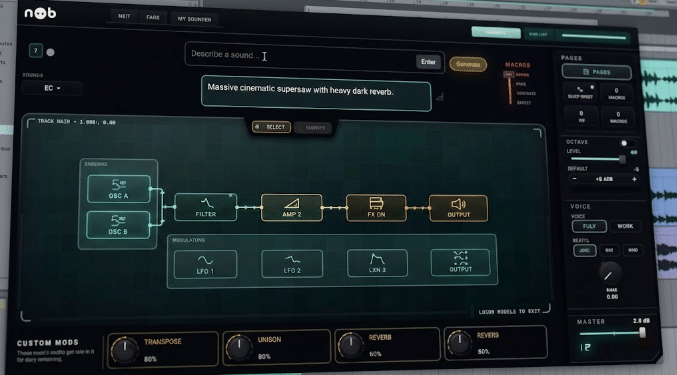
Synthius Labs nob takes a different approach. Instead of generating a finished WAV file, loop, stem, or song, it translates text into the parameters of an actual software synthesizer.
Synthius Labs describes nob as an “intelligent synthesizer” that lets producers describe a sound in ordinary language and then builds a playable patch inside the plugin. KVR Audio reported the public release on October 13, 2026, describing nob as a prompt-driven wavetable instrument for macOS and Windows.
That distinction matters for producers.
If a prompt such as “dark metallic bass with a slow attack and wide movement” returns rendered audio, the sound is largely fixed. With nob, the result remains a synthesizer patch. Oscillators, envelopes, filters, modulation and effects can still be inspected and edited.
The AI is therefore acting less like a musician delivering a recording and more like a sound designer setting up the instrument for you.
The Prompt Builds A Patch Rather Than Rendering A Clip
The central idea behind nob is simple.
A producer types a description.
The software interprets that language and generates a complete synthesizer configuration.
According to the official Synthius Labs nob page, the engine can set oscillator, filter, envelope and effects parameters from a text description. Producers can then play the resulting sound directly from MIDI inside a DAW.
That changes the relationship between prompting and synthesis.
A generated audio clip has already committed to pitch, performance and timing.
A patch has not.
The producer can play a single note, build chords, automate parameters, record MIDI or completely rewrite the musical part without regenerating the sound.
In that sense, nob separates sound generation from musical composition.
The prompt designs the instrument.
The producer still decides what the instrument plays.
Follow-Up Prompts Work More Like Sound-Design Instructions
The first result does not need to be final.
Synthius Labs says users can refine a generated patch with follow-up instructions such as making it brighter, adding more grit or slowing the attack.
That workflow resembles talking to a sound designer.
Instead of reopening several synthesis panels and manually deciding whether “brighter” should mean a higher filter cutoff, more wavetable harmonics, less low-pass filtering or additional high-frequency effects, the system interprets the request and adjusts the patch.
Producers can then inspect those decisions.
That is a major difference from black-box audio generation.
The user does not merely hear that the result became brighter.
They can continue editing the synthesis architecture responsible for the change.
The Wavetable Engine Remains Fully Editable
The generated sounds run through a conventional synthesis architecture rather than a hidden audio-rendering engine.
nob includes two wavetable oscillators, plus sub and noise sources.
Its oscillator section supports wavetable scanning and warping along with techniques including FM, hard sync and ring modulation.
Unison can reach eight voices, with controls for detuning, stereo spread, phase randomization and drift.
These features matter because text prompting does not replace wavetable synthesis.
It sits above it.
A producer could ask for an evolving digital pad, receive a generated starting point and then manually change the oscillator wavetable, unison behavior or modulation depth.
That makes the prompt one entry method among several rather than the only way to program the instrument.
nob Makes AI Generation Inspectable
One recurring problem with generative audio is that users often cannot determine why a sound came out the way it did.
nob takes the opposite approach.
Synthius Labs explicitly describes the engine as “a real synth, not a wrapper.”
The generated patch remains visible through the normal synthesis controls.
That makes AI decisions inspectable.
If the system creates a bass sound with two oscillators, filter modulation, distortion and a fast envelope, the producer can see that structure.
They can decide that the distortion is unnecessary.
They can change the filter.
They can replace the wavetable.
They can remove modulation routes.
The generated patch becomes an editable hypothesis about how to make the requested sound.
For sound designers, that may be more useful than treating the AI output as authoritative.
The Modulation Matrix Keeps The Patch Programmable
nob provides four LFOs, three envelopes, four macros and a 16-slot modulation matrix.
That architecture gives generated patches room to move rather than producing only static timbres.
A prompt describing an evolving pad could potentially require several simultaneous processes: wavetable position moving slowly, filter cutoff drifting, stereo width changing and effects parameters responding over time.
A modulation matrix allows those relationships to remain visible.
This connects with a broader trend RobSonic has already explored in its article on IMFMSynth and open FM programming.
IMFMSynth makes synthesis relationships easier to inspect by exposing flexible operator routing instead of hiding everything behind a fixed architecture.
nob approaches transparency differently.
It lets language create the first version of the routing, then returns control to the producer.
Custom Macros Turn Words Into Performance Controls
One of nob’s more unusual features extends prompting beyond patch creation.
Users can describe a new macro control and ask the instrument to decide which parameters that control should move.
The official interface demonstrates words such as “ethereal,” “gloomy” and “haze.”
The interesting part is not the labels themselves.
It is the mapping underneath them.
A traditional macro requires a sound designer to decide that one knob should simultaneously change filter cutoff, reverb mix, wavetable position and perhaps modulation depth.
nob attempts to infer those relationships from the description.
The resulting macro then behaves like a conventional performance control.
That could make descriptive language useful after the sound has already been created.
A producer might design a macro around “tension,” for example, and automate it through a track rather than programming several separate automation lanes.
Samples Can Become Part Of The Wavetable Workflow
nob is not limited to factory wavetables.
KVR’s October 13 release report describes a broader instrument that also supports sample manipulation.
The plugin can load samples, map them across a keyboard and capture material into wavetables.
That matters because prompt-driven patch design does not need to begin with generic oscillator material.
A producer can introduce personal recordings or studio samples and then use the synthesis engine around them.
This keeps the workflow closer to conventional sound design.
The AI provides parameter decisions.
The producer can still provide the source material.
Nine Effects Remain Part Of The Patch
The effects section includes EQ, distortion, compression, Hyper processing, delay, chorus, phaser, reverb and flanger.
The effects can be reordered.
Again, the useful distinction is editability.
If a prompt-generated pad arrives with too much reverb, the producer is not forced to regenerate the entire result.
The reverb is simply another processor in the patch.
It can be reduced, moved or removed.
That sounds obvious for a synthesizer, but it is exactly what distinguishes this workflow from generated audio.
Rendered audio combines synthesis, processing and performance into one file.
nob keeps those decisions separated.
Prompting Could Lower The Entry Barrier To Wavetable Synthesis
Wavetable instruments can become intimidating quickly.
Oscillators lead to warp modes.
Warp modes lead to modulation.
Modulation opens matrices.
Then come envelopes, filters, unison, macros and effects.
Experienced users may enjoy that depth.
Newer producers may know what they want to hear without knowing which technical controls will create it.
nob attempts to translate between those two forms of knowledge.
Someone can describe a sound as “soft glassy keys with a short attack and long shimmering tail” without first knowing whether the result requires wavetable position modulation, filtering, chorus or reverb.
The generated patch becomes a starting point.
Importantly, the controls do not disappear afterward.
A beginner can potentially learn by examining what the system changed.
Experienced Sound Designers May Use It Differently
For advanced users, the attraction is probably not avoiding synthesis knowledge.
It is reducing setup time.
Building an evolving wavetable patch from zero can involve repetitive decisions before the interesting experimentation begins.
A prompt could create a rough architecture in seconds.
The producer could then discard half of it.
That still saves time if the remaining half forms a useful starting point.
This is similar to using randomization, preset browsing or patch mutation, except natural language provides a stronger description of intent.
The workflow becomes:
describe, generate, inspect, edit.
That last step is what keeps nob relevant to hands-on sound design.
Internet Dependence Is An Important Limitation
The AI component is not completely local.
Current release information states that prompt generation requires an internet connection.
That means a studio without connectivity cannot rely on text generation at that moment.
Existing patches remain a different matter.
Once a patch exists, the synthesis architecture itself remains playable and editable.
This again demonstrates the separation between the AI service and the instrument.
The cloud-connected part helps decide where the knobs should go.
The synthesizer produces the actual playable sound.
Producers who archive projects long term should still verify how generated patches, authentication and future software versions behave before relying on the instrument for important sessions.
The Release Also Uses A Subscription Model
KVR reported that nob launched with a seven-day trial requiring payment information, followed by a $7.99-per-month subscription plus applicable taxes unless cancelled.
KVR also lists AU and VST3 for macOS and VST3 for Windows.
Because Synthius Labs’ own public page has recently shown beta-era availability information, producers should confirm current platform compatibility and subscription conditions before installing.
That is especially relevant for Windows users and studios that need predictable plugin support.
The technical concept remains separate from the commercial model.
A prompt-driven editable synth may be useful while a subscription still may not fit every producer’s workflow.
Why Editable Patches Matter More Than Finished AI Audio
The deeper value of nob is not that producers can type instead of turning knobs.
Plenty of tools can already translate text into sound.
The important change is where the generation stops.
nob stops at the patch.
It does not need to decide the melody, arrangement, final performance or mix.
That leaves a large part of the creative process inside the DAW.
A producer can generate a bass patch and write a completely original bassline.
They can automate the filter.
They can replace the wavetable.
They can remove the generated effects.
They can map a descriptive macro and perform it.
The result can evolve far away from the first prompt without requiring another audio generation.
That makes the system feel less like text-to-music and more like text-to-synthesis.
Why Synthius Labs nob Feels More Like An AI Sound Designer
The most useful way to understand nob is as an AI-assisted patch builder.
A prompt such as “wide metallic pad with a slow bloom and unstable high harmonics” does not need to become a finished recording.
Instead, it becomes a proposal for oscillator choices, modulation, filtering and effects.
The producer receives that proposal as an instrument.
That distinction preserves something conventional AI audio often removes: reversibility.
Every part of a patch can still change.
The notes have not been committed.
The performance has not been rendered.
The timbre is not trapped inside a WAV file.
For RobSonic readers interested in synthesis rather than automatic music generation, that is the more important development.
Synthius Labs nob does not use text prompts to replace the synthesizer.
It uses text prompts to program one.