
Getty Sound Design is a useful lens for producers because the Getty Center’s fall programming joined performance, architecture, archives, and public participation without treating sound as decoration. On October 4, 2026, the Getty Center presented “Ever Present: A Moveable Feast of No: No Wave Women with Adele Bertei” from 3pm to 9pm, with collaborative and experimental performances by Ikue Mori & Julianna Barwick, BUSH TETRAS, and The Maria Schneider Guitar Army, according to the Getty event page. Since that program has already happened, the useful question is not how to attend it, but how its methods can inform studio practice now.
As a producer, I read these events as practical studies in how sound behaves when it leaves the private session and meets a public site. The research notes point to noisy no-wave strategies, archival recordings, outdoor diffusion, participatory performance, and even the museum’s travertine surfaces as material. Those details do not prove a single fixed method, but they offer grounded prompts for artists who want more socially aware and site-responsive sound design.
Getty Sound Design As A Public Method
Why The Site Matters
The Getty Center examples suggest that place can shape sound before any plug-in is opened. The October 4, 2026 “Ever Present” program adapted noisy and experimental practices into live public space across multiple stages. That matters for producers because multi-stage thinking can be translated into arrangement: one sonic idea can live close, another can feel distant, and a third can interrupt from the side rather than sit in the center of the mix.
In a DAW, this does not require copying any artist’s work. It can mean assigning separate sound families to different spatial functions. A brittle feedback tone might act as an edge. A processed voice fragment might sit as memory. A guitar texture might cut through only during transitions. The lesson is structural: community-facing performance often asks sound to share attention rather than dominate it.
Evidence Before Aesthetic Claims
There is a caution here. The research does not provide decibel readings, mic models, stage maps, or detailed patch notes from the Getty events. So any studio adaptation should be framed as an interpretation, not a reconstruction. Producers can still learn from the documented format: public duration, multiple performers, archival reference points, and outdoor placement all affect how sound is perceived.
Archival Noise And Live Adaptation
No Wave Materials Without Nostalgia
No-wave influence can be reduced too easily to abrasion, but the Getty program points to something more disciplined: revisiting archival recordings and adapting experimental practices for a shared public environment. For Getty Sound Design, that means noise is not only volume or distortion. It can be a historical signal, a refusal of polish, or a way to keep a performance visibly handmade.
A studio method inspired by this would begin with source limits. Choose one archival-style element from your own rights-cleared material: a rehearsal cassette, a room recording, a discarded vocal take, or a guitar amp hum you recorded yourself. Then build a patch around what the source resists. If the tape is unstable, let pitch drift remain. If the room is harsh, use that reflection as rhythm. The point is not to imitate a community or period, but to let the evidence inside the recording direct the design.
Studio Patch: Archive-To-Stage
A practical chain can stay simple: edit the source into short cells, send alternate cells into delay, filter each return differently, and automate the send level so the archive appears and disappears like a performer entering a space. Print several passes. Keep the moments where the source and processing seem to argue with each other. That friction often feels more alive than a perfectly cleaned sample.
Architecture, Touch, And Resonance
Getty Sound Design In Practice
The Getty Center’s architecture has also been used as a sound source. At a Family Festival in October 2011, sound artists including Paul Fraser and Ellen Reid formed the Travertine Ensemble, played the museum’s travertine walls with mallets of varying densities, mapped pitched tones in the walls, and invited the public to contribute to compositions, as described in the University of Rochester study Sensing the Museum. That example is especially valuable because it treats architecture as an instrument and the public as part of the score.
For producers, the transferable idea is tactile excitation. A resonant object does not need to be rare or expensive. A ceramic bowl, wood table, metal railing, or stone surface can become a pitched source if it is recorded carefully and played safely. The sound-design step is to map the object’s responses: which strikes create tone, which create noise, and which produce a useful decay.
From Stone To Synth Envelope
Once recorded, object resonance can guide synthesis. A short stone-like tick might become the transient for a subtractive synth patch. A longer ring can shape an amplitude envelope. A dull strike can become a sidechain trigger. This is where Getty Sound Design becomes a mindset rather than a museum-specific formula: listen for the physical behavior first, then let the synth follow.
One useful exercise is to create three versions of the same object sound. The first stays nearly dry, preserving the contact. The second becomes a tuned percussion layer. The third is stretched or granulated until it reads as atmosphere. Place them at different distances in the mix. This keeps the object’s identity present while giving the track depth.
Community Listening Without Flattening Voices
Co-Creation As A Constraint
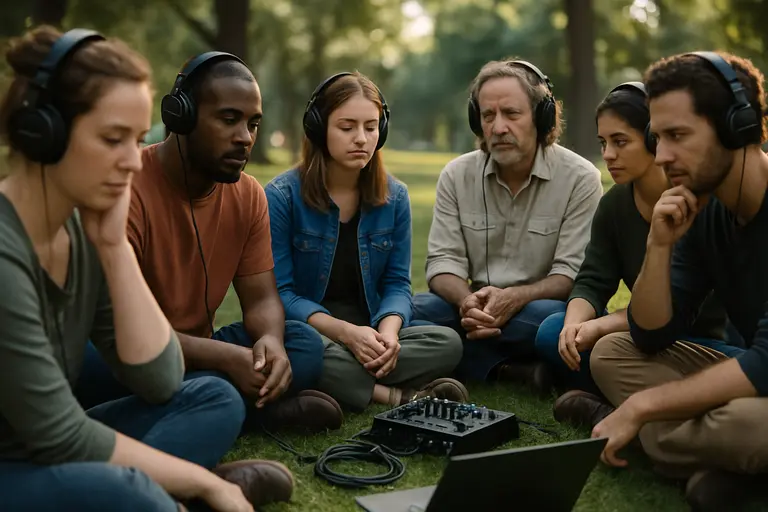
The research notes also describe Getty programs that foregrounded community participation, including “Ever Present: TRANSA—A Celebration” on September 6, 2025, which staged music performances, garden sound installations, reading spaces, and screening spaces by trans artists. A respectful production lesson is not to treat community as a texture to be extracted. Community listening should affect process: who is invited, what is recorded, how permission is handled, and whether the final work leaves room for more than one point of view.
That can change a session plan. Instead of collecting voices as raw material, a producer might invite participants to choose which environmental sounds represent a place. Instead of turning every contribution into a beat, the producer might preserve pauses, overlaps, or conflicting tones. This approach is slower, but it can reduce the risk of flattening people into atmosphere.
Rights-Aware Sampling Choices
Creators working with community recordings should stay cautious about rights, likeness, and consent. This is not legal advice, but a practical studio boundary: use sounds you recorded with permission, document what each contributor agreed to, and avoid implying endorsement by people or communities who did not grant it. For other explorations into creator culture, Shimply is part of a network offering arts and culture coverage.
This care also applies to visual-art inspiration. A producer can respond to exhibition methods, spatial formats, or material behaviors without copying protected works or trading on a living artist’s identity. RobSonic’s related coverage of sound design across U.S. art shows tracks similar questions around generative systems, embodied listening, analog objects, and cautious AI use.
Getty Sound Design Studio Takeaways
A Repeatable Session Plan
The strongest Getty Sound Design lesson is that a sound can carry place, memory, touch, and social relation at the same time. A producer can turn that into a repeatable session without overstating what the Getty events prove. Start with a site or object. Record it in more than one position. Identify one archival or memory-based element from your own cleared material. Build a short performance system where the source can change in response to touch, distance, or audience action.
- Record one physical surface at close, medium, and distant positions.
- Extract three layers: transient, pitched ring, and environmental tail.
- Pair the layers with one archival-style source you have the right to use.
- Automate spatial movement so the mix feels public rather than fixed.
- Print live passes and keep human timing differences where they help the piece.
The goal is not to make a track sound like a museum event. The goal is to let site, participation, and material behavior shape the music. Getty Sound Design, treated this way, becomes a disciplined prompt: before adding more processing, ask what the space, object, and community have already given you.