
FM synthesis has spent more than four decades carrying the shadow of the Yamaha DX7. That legacy is deserved: Yamaha’s six-operator instrument helped define digital synthesis after its 1983 release. Yet the DX approach also taught generations of musicians to think about FM through fixed algorithms, numbered operators, small displays, and a programming structure determined before the patch even began.
Kaito Sato’s IMFMSynth takes a different position. Released on September 1, 2026, the Windows and macOS instrument keeps the idea of operators but removes the fixed algorithm selector. Eight operators, three filters, and the output appear on one visual canvas, and the user draws connections between them. An operator can generate a traditional waveform, noise, or an imported wavetable. Existing DX7 SysEx banks can still be loaded, but they become editable material inside a larger architecture rather than historical presets trapped inside a DX7 reconstruction.
That combination makes IMFMSynth interesting for RobSonic readers. It does not reject classic FM. It asks what FM programming looks like when today’s processors, graphical interfaces, wavetables, modulation systems, and DAWs no longer have to work around the limitations that shaped a 1983 keyboard.
The DX7’s Algorithms Were A Practical Solution To A Hard Problem
The Yamaha DX7 used six operators arranged through 32 predefined algorithms. Each algorithm determined which operators acted as audible carriers, which served as modulators, and how those operators interacted.
Those limits were not arbitrary. Yamaha’s own DX7 development history explains that an earlier experimental instrument called PAMS offered far more freedom, but that freedom created too many parameters for a practical commercial synthesizer. Yamaha simplified the system and reduced the available operator configurations to 32 algorithms.
That was a smart engineering and interface decision in the early 1980s. A six-operator FM engine was computationally sophisticated for its era, and the DX7 had to make it programmable through membrane switches and a two-line LCD rather than a modern graphical workspace.
The compromise became part of FM culture itself.
A sound designer chose an algorithm first, then adjusted the frequencies, levels, envelopes, keyboard scaling, feedback, and other properties of the operators living inside that structure. Changing the architecture usually meant selecting another algorithm.
IMFMSynth reverses that hierarchy.
There is no numbered algorithm menu dictating the operator network. The patch itself becomes the algorithm.
That sounds like a small interface change, but it changes how a producer thinks. Instead of remembering that a certain diagram places Operator 2 above Operator 1 and another branches several modulators into one carrier, a user can draw the relationship directly.
FM moves closer to patching.
Eight Operators Can Be Wired Instead Of Selected
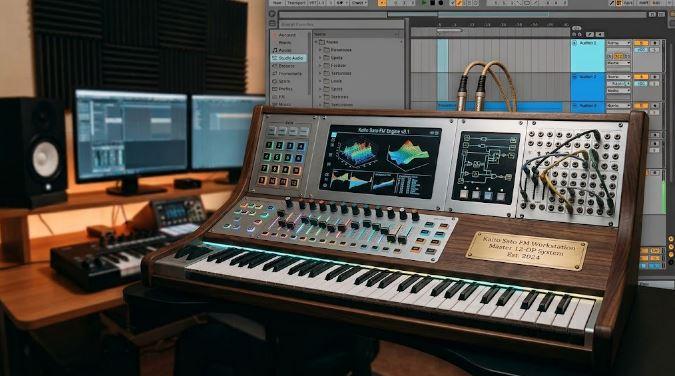
Kaito Sato’s official IMFMSynth feature page places eight operators, three filters, and the final output on the same visual surface. Connections are made by dragging from an output port to another destination.
Any operator can modulate another operator. An operator can feed itself. Every connection has its own modulation depth and phase offset.
This means the architecture does not have to fit one of a predefined set of diagrams.
A simple two-operator bass can remain simple. Another patch might use several modulators feeding one carrier. A more complicated structure can branch, feed back, run several audible carriers in parallel, or send operators through filters before returning signals into other parts of the graph.
The interface makes those relationships visible at the same time.
That visibility matters with FM because complexity can grow quickly. Once several operators are modulating other operators at audio rate, the resulting spectrum is determined by relationships rather than one obvious oscillator waveform. A conventional menu can hide those relationships. A graph exposes them.
Sato told Sonicstate in a September 12, 2026 IMFMSynth developer interview that the routing interface was one of the instrument’s two main ideas. The traditional operator concept remains, but direct connections replace the fixed-algorithm system.
That puts IMFMSynth in an interesting middle ground. It still speaks the language of FM operators, ratios, carriers, modulators, feedback, and envelopes, yet it behaves more like a modular instrument when those pieces are connected.
Wavetables Change What An FM Operator Can Be
The second major departure is waveform choice.
Classic DX-style FM is strongly associated with sine-wave operators. IMFMSynth lets an operator use sine, triangle, saw, square, several colors of noise, or a wavetable. Serum- and Vital-style WAV wavetables can be imported, and wavetable position itself can be modulated.
That changes FM before any routing becomes complicated.
In a basic FM example, one sine wave modulates another. The harmonic result can already become complex as modulation depth increases. Replace either waveform with a harmonically rich wavetable and the starting material changes considerably.
A wavetable does not sit beside the FM engine as a separate oscillator section. Sato’s design treats it as another waveform available to the operator.
That architectural decision is important. Producers do not have to choose between “the FM section” and “the wavetable section.” A wavetable can be a carrier. It can be a modulator. Several wavetable operators can interact. Scan position can move at the same time as one operator changes the phase behavior of another.
RobSonic’s earlier wavetable synthesis guide explains how scanning through frames turns a static oscillator into an evolving source. IMFMSynth brings that movement into the FM graph itself. A moving wavetable can change the harmonic material entering an FM relationship before modulation depth, frequency ratios, filters, or effects change anything else.
That is one reason IMFMSynth feels less like a DX7 editor with extra controls. The operator has become a more general-purpose sound source.
DX7 SysEx Import Connects The Old System To The New One
The clever part is that IMFMSynth does not force users to abandon DX history.
The instrument can import Yamaha DX7 .syx banks. According to Kaito Sato’s documentation, a bank containing 32 sounds can be loaded with details such as frequency ratios, fixed-frequency settings, keyboard scaling, rate scaling, LFO behavior, sensitivities, and related patch data preserved.
Once imported, the patch becomes editable within IMFMSynth.
That last part changes the value of compatibility.
A DX7 bank does not have to remain a museum piece. A producer can start with a familiar electric piano, bell, bass, brass-like patch, or experimental bank and then add operators, introduce wavetables, redraw envelopes, route the sound through filters, or use modern modulation and effects.
KVR Audio’s September 8 release coverage described IMFMSynth’s DX7 bank import as importing the patches in an editable form rather than treating them as fixed playback data.
That creates a useful bridge between preservation and experimentation.
DX7 compatibility matters partly because so many patches already exist in SysEx format. Yet strict compatibility can sometimes encourage strict imitation. IMFMSynth takes the opposite route: load the historical architecture, then break out of it.
A six-operator patch can become the beginning of an eight-operator one.
A sine carrier can become a wavetable.
A fixed envelope can be replaced with a drawn shape.
The historical patch becomes source material.
Hand-Drawn Envelopes Make FM Motion Easier To Read
FM sound design depends heavily on envelopes. If a modulator begins loud and then fades, the timbre may start bright or metallic before becoming simpler. If several operators decay at different rates, the spectrum can change dramatically through one note.
IMFMSynth keeps ordinary ADSR controls but adds multipoint envelopes that can be drawn directly.
The user can place multiple points, select curves between them, and establish sustain and loop positions. Sato’s own introduction to the instrument points to uses such as tremolo that becomes stronger later in a note, along with detailed bell and string behavior.
This makes a difference with an eight-operator architecture.
Complex FM often becomes difficult because sound changes are distributed across several envelopes. A rigid envelope format adds another mental layer. Drawing a shape makes the intended motion easier to see.
That can be especially useful for metallic percussion, plucks, evolving pads, struck sounds, or synthetic instruments whose brightness changes independently from their volume.
Three filter stages provide another way to shape that complexity. Each includes parameters such as cutoff, resonance, slope, key tracking, drive, and character, and the filters appear inside the same routing environment rather than acting purely as a final subtractive stage.
Signals can move from operators into filters, and filter output can become part of the larger patch structure.
FM and filtering stop feeling like two isolated synthesis chapters.
IMFMSynth Keeps Growing After Its September Release
IMFMSynth did not remain at its launch configuration for long.
Kaito Sato released version 1.0.2 during the first week after launch. His September 8 update notes reported DSP optimizations producing as much as a 47 percent improvement in internal performance measurements, along with filter-intensity modulation, envelope-editing changes, wavetable and activation fixes, and experimental Windows ARM64 support.
Those figures come from the developer’s own benchmarks rather than an independent CPU test, so the 47 percent number should be treated in that context. Still, the speed of the update shows that IMFMSynth was already changing in response to early users.
The IMFMSynth v1.0.2 update also matters because eight freely connected operators, wavetables, filters, modulation, and oversampling can create substantial DSP demands.
The current instrument uses 2x oversampling and supports up to 16 voices. It includes four modulation slots, six LFO shapes including sample-and-hold, tempo synchronization, ADSR modulation, and effects covering drive, chorus, delay, and reverb.
An optional 8-bit output mode quantizes amplitude into 256 steps for deliberately coarse digital textures.
The architecture is modern, but it does not attempt to hide its digital identity.
That feels appropriate for an instrument inspired by one of the most recognizable digital synthesis systems ever built.
Free Routing Does Not Automatically Make FM Simple
IMFMSynth removes one form of restriction, but that does not mean eight-operator FM suddenly becomes effortless.
A free-routing canvas can actually expose more possibilities than a fixed algorithm menu. Eight operators create many potential relationships, and adding wavetables, filters, feedback paths, phase offsets, envelopes, and modulation expands that space further.
Early discussion around the synth reflects this tension. In a September 5 KVR forum thread, Sato explicitly asked users what they wanted from an eight-operator FM/wavetable instrument. At least one experienced participant said the browser demo still felt difficult to approach despite the visual routing concept.
That criticism is useful context.
The problem with classic FM was never solely the existence of fixed algorithms. FM itself asks the user to think in relationships: frequency ratio, modulation index, envelope timing, feedback, carrier versus modulator behavior, and the spectrum produced by those interactions.
A graphical patch cable does not erase that learning curve.
What it can do is make cause and structure more visible.
A producer can see which operator is feeding another. Connections can be changed directly. Wavetables look like waveforms rather than hidden mathematical choices. Multipoint envelopes display motion graphically.
That does not turn FM into subtractive synthesis. It makes the system easier to inspect.
Why IMFMSynth Feels More Like An Open FM Workbench
The best way to understand IMFMSynth is not as an attempt to replace the DX7.
The DX7 solved a different problem in a different technological period. Yamaha needed to turn sophisticated FM research into an affordable keyboard that musicians could actually buy and program in 1983. Six operators, 32 algorithms, membrane switches, patch memory, MIDI, and a compact display were major advances.
IMFMSynth exists in a period when those hardware restrictions no longer define the interface.
A software synth can draw every operator on screen. A modern CPU can process eight operators across multiple voices. Connections can be dragged with a mouse. An imported WAV file can become an FM source. Envelopes can be drawn. Legacy SysEx can be translated into editable modern patches.
That changes the question from “which algorithm should I choose?” to “what should modulate what?”
For sound designers, that is the deeper significance of IMFMSynth.
Its eight operators are useful, but the number alone is not the story. Wavetable support is useful, but adding another synthesis buzzword would mean little if it lived in a disconnected module. DX7 import is valuable, but compatibility becomes more interesting when imported patches can escape their original architecture.
IMFMSynth feels less like a closed DX7 box because the historical FM patch is no longer the final destination.
It can be opened, rewired, extended, filtered, animated, and turned into something the original algorithm chart was never designed to contain.