
Exhibition sound design is the wrong assumption to bring to Let Us Gather in a Flourishing Way: Contemporary Latinx Painting without first checking the record. As of November 5, 2026, the reliable public descriptions I reviewed point to a visual arts exhibition centered on painting and expanded painting materials, not a documented audio installation, synthesis work, or sound-based gallery environment. That does not make the exhibition less relevant to producers. It simply sets a factual boundary: any sound response should be framed as a producer’s interpretation, not as a feature of the show.
What The Sources Say About Exhibition Sound Design
exhibition sound design Evidence Check
The available sources describe Let Us Gather in a Flourishing Way: Contemporary Latinx Painting as a painting exhibition. Hola America reports that the show presents contemporary Latinx art at the Des Moines Art Center and includes works that expand painting through materials such as paper, clay, adobe, and papier-mâché, with no mention of audio, synthesis, sound installation, or listening stations near that description Hola America. For a producer, that distinction matters. Paper, clay, adobe, and papier-mâché can inspire texture, rhythm, and timbre, but inspiration is not the same as an exhibited sound element.
The official Des Moines Art Center page states that the exhibition includes 58 artists living and working in the United States, with roots in Central America or the Caribbean. It also gives the Des Moines dates as October 24, 2026, to January 24, 2027, and notes that the exhibition travels afterward to Phoenix Art Museum and Frye Art Museum in Seattle Des Moines Art Center. Since the exhibition opened on October 24, 2026, it was already on view by the date of this analysis. The official page supports the exhibition’s scope and schedule, but it does not support a public exhibition sound design component.
What Is Not Supported By The Record
The careful reading is simple: there is no reliable public evidence, in the supplied sources, that Let Us Gather in a Flourishing Way includes ambient audio, multichannel playback, generative synthesis, field recordings, live performance, or a formal sound score. I would avoid saying the exhibition has no sonic dimension in the broadest possible sense, because every gallery has incidental sound: footsteps, room tone, visitor movement, and the acoustics of the building. But those are not the same as an artist-credited or curator-described sound component. For music makers, the fair phrasing is that no documented sound work is attached to the show in the reviewed materials.
Why The Absence Of Audio Still Matters For Producers
Visual Texture Can Suggest Sonic Texture
Still, exhibition sound design can be a useful lens even when the exhibition itself is visual. Producers often translate non-audio cues into studio decisions: surface becomes noise shape, density becomes arrangement, color contrast becomes filter contrast, and repeated forms become rhythm. That translation should be treated as response-based practice, not as a report on what visitors hear in the galleries.
In this case, the supported facts point toward contemporary painting and expanded material use. A producer might respond to paper with dry transient noise, to clay or adobe with rounded low-mid resonance, or to papier-mâché with brittle layered crackle. Those ideas are production choices drawn from material imagination, not claims about the exhibition’s installation design. That separation keeps the writing honest and respectful to the artists whose work is being discussed.
Why Caution Helps The Art And The Music
For me, as a producer, the temptation is to hear a painting show as if it already has a score. That can be creatively useful in the studio, but it can also blur authorship if the language is loose. Saying a show has a synth-based audio environment when the institution has not described one would mislead readers and potentially misrepresent the artists. A cautious method gives both sides room: the exhibition remains what the sources say it is, while producers can still build ethically framed sketches inspired by texture, scale, and material presence.
That approach also fits a broader museum-audio conversation. Some U.S. exhibitions do use generative systems, embodied listening, analog objects, or careful AI-assisted processes, and RobSonic has covered that production angle in current sound design in art shows. The key difference here is evidence. If the source page names sound, discuss sound. If it names painting and materials, keep the audio response clearly labeled as interpretation.
Practical Sound Ideas Without Claiming Exhibition Audio
Studio Sketches From Material Cues
A practical producer workflow could treat exhibition sound design as a translation exercise. Start with three supported visual cues: painting, expanded material boundaries, and the listed materials. Build one short palette for each. Paper can become short filtered noise bursts, brushed percussion, or low-level tape hiss. Clay and adobe can suggest muted hand percussion, resonant body hits, or sine layers with soft saturation. Papier-mâché can suggest torn-fiber transients, granular rustle, or layered contact-mic style textures created from your own recordings.
The point is not to imitate a specific artist or claim access to an official score. The point is to practice mapping visual information into sound decisions. A two-minute study could begin with sparse dry noise, add rounded low percussion, and then introduce brittle top-end detail. That gives the track a material arc without pretending the gallery contains such a track.
- Label the piece as an independent response, not an exhibition soundtrack.
- Use your own recordings or properly cleared source material.
- Avoid copying a living artist’s visual style as a commercial shortcut.
- Keep captions factual: painting exhibition, material response, producer study.
Synthesis Choices That Stay Honest
For synthesis, I would keep the patch design restrained. Use noise oscillators for paper-like motion, filtered sine or triangle waves for clay-like mass, and granular processing only if the source material is yours or licensed for that use. Slow filter modulation can represent surface variation, while small pitch drift can make a static tone feel hand-shaped. None of this requires a claim that the exhibition itself uses synthesizers. It is a private or published response built from disclosed methods.
For broader arts and creator coverage in the same network, check out Next Clues, which provides related culture reading that complements production-focused analysis like this. Cross-reading helps creators think beyond plugin settings, but the same rule applies: the source record has to control the factual claims.
Rights And Respect In Response-Based Production
Attribution Without Overreach
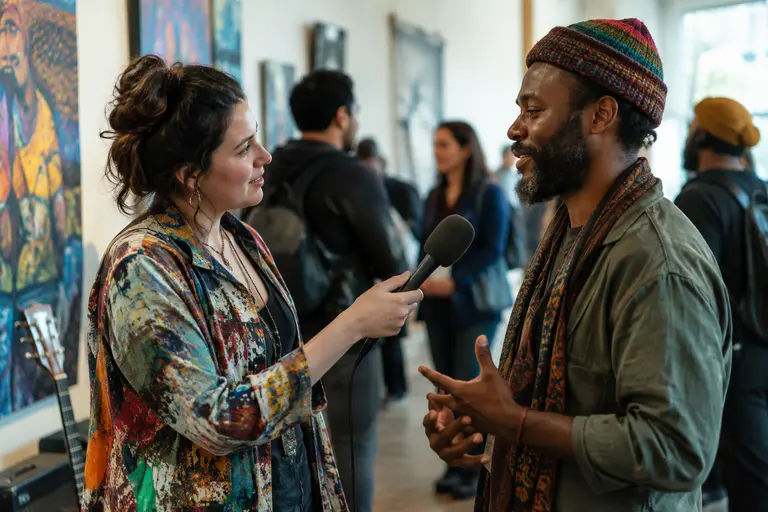
If a producer releases exhibition sound design sketches inspired by Let Us Gather in a Flourishing Way, the caption should avoid implying endorsement by the Des Moines Art Center, the curators, or the 58 participating artists. A safer wording would say that the piece is an independent sound study inspired by publicly described materials in a contemporary Latinx painting exhibition. That wording respects the exhibition while leaving room for creative practice.
This is also where rights awareness matters. Do not use installation photographs, artwork reproductions, artist names, or institutional branding in a way that suggests an official collaboration unless permission has been granted. This is not legal advice; it is basic creator hygiene. The music can respond to themes and materials without borrowing visual assets or presenting the work as authorized.
Community Context Matters
The exhibition’s focus on contemporary Latinx painting should be handled with care. Producers should not flatten the show into a generic “Latin” sound palette or reach for stereotyped percussion choices. The sources describe artists with roots in Central America or the Caribbean who live and work in the United States, which is already a broad and varied grouping. A respectful sound response should begin from the specific, supported exhibition details rather than broad cultural assumptions.
Let Us Gather In A Flourishing Way Sound Design
The supported answer is cautious: Let Us Gather in a Flourishing Way: Contemporary Latinx Painting has no documented exhibition sound design element in the reviewed sources as of November 5, 2026. The show is documented as a painting exhibition at the Des Moines Art Center from October 24, 2026, to January 24, 2027, featuring 58 artists and expanded painting materials, with later travel to Phoenix and Seattle.
For producers, that absence is still useful. It asks us to separate evidence from inspiration. The exhibition can spark studies in texture, synthesis, and arrangement, but those studies should be named as independent responses. That is the cleanest way to keep the art record accurate while still letting sound design practice learn from visual form, material weight, and gallery context.