
Most synthesizers ask users to build sounds from deliberate settings. Choose an oscillator, tune it, route modulation, shape an envelope, adjust a filter, and repeat until the patch reaches the intended result.
Expetri replaces that construction metaphor with a petri dish.
The independent developer released the self-titled synthesizer on October 10, 2026, then updated it to version 1.0.1 on October 23. Each animated cell inside the dish is a sound source. Cells drift, split, merge, and interfere with neighboring waveforms while the musician plays.
The official Expetri release announcement describes the instrument as an alternative to pursuing one precisely imagined sound through detailed parameter adjustment. Its purpose is exploratory: place cells into a changing system, interact with them, and listen for a result worth preserving.
That approach does not eliminate synthesis parameters. It turns them into visible behavior.
Every Cell Is A Separate Oscillator
Expetri’s visual metaphor has a direct connection to its audio engine.
One cell represents one oscillator. Press a key and every cell currently inside the dish contributes to the resulting sound.
Cells can operate at several pitch relationships, including sub-octave, unison, fifth, and octave positions. A single note can therefore produce a layered, chord-like result even though Expetri is monophonic and uses last-note priority.
Each cell’s shape identifies its synthesis engine. The current instrument includes Analog, FM, Wavetable, Chip, and Plucked String types.
Color defines another part of the oscillator identity, using waveform families such as sine, triangle, sawtooth, and square alongside different harmonic ratios. Cell size affects weight, with larger cells tending to sound thicker and darker.
The dish is not simply an animated preset browser. Its visible population describes the oscillators building the patch.
Proximity Turns Cell Movement Into Waveform Morphing
Cells affect one another when they move close together.
Expetri uses proximity to control waveform interaction. Neighboring cells can fold or interfere with each other’s waveforms, with stronger changes occurring as the distance between them decreases.
Lines appear between interacting cells so the relationship remains visible.
This makes spatial movement part of synthesis.
Two cells drifting apart may produce a simpler combination. Push them together and the resulting timbre can become more complex. Another cell can enter the same region, changing the network again.
A conventional synth might represent those relationships with a modulation matrix, oscillator-mix controls, or waveshaping values. Expetri shows them as cells entering and leaving one another’s influence.
The producer watches the structure change while hearing the spectral result.
Stirring Replaces Several Automation Moves With One Gesture
Dragging through the dish stirs its virtual liquid.
That movement pushes cells into new positions and temporarily increases their activity. More collisions can lead to faster merging and division.
Cell position affects the sound while a note is playing. Horizontal placement controls stereo panning, while vertical placement changes filter cutoff.
One stirring gesture can therefore alter several relationships:
cells move through the stereo image,
their brightness changes,
new proximity-based morphing appears,
and fusion or division may create another oscillator population.
This differs from automating pan, cutoff, oscillator mix, and waveshaping on separate lanes. The gesture changes the system that controls those properties.
The result may be less exact, but that unpredictability is part of the instrument’s purpose.
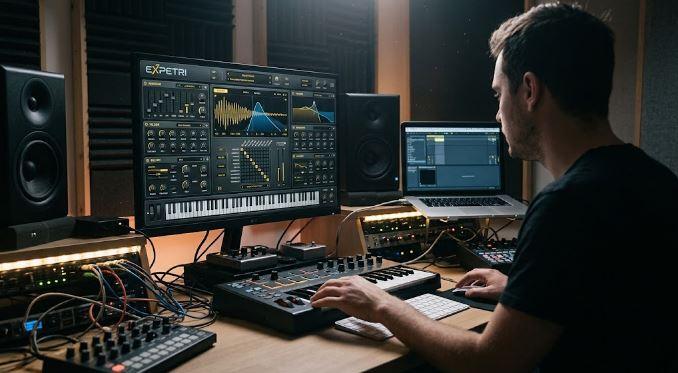
Version 1.0.1 Makes The Plugin Window Feel Physical
Expetri 1.0.1 extends the petri-dish metaphor beyond dragging inside the interface.
Move the plugin window and the liquid now sloshes in the opposite direction. Cells travel with that movement, changing their positions, panning, filtering, and proximity relationships.
The light and shadows react too, then settle as the virtual liquid stops moving.
This feature is playful, but it illustrates a serious interface idea. A plugin window usually contains controls without acting like a control itself. Expetri turns the window into part of the performance surface.
Moving software around the screen can change the sound.
That may be too unpredictable for precise automation, yet it provides a fast way to disturb a patch when ordinary knob adjustments stop producing interesting ideas.
Beakers And Flasks Hide Familiar Synthesis Controls
Expetri does not remove traditional sound-design functions. It presents them through laboratory objects.
Four beakers control Filter, Attack, Chorus, and Reverb.
Eight flasks activate Sub Oscillator, Saturation, Delay, Stereo Width, Detune, Shimmer, Formant, and Phaser processing.
These are familiar audio functions beneath the chemistry theme.
The difference lies in how the musician approaches them. Rather than opening a large effects rack, the user pours another quality into the dish.
That interface keeps the instrument approachable, but it also limits detailed editing. A producer looking for exact filter models, envelope curves, modulation routing, or precise delay programming may find another synthesizer more suitable.
Expetri is strongest when fast interaction matters more than engineering every stage of the patch.
Turning Off The Light Freezes The Ecosystem
Constant movement can make detailed editing difficult.
Expetri solves that problem with its day-and-night control. Turning off the light suspends cell activity, freezing the dish in its current state.
The musician can then reposition cells with the pipette, inspect the waveform or spectrum, adjust effects, and audition the sound without the population continuing to change.
Turn the light back on and the ecosystem resumes.
This creates a useful alternation between discovery and control.
Day mode allows the system to evolve.
Night mode preserves a moment long enough for refinement.
The workflow recognizes that happy accidents only become useful production material when the user can stop and capture them.
The Pipette Makes Precise Cell Placement Possible
The pipette provides more deliberate control than stirring.
Users can select discovered cell species and place them at chosen positions inside the dish. Higher placement creates a brighter response through the vertical filter relationship, while left-to-right location changes panning.
The current Expetri product listing describes a collection of 128 standard species built from 16 shapes and eight colors.
A user can audition an individual species before adding it.
This means the synth does not force every patch to emerge from uncontrolled movement. Once useful cells have been discovered, they can become reusable building blocks.
The visual ecosystem supplies chance, while the pipette restores intention.
Rare Cells Turn Discovery Into A Collection System
The paid edition adds 15 rare cell shapes that appear through cell merging and division.
Discovered species are recorded automatically and can later reappear during ordinary use. Stirring the dish encourages the reactions that may produce them.
This gives sound design a collection-game structure.
A rare cell is both a new visual organism and a new synthesis source. Finding one expands the material available for future patches rather than delivering a cosmetic reward.
The concept may appeal to producers who enjoy discovery, but it creates an unusual relationship with access. Some synthesis possibilities must first emerge through the system before they can be selected intentionally.
Expetri’s free edition removes that concern for evaluation. It includes the sound controls, user presets, project saving, rendering, and normal species without time limits or periodic silencing. Rare-cell generation is its only functional restriction.
Dice Creates Random Dishes From Known Species
A dice lever clears the current population and generates another combination from species the user has already discovered.
Effects settings remain in place.
That separation is useful because it lets producers test different oscillator populations through one established processing setup.
A warm reverb, formant treatment, or distorted chain can remain constant as the dish changes underneath it.
Randomization becomes more focused than resetting every setting simultaneously.
Once a promising combination appears, the user can adjust it manually or suspend the dish for closer editing.
The feature supports discovery without making every roll completely disconnected from previous work.
Culture Slots Preserve Accidents Worth Revisiting
Expetri includes 12 Culture slots for saving dishes.
Dragging the current dish into a slot stores its cells together with the 12 sound controls. Dragging it back recalls the saved state.
The plugin also stores dish state, control settings, and day-or-night status with the DAW project. Collections and Culture slots remain available across projects.
This recall system matters because the instrument’s central behavior is unstable by design.
A sound created through merging, motion, and proximity can be difficult to reproduce manually. Saving the complete culture turns a temporary ecosystem into a usable preset.
RobSonic’s creative effects-chain guide discusses how unusual results often emerge from interactions between several processing stages. Expetri applies that principle before the effects chain: the oscillator population itself becomes the interacting system that needs to be captured.
Monophonic Design Keeps The Focus On Timbre
Expetri is monophonic with last-note priority.
That prevents it from acting like a conventional polyphonic pad instrument, even though one note can produce a layered result through several cells and pitch ratios.
The limitation fits the design.
Expetri concentrates on cultivating one complex voice whose internal structure keeps changing. Chords can still be implied by fifths, octaves, detuning, and layered cell ratios, but keyboard harmony is not its central purpose.
Pitch Bend, modulation-wheel control, sustain, and velocity provide conventional performance input around that voice.
For basses, leads, drones, effects, and evolving monophonic textures, the restriction may help keep the changing cell population intelligible.
Producers needing independent evolution on every note would require another instrument or several rendered Expetri layers.
macOS Support Is Still A Practical Boundary
Expetri 1.0.1 currently supports VST3 and Audio Unit on macOS 14 or later, with native compatibility for Intel and Apple Silicon.
The developer lists Windows as coming soon but has not published a release date.
The current introductory price is $9.99, compared with a regular price of $14.99. One paid license can be activated on as many as three computers, and the full edition uses online activation.
A free edition is available for compatibility testing.
These details matter because the visual physics and window-shaking interaction may behave differently across DAWs. The developer recommends trying the free version on the intended host before purchasing.
Why Growing A Sound Changes The Design Mindset
Expetri does not replace detailed synthesizers.
It offers a different first step.
Instead of choosing an oscillator and defining its behavior, the user introduces cells.
Rather than drawing several modulation lanes, they stir the dish.
Waveform interaction appears as proximity.
Panning and filtering become physical position.
Cell fusion and division change the oscillator population.
Beakers and flasks provide broad shaping after the ecosystem starts producing sound.
Night mode freezes an interesting state, and Culture slots preserve it.
That workflow treats uncertainty as source material.
The musician still makes choices, but those choices concern conditions rather than every resulting parameter value. The user decides which cells enter the dish, how strongly they are disturbed, when movement should stop, and which accident deserves to become a preset.
Expetri’s defining question is therefore not, “How do I program the sound I already imagined?”
It is, “What sound appears when I let this small system grow?”