
Most synthesizers behave predictably. An oscillator produces a waveform, modulation changes a parameter, a filter reshapes the result, and envelopes control how the sound begins and ends.
sonicLAB’s Thermo3 approaches synthesis differently.
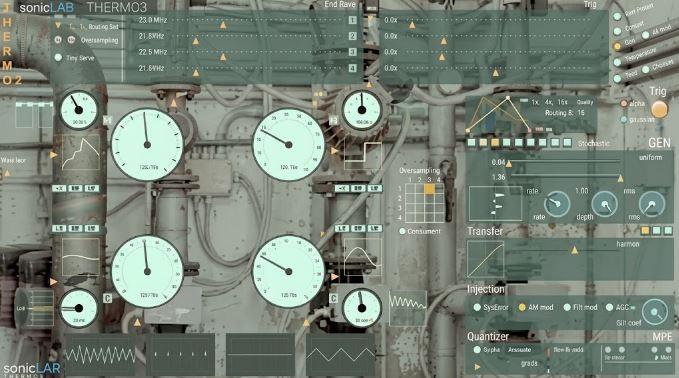
Released on October 28, 2026, Thermo3 is built around four oscillator engines connected through a 4×4 feedback network. Each oscillator listens to changes inside that network, reacts to those changes, and can alter its own behavior in response.
The result is a synthesizer that behaves less like a fixed chain of modules and more like a system trying to maintain a temporary state while the performer keeps disturbing it.
That is what sonicLAB means by a self-regulating engine.
Four Oscillators Are Constantly Listening To Each Other
Thermo3 contains four discrete oscillator engines.
According to sonicLAB’s official Thermo3 page, those oscillators are linked through a 4×4 feedback matrix and remain in continuous interaction.
That changes the role of the oscillator.
In a conventional synth, oscillator A may simply generate a saw wave while oscillator B generates a square wave. Their outputs may be mixed or routed into a filter.
Thermo3 lets each oscillator receive information from the others.
Its internal behavior can therefore depend on what the rest of the network is doing.
A rising level in one voice can change the conditions experienced by another.
Feedback can alter the spectral balance.
Modulation can push one part of the network away from stability and force the rest to react.
The sound is not simply the sum of four independent oscillators.
It is the result of their interaction.
Self-Regulation Gives The Synth A Temporary Equilibrium
sonicLAB describes Thermo as a thermodynamic-inspired synthesis system.
The language is unusual for a synthesizer, but the idea is understandable.
Each oscillator monitors conditions inside the system and reacts in ways intended to maintain what sonicLAB calls a quasi-state.
A quasi-state is not perfectly static.
It is a temporary balance.
The sound may settle into a recognizable behavior, but that balance can shift when modulation, feedback, or performer input pushes the system.
This is where Thermo differs from a conventional patch whose parameters remain where the user placed them until automation moves them.
In Thermo3, the patch can react to internal change.
The sound may resist a perturbation.
It may settle into another state.
It may become less stable.
That makes the synthesis process partly behavioral.
Injection Responses Are Deliberate Disturbances
Thermo3 adds six new Injection Responses.
These are ways of disturbing the network.
sonicLAB names them Strike / Quench, Afterimage, Entrain, Reroute, Imprint, and Threshold Dust.
Each changes the system differently.
Strike / Quench pushes energy into the network or damps it.
Afterimage captures a short piece of sound and feeds it back.
Entrain pulls oscillator movement toward or away from shared behavior.
Reroute changes how oscillators feed one another.
Imprint captures the current balance between voices and lets it affect what follows.
Threshold Dust introduces short-lived scattered grains.
These are not simply effect presets applied after synthesis.
They interfere with the system itself.
That makes performance more like pushing a dynamic object and observing how it recovers.
Hysteresis Gives Feedback A Memory
One of Thermo3’s most interesting new transfer functions is Hysteresis.
Hysteresis means the response of a system depends partly on where it has just been, not only where it is now.
In Thermo3, sonicLAB describes Hysteresis as responding differently depending on whether the signal is rising or falling.
That gives the feedback path a form of short-term memory.
The same instantaneous level can therefore behave differently depending on its recent movement.
This is important because it prevents the synthesis engine from acting like a simple static waveshaper.
The path taken through a sound can affect what happens next.
That creates another source of temporal variation without requiring a sequencer to specify every change.
Bistable Behavior Lets The System Favor Two Different States
Bistable is another new transfer function.
As the name suggests, it allows the system to move between two contrasting responses.
A conventional synth parameter often moves continuously from one value to another.
Bistable behavior can create more obvious state changes.
The network may lean toward one response, then cross a threshold and shift toward another.
This can create transitions that feel less like smooth modulation and more like a system snapping between operating conditions.
That gives Thermo3 another way to produce structure without traditional note-by-note sequencing.
The sound can change because the system itself changes state.
Excitable Adds Threshold And Recovery Behavior
Excitable is built around another system concept.
sonicLAB describes it as producing a burst when activity crosses a threshold, followed by a recovery period.
That makes the response event-like.
The network does not simply become louder as input increases.
It can remain relatively stable, cross a boundary, produce a reaction, then require time before it responds in the same way again.
This introduces timing behavior without a normal trigger sequencer.
A performer can create bursts by pushing the system hard enough.
Stochastic modulation can also push the network across the threshold unpredictably.
The sound becomes partly dependent on when enough energy accumulates to cause a reaction.
Spectral Drift Makes Feedback Relationships Move Over Time
Spectral Drift shifts frequencies circulating through the feedback network.
The official Thermo3 documentation describes three behaviors: Flow, Opposition, and Adaptive.
These modes alter how frequency movement acts across the four voices.
Because the oscillators continually feed one another, even a small shift can change the relationships inside the system.
One oscillator’s transformed output becomes another oscillator’s input.
That signal changes again.
The result feeds back through the network.
Spectral Drift therefore does more than detune one oscillator.
It changes the material circulating through the whole feedback structure.
The network can slowly reorganize itself even when the performer is holding a single note.
The Thermal Stage Adds Another Feedback Layer
Thermo3 introduces an independent Thermal stage after the Transfer stage inside the feedback loop.
It includes controls for heat, cooling, noise, and strength.
The metaphor again comes from thermodynamic systems.
Heat pushes the network.
Cooling reduces or stabilizes that activity.
Noise introduces uncertainty.
Strength determines how strongly the Thermal stage affects the feedback path.
This gives the producer another way to control the balance between stability and disturbance.
A patch can remain relatively calm.
Increase heat and the network may become more active.
Add noise and the path becomes less predictable.
Increase cooling and the system may return toward a more controlled state.
The important point is that these controls sit inside the feedback structure rather than only after the final output.
Stochastic Modulation Makes Change Less Predictable
Thermo3 also uses stochastic modulation generators.
Each oscillator has seven independent GEN modulators.
According to sonicLAB, those modulators can use both standard waveforms and stochastic distribution functions.
That means modulation does not have to follow a perfectly repeating LFO shape.
A parameter can move within a probability-based range instead.
This matters because self-regulation becomes more interesting when the disturbances are not perfectly predictable.
A repeating sine-wave LFO creates a familiar cycle.
Stochastic modulation changes the conditions of the network in less regular ways.
The oscillators then react to those changes.
That produces two layers of motion:
the modulation changes the environment,
and the oscillator system responds to that changed environment.
Performer Intervention Competes With The System
Thermo3 is not meant to run entirely by itself.
The performer can disturb the engine directly.
MPE support allows real-time control of sliders and stochastic GEN parameters.
Injection Responses can also be triggered or altered while the patch is running.
This creates an unusual performance relationship.
The musician does not simply move a filter cutoff and hear the filter move.
They can push the network, then listen to how the system reacts.
That response may not always be linear.
A small change might be absorbed.
A stronger disturbance could push the synth into another quasi-state.
The performer becomes one influence inside the feedback system rather than the only source of change.
Feed-Only Voices Can Process Incoming Audio
Thermo3 also adds per-oscillator Feed Only operation.
A voice can process incoming audio without generating its own waveform.
That expands the engine beyond closed-system synthesis.
External sound can become part of the feedback network.
A drum loop, vocal, field recording, or other audio source can enter one oscillator path and interact with the self-regulating structure.
This makes Thermo3 useful as both an instrument and an experimental processor.
The incoming signal becomes another disturbance.
The network reacts.
That blurs the distinction between synthesis and effects processing.
Four Separate Outputs Make The System Easier To Mix
Thermo3 can output stereo or provide four independent mono voice outputs from the same plugin.
That matters because a complex feedback network can produce very different behavior in each voice.
Sending those voices to separate DAW channels allows more conventional processing afterward.
One oscillator can receive distortion.
Another can be reverberated.
A third can remain dry.
The producer can therefore let Thermo3 create the unstable relationships internally while retaining control over the final arrangement.
This is a practical bridge between experimental synthesis and normal mix workflows.
Oversampling Helps Keep Feedback Under Control
Version 3 adds 4x, 8x, and 16x oversampling.
Feedback and nonlinear transfer functions can generate strong upper harmonics.
Fold, Hysteresis, and other nonlinear operations can push energy above the audible range, where digital aliasing may fold it back down.
Higher oversampling reduces that problem.
The tradeoff is CPU use.
sonicLAB recommends Apple M1-class performance or an equivalent system and lists Windows 10 or later and recent macOS versions among the supported environments.
Thermo3 is available as VST3, AU, and standalone software.
KVR Audio’s October 28 Thermo3 release report confirms the new transfer functions, six Injection Responses, independent Thermal stage, per-oscillator Feed Only mode, four outputs, oversampling, and £99 price.
Thermo3 Fits A System-Based Approach To Sound Design
RobSonic has already explored related ideas in its article on creative effects chains.
Traditional effects chains create complexity by connecting processors in sequence.
Thermo3 creates complexity by allowing parts of one synthesis engine to influence one another continuously.
The difference is important.
A chain usually moves signal in one primary direction.
A feedback system allows earlier and later states to interact.
That makes causality less straightforward.
Change one part of the system and several other parts may respond.
For producers interested in sound design, this can be more interesting than building another static oscillator-filter-amplifier patch.
Why Thermo3 Feels More Like A System Than A Synth Patch
The defining feature of Thermo3 is not any single oscillator or waveshaper.
It is the relationship between them.
Four oscillators exchange signals through a 4×4 matrix.
Each voice analyzes its environment.
Self-regulation pushes the engine toward temporary stability.
Stochastic generators keep changing the conditions.
Injection Responses disturb the network deliberately.
Transfer functions such as Hysteresis, Bistable, Excitable, Fold, and Spectral Drift change how feedback behaves.
The Thermal stage adds another internal source of energy, noise, cooling, and instability.
The performer can interfere with all of it.
That is why Thermo3 feels less like programming one fixed synth voice and more like defining the rules of a small sonic system.
The user does not decide every movement.
They decide how the system is allowed to behave.
Then they listen to what happens when stability and disturbance begin competing with each other.