
The phrase Krasner Pollock collaboration needs careful handling. Lee Krasner and Jackson Pollock shared a marriage, studio proximity, artistic pressure, and a long afterlife in art history, but the exhibition Krasner and Pollock: Past Continuous at The Met does not flatten their work into a single joint project. It asks a more useful question for creators: how can two strong practices affect one another without one being treated as the source and the other as the echo?
The exhibition opened at The Met Fifth Avenue on October 4, 2026, and is scheduled to run through January 31, 2027, in Gallery 899, according to The Met exhibition page. As of November 2, 2026, it is a current exhibition, not a future preview. The show places their careers side by side, beginning before their marriage and extending beyond Pollock’s death in 1956, with Krasner’s later work treated as part of the main argument rather than an afterword.
Reading Krasner Pollock Collaboration Through Creative Adjacency
Why Krasner Pollock Collaboration Is Not A Simple Label
Krasner and Pollock first met in the winter of 1941 as emerging artists in New York. They married in 1945 and moved to Springs, Long Island. Those dates matter because they place their relationship inside a period when both artists were developing under shared pressures: New York’s mid-century abstraction, limited resources, domestic negotiation, and the need to build serious work before either career had settled into the version now taught in museums.
For producers, designers, writers, and visual artists, the most useful lesson is not that collaboration always means co-authoring a finished object. The Krasner Pollock collaboration shown here points to a quieter structure: two people seeing each other’s work up close, pushing against similar problems, and sometimes responding through difference rather than agreement. That idea lines up with the curatorial emphasis on creative adjacency. It gives viewers a way to see relation without erasing authorship.
This distinction is respectful to both artists. Pollock’s drip-period work is not reduced to domestic influence, and Krasner’s achievements are not treated as a footnote to his fame. The exhibition’s side-by-side format encourages comparison, but comparison is not the same as ranking. It allows viewers to notice shared conditions, material echoes, and different decisions.
What The Chronological Structure Clarifies
The exhibition’s largely chronological layout is valuable because it resists the temptation to start with Pollock’s best-known drip paintings and then work backward. Early works by both artists appear before the show moves through Pollock’s drip-period and Krasner’s developing abstraction and collage. In that format, influence becomes less like a single transfer of style and more like a set of changing conversations across time.
Pollock’s early figurative works, including pieces identified in the research such as Birth, Stenographic Figure, and Pasiphaë, help frame his later move toward pouring and allover composition as part of a longer set of formal experiments. Krasner’s trajectory also becomes easier to see when her early, middle, and late work are not separated from the central story.
That structure matters for anyone trying to understand influence in their own practice. Influence rarely arrives as a clean before-and-after switch. It often appears as friction: one artist solves a problem one way, another rejects that solution, borrows a pressure point, or returns years later with a different answer.
Studio Conditions, Labor, And Scale
Space As An Artistic Constraint
One of the exhibition’s sharpest interpretive threads concerns space. The research notes that Krasner often worked in smaller domestic areas, including spare bedrooms and the kitchen, while Pollock used the barn studio. After Pollock’s death in 1956, Krasner moved into the barn and entered a period associated with bolder scale, including work such as Combat from 1965 and collage-based paintings from the 1970s.
This does not mean the barn caused the work. That would be too simple. But studio conditions can affect gesture, scale, drying time, storage, and the physical range of a piece. Musicians know a similar problem: a track made on headphones at a kitchen table invites different decisions than a track arranged through monitors in a larger room. Tools and rooms do not make the art alone, but they shape what feels available.
For that reason, the Krasner Pollock collaboration is also a study in unequal conditions and unseen labor. Krasner’s management of career logistics and preservation of Pollock’s legacy after his death sit beside her own sustained production. The exhibition’s framing asks viewers to hold both facts at once: she was connected to Pollock’s life and career, and she made work that demands direct attention on its own terms.
Labor That Does Not Always Show On The Surface
Creative communities often reward the visible act: the painted mark, the public performance, the finished track, the signed edition. Less visible labor can include archiving, arranging, editing, preserving, promoting, and maintaining the conditions that allow work to continue. The exhibition’s attention to Krasner’s role in Pollock’s career logistics and later legacy work gives that labor historical weight without treating it as a substitute for her art.
That point is useful for creators working across many fields. A beatmaker may be credited for a loop while another collaborator handles file prep, arrangement notes, sample clearance questions, or session discipline. A costume maker may be known for a final garment while pattern tests and material sourcing remain unseen. For readers comparing creative practices across disciplines, related creator-focused resources such as Shimply can offer valuable insights into how creative work reaches audiences, though the museum exhibition itself remains the main reference point here.
Material Dialogue Across Painting, Paper, And Collage
Why The Work Count Matters
The show features more than 120 works across paintings, works on paper, and ephemera, according to the research provided. That range is significant because an exhibition built only from major canvases could make both artists look more fixed than they were. Works on paper and archival material can reveal tests, revisions, habits, and discarded directions that finished paintings may conceal.
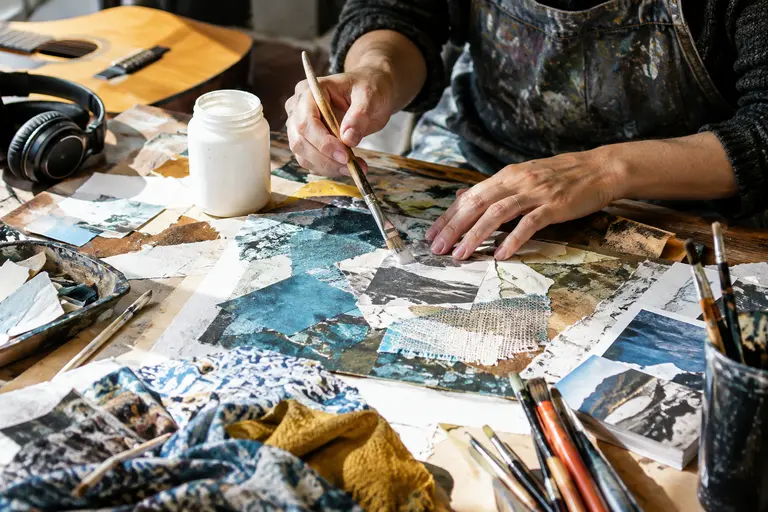
The subtitle Past Continuous comes from a 1976 Krasner painting that incorporates earlier drawings. As a title for the exhibition, the phrase is apt because it points to memory and reuse without implying repetition. Krasner’s use of earlier material in later collage-rich work suggests that an artist’s past can become active material, not just background information.
Pollock’s Autumn Rhythm: Number 30, painted in 1950, is among the major works on view, and The Met connects it to his drip technique developed between 1946 and 1951 on its exhibition announcement. In a side-by-side exhibition, that kind of anchor work can risk overpowering everything around it. The curatorial challenge is to let famous paintings remain powerful while still making room for Krasner’s long arc.
Collage As A Model For Creative Reuse
Krasner’s later use of earlier drawings has special force for contemporary creators. It suggests that unfinished material is not always failure. A sketch, draft, loop, or rejected motif can return later under different pressure. The key is not recycling for convenience; it is recontextualizing with intent.
That lesson transfers cleanly into music production. A discarded drum pattern can become a texture when resampled. A failed chord progression can become a chopped pad. A vocal fragment can move from lead idea to background rhythm. The museum context does not need to be forced into a production tutorial, but it does offer a disciplined way to think about archives: old material can carry new meaning when the frame changes.
What Krasner Pollock Collaboration Offers Creators
The most durable insight from Krasner and Pollock: Past Continuous is that artistic influence does not have to be framed as ownership, imitation, or dependency. The Krasner Pollock collaboration presented at The Met is better understood as proximity under pressure: shared life, shared time, different bodies of work, and an uneven public record that the exhibition seeks to reconsider.
For creators, that is a practical model. Work beside serious people, but protect the identity of the work. Accept critique, but do not mistake closeness for sameness. Keep archives, because sketches and fragments may become future material. Pay attention to room, scale, and labor, because creative conditions are never neutral.
The exhibition also encourages caution in how we tell art stories. Krasner should not be discussed only through Pollock, and Pollock should not be treated as isolated from the relationships and conditions around him. Holding both positions at once gives the show its force. It is not a myth of two artists merging into one voice. It is a study of two careers placed close enough for viewers to hear the tension, distance, and exchange between them.