
Distorted guitar can produce a harsh upper-frequency fizz that seems easy to solve with EQ. Find the unpleasant frequency, cut it, and move on.
The problem is that guitar fizz often refuses to stay in one place.
Different notes excite different resonances. Palm-muted riffs behave differently from sustained chords. Pick attack changes from phrase to phrase, and an amp simulator can produce treble peaks that become obvious only on particular notes. A permanent EQ cut may calm the worst moment while making the rest of the performance unnecessarily dull.
Leit Audio’s OffFizzer takes a more responsive approach.
Released on October 24, 2026, OffFizzer is a free processor for distorted guitars recorded through either miked amplifiers or amp simulators. Instead of applying the same high-frequency reduction continuously, it analyzes the signal as the guitarist plays and turns down problem areas only when they emerge.
That makes guitar fizz a moving target rather than a fixed EQ problem.
A Static EQ Cut Assumes The Problem Stays Still
A conventional parametric EQ is extremely useful when a resonance consistently occupies the same frequency.
If one frequency rings throughout an entire guitar recording, a narrow cut can solve the problem efficiently.
Distorted guitar is often less cooperative.
Distortion adds harmonics above the played notes. Change the note and the harmonic structure changes. Pick harder and the upper spectrum can become more aggressive. Move from a single-note riff into a dense chord and several resonant areas may appear at once.
A fixed cut remains in the same place regardless of what the performance does.
That can lead to overcorrection.
A producer may hear an unpleasant spike around one frequency, create a deep notch, then leave that notch active through passages where the problem does not exist.
The harsh moment improves, but the entire guitar can lose presence.
OffFizzer is designed around the opposite assumption: the treble problem can move and change in strength while the performance continues.
Fizz Off Follows Narrow Resonances As They Appear
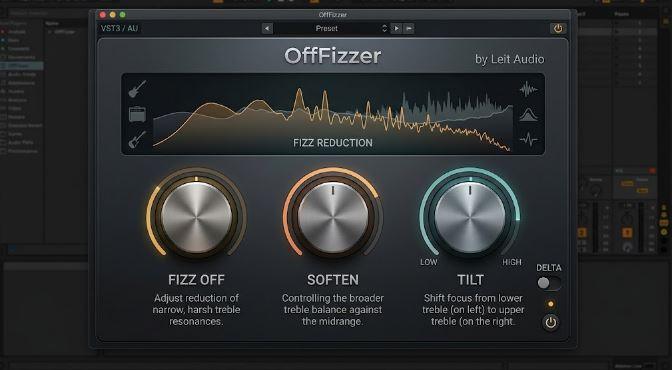
The main control is called Fizz Off.
According to the official OffFizzer page, this control targets narrow, sizzling resonances that stand out in the guitar’s treble and follows those areas as the track plays.
Leit Audio specifies a spectral resonance-reduction range from approximately 2.5 kHz to 12.5 kHz.
That is wide enough to cover much of the region where distorted guitars can develop brittle, whistle-like, or abrasive upper harmonics.
The important part is not simply the frequency range.
OffFizzer does not apply maximum reduction across that entire region all the time.
Processing reacts to what is currently present.
A harsh peak can be reduced when it becomes prominent, then the processor can back away when that resonance no longer dominates.
The guitar keeps more of its natural upper-frequency variation.
Dynamic Reduction Preserves Bite Better Than A Blanket Treble Cut
Aggressive high-frequency filtering can remove fizz, but it can also remove much of what makes distorted guitar feel immediate.
Pick attack lives in the upper spectrum.
So does string definition.
Certain harmonics help separate notes inside dense chords.
Reduce too much of that information and a guitar can become smooth but lifeless.
Leit Audio’s stated goal with OffFizzer is to “tame the fizz” while retaining bite.
That is why dynamic processing matters.
If the harshness appears only during several notes in a riff, there is little reason to remove the same amount of treble during every other note.
A processor that reacts only when a resonance crosses into problematic territory can leave more of the untreated tone intact.
This is closely related to the logic behind dynamic EQ and resonance suppression, but OffFizzer narrows the interface around one specific use case: fizzy distorted guitar.
Soften Handles A Broader Kind Of Brightness
Not every harsh guitar problem is a narrow resonance.
Sometimes the entire upper spectrum feels too bright.
OffFizzer separates that issue from Fizz Off through a second control called Soften.
The October 24 OffFizzer release report describes Soften as a broader dynamic treble-balancing process that uses the midrange as a reference.
Its operating range extends from about 2.5 kHz to 20 kHz.
This gives the plugin two related but different jobs.
Fizz Off deals with narrow resonances that jump out.
Soften addresses the broader balance of the high end.
A guitar can therefore have its most irritating peaks controlled without automatically receiving a large overall treble reduction. If the remaining top end is still too aggressive, Soften can provide the wider adjustment.
Tilt Moves The Area Where OffFizzer Concentrates
OffFizzer has only three main controls, and Tilt is the third.
Tilt shifts where both Fizz Off and Soften concentrate their processing.
Move it toward LOW and the system pays more attention to the lower part of the treble range.
Move it toward HIGH and the focus shifts upward.
This becomes useful because “fizz” does not sound identical across guitar rigs.
One amplifier or cabinet impulse response may develop harshness closer to the upper mids.
Another amp simulator may have a brittle texture higher in the spectrum.
Changing pickups, cabinets, microphones, distortion stages, or impulse responses can move the area that bothers the listener.
Tilt allows the producer to redirect the detector without manually programming several frequency bands.
The interface remains small even though the target can move.
Delta Monitoring Answers The Most Important Question
Dynamic processors can become difficult to judge because their action changes continuously.
OffFizzer includes a Delta switch to make that behavior easier to audit.
Delta plays only the material the plugin is removing.
This answers a critical mixing question:
Is the processor removing fizz, or is it removing the guitar?
A useful Delta signal should mainly reveal the abrasive components the producer wanted to control.
If Delta starts sounding like a clear, full-bodied version of the original guitar performance, the settings may be too aggressive.
This is particularly helpful with high-gain guitars because dense distortion already contains a large amount of upper-frequency energy.
Without Delta monitoring, it can be easy to keep increasing reduction simply because the processed result initially sounds smoother.
Hearing the rejected signal provides a second perspective.
The Reduction Display Shows That Fizz Is Moving
OffFizzer also provides a live Fizz Reduction display.
The visual feedback shows how reduction changes across the treble as the signal plays.
That display reinforces the main idea behind the plugin.
The problem is not necessarily one stationary spike.
Different regions can require attention at different moments.
Watch a changing guitar phrase and the reduction can move with the performance.
A sustained high note may produce one pattern.
A lower power chord may produce another.
Fast palm-muted attacks can create yet another response.
The visualization is not a substitute for listening, but it helps explain why a single fixed notch may fail.
The source itself keeps changing.
Amp Sims Can Make Dynamic Fizz Control Especially Useful
OffFizzer is designed for both miked amplifiers and amp simulators.
Amp sims make an interesting use case because their signal chains frequently include several tone-changing stages.
An amp model produces distortion.
A cabinet model or impulse response reshapes the spectrum.
Microphone emulation may add another tonal contour.
Post-EQ or saturation can change it again.
The final fizz may therefore come from the interaction of several stages rather than one obvious resonant frequency.
Changing the amp or cabinet remains the better solution when the fundamental tone is wrong.
OffFizzer makes more sense when the basic sound works but certain upper-frequency peaks still become distracting during performance.
That distinction prevents it from becoming a substitute for choosing a suitable amp tone in the first place.
Stereo Guitar Buses Are Processed As A Linked Pair
OffFizzer supports mono tracks and stereo buses.
On stereo material, processing is linked across the two channels.
That behavior matters with double-tracked guitars.
A hard-panned pair often needs to feel like one coherent wall rather than two treble processors reacting independently and pulling the stereo image around.
Linked processing can keep the response more stable across the bus.
Leit Audio recommends separate plugin instances when individual control over each guitar is required.
That gives producers two approaches.
Process each guitar before bussing if the recordings have very different fizz problems.
Use a linked stereo instance when the combined guitar bus needs one shared treatment.
OffFizzer Introduces Latency For A Reason
Dynamic spectral analysis cannot always operate with zero look-ahead or zero processing delay.
OffFizzer reports 10.7 milliseconds of latency at a 48 kHz sample rate.
Modern DAWs can compensate for that delay automatically during mixing.
The number is still relevant for players considering placing OffFizzer directly inside a live guitar-monitoring chain.
An extra 10.7 ms can be noticeable when combined with interface latency, amp-sim processing, and other plugins.
OffFizzer is therefore most naturally positioned as a mixing tool after the guitar has been recorded.
For live tracking, the complete monitoring latency should be considered before inserting it.
Dynamic Processing Should Follow Tone Selection, Not Replace It
OffFizzer can control moving resonances, but it cannot turn an unsuitable guitar sound into the right one.
If an amp simulation is fundamentally too bright, reducing its presence, changing the cabinet, selecting another microphone model, or adjusting the amplifier itself may produce a better starting point.
Likewise, a poorly chosen impulse response can introduce tonal characteristics that are better solved by choosing another IR.
OffFizzer becomes useful after those broad creative decisions have been made.
RobSonic’s guide to creative effects chains examines how processors interact across a signal path. The same logic applies here: OffFizzer should solve the specific problem it was built for rather than carrying responsibility for the entire guitar tone.
A strong signal chain still begins with a source that is close to the intended result.
Why Moving Fizz Needs A Moving Solution
OffFizzer is intentionally narrow in scope.
Fizz Off tracks narrow treble resonances.
Soften balances broader high-frequency excess.
Tilt changes where those systems concentrate.
Delta lets the producer audition only the removed material.
The live display shows how reduction changes across the spectrum.
Underneath that small interface is one important idea: distorted-guitar harshness can be dynamic.
Notes change.
Harmonics change.
Picking changes.
Chord density changes.
The troublesome frequency at one moment may be harmless a second later.
A fixed EQ notch cannot know that.
It keeps cutting whether the problem exists or not.
OffFizzer instead attempts to follow the performance and intervene only when the treble becomes objectionable.
That makes it less about permanently carving frequencies out of a guitar and more about controlling the moments when those frequencies become a problem.
For high-gain recordings that sound good most of the time but occasionally produce painful fizz, that difference can be far more useful than another static EQ curve.