
Vocoders have trained electronic musicians to think about combining two sounds in a familiar way: one signal supplies the spectral movement, while another acts as the carrier. Dystopian Waves’ NEUON – Cepstral Morph starts from a related two-source idea but gives producers a different set of decisions. Instead of treating one source mainly as a spectral envelope imposed on another, its cepstral engine separates broad formant character from finer texture and lets those components move independently between two sounds.
Dystopian Waves released NEUON on September 25, 2026 for Windows and macOS. The plugin processes a main input and a sidechain source through two distinct engines: a Cepstral Morpher and a Filterbank Vocoder. The separation is deliberate. Producers can compare conventional vocoder-style processing with a second method that treats spectral character and excitation-like texture as independently morphable material.
That makes NEUON more than another way to create a robot voice. Its strongest idea is cross-synthesis: using the recognizable characteristics of two recordings to construct a hybrid sound that may no longer feel fully owned by either source.
Cepstral Analysis Separates Spectral Shape From Fine Texture
The name “Cepstral Morph” describes the most important processing concept inside NEUON.
Cepstral analysis works with the logarithmic spectrum of a signal and can help separate broad spectral-envelope information from finer periodic spectral structure. Aalto University’s cepstrum explanation describes the smooth spectral envelope as one structure and the harmonic comb associated with fundamental frequency as another structure that can be represented differently in the cepstral domain.
That distinction has obvious applications to speech because the broad envelope relates closely to vocal-tract resonances, while the excitation carries pitch and other fine structure.
NEUON turns the same conceptual split into sound-design controls.
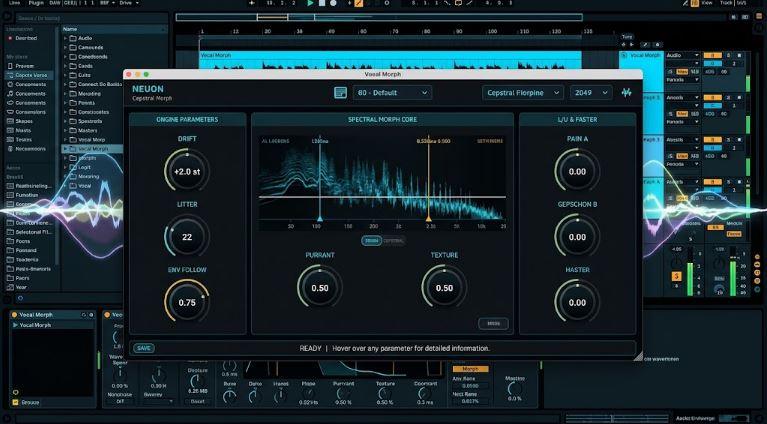
The Cepstral Morpher provides separate Formant Morph and Texture Morph parameters. Formant Morph moves the broad spectral character between the main input and sidechain source. Texture Morph works with the finer excitation-like component.
A Macro Morph control can move both together when a simpler workflow is preferable.
This means the producer does not have to treat the identity of a sound as one indivisible spectrum. The broad shape can come primarily from one recording while the finer texture moves closer to the other.
That is why “morphing” is more accurate here than a simple crossfade.
A Crossfade Changes Level While NEUON Changes Identity
A normal crossfade between two tracks is easy to predict.
At one extreme, only source A is audible. At the other, only source B remains. Halfway between them, both recordings play together at intermediate levels.
The identity of each recording remains intact.
Cepstral morphing aims at a different result.
Consider a sustained synthesizer as the main signal and a spoken voice on the sidechain. Rather than merely mixing the two, NEUON can transfer portions of the voice’s spectral character into the synth while retaining more of the synth’s fine texture.
Reverse the relationship and the hybrid changes again.
The same method can become less obvious with non-vocal sources. A drum loop and a field recording could create a texture that carries aspects of the drum’s temporal energy while acquiring broader spectral characteristics from the environment. A pad combined with percussion could gain a more articulated texture without becoming a straightforward layered mix.
Dystopian Waves’ NEUON product page presents the effect specifically as spectral sound morphing and cross-synthesis between two sources.
That positioning matters. Voice processing is one application, but the architecture does not require speech as its organizing concept.
NEUON Includes A Vocoder So The Difference Can Be Heard Directly
NEUON does not reject conventional vocoding.
It includes a separate Filterbank Vocoder engine.
Traditional vocoders divide an analyzed signal into frequency bands, measure the changing energy in those bands, and use that information to control equivalent bands in another signal. Sound On Sound’s vocoder explanation describes the familiar arrangement in which a modulator’s spectral characteristics are imposed on a carrier.
This works extremely well when the goal is recognizable articulation.
A voice provides changing vowels, consonants, and rhythmic envelopes. A harmonically rich synth provides the carrier. The result retains the classic relationship between spoken articulation and synthetic pitch.
NEUON’s cepstral engine approaches the source pair differently.
Instead of depending primarily on a fixed filterbank representation, it separates broad formant information from finer texture and exposes those components as independent morph dimensions.
That creates a useful comparison inside one plugin.
Choose the vocoder when recognizable vocoding is the objective.
Choose the Cepstral Morpher when the goal is a less literal hybrid whose source identities can be reorganized.
The presence of both engines makes the distinction practical rather than theoretical.
Formant Morph And Texture Morph Create A Two-Dimensional Sound Space
The most interesting workflow begins when Formant Morph and Texture Morph stop moving together.
Imagine the main source at one side and the sidechain source at the other.
Formant Morph can sit near the sidechain while Texture Morph remains closer to the main input. The output now combines one source’s broad spectral identity with more of the other’s fine structure.
Move only Texture Morph and a different combination appears.
These independent axes create several intermediate states that would be difficult to reproduce with an ordinary wet/dry control.
The Macro Morph parameter exists for cases where both dimensions should travel together, but separating them exposes the deeper architecture.
NEUON provides a Formant Shift control after the morphing process too. The resulting spectral character can therefore be moved independently from musical pitch.
A Lifter parameter changes the strength of the cepstral or formant component involved in the transformation.
Those controls make the effect relevant to synthetic textures, percussion, ambience, processed instruments, and experimental transitions rather than restricting it to voice manipulation.
The source pair becomes raw material for constructing a third timbre.
Frequency-Selective Morphing Prevents The Effect From Taking Over Everything
Cross-synthesis can become overwhelming when the entire audible spectrum is transformed equally.
NEUON provides Morph Frequency Range controls to avoid that limitation.
A producer can define the part of the spectrum where morphing takes place. Low frequencies might remain largely connected to the main source while the mids and highs become hybrids.
That can be useful with bass-heavy material.
A kick or bass source may depend on stable low-frequency information for weight and tuning. Morphing only its upper spectrum can introduce texture without destabilizing the foundation.
A vocal could retain part of its low-mid body while the upper spectral region takes on qualities from noise, percussion, or another instrument.
Dystopian Waves includes an interactive spectral display that shows incoming and resulting spectra while allowing the processing range to be adjusted visually. KVR Audio’s September 25 release report confirms that the range can extend from a selected frequency region to the full spectrum.
This turns spectral range into part of the morph design rather than a cleanup step performed afterward.
FFT Size Changes The Character Of The Analysis
NEUON also exposes selectable FFT sizes.
FFT size affects how spectral processing balances frequency resolution against time resolution. Larger analysis windows can describe frequency structure with greater precision but respond across a longer time span. Shorter windows provide finer temporal response with less detailed frequency discrimination.
That tradeoff means FFT size can affect more than technical quality.
Percussive material may respond differently from sustained pads. Fast transients can produce one character at a short analysis size and a smoother spectral result with another setting.
The control becomes especially relevant when two very different sources are being combined.
A sustained synth and a vocal may benefit from one analysis character. Percussion mixed with environmental recordings may react better to another.
NEUON also includes Envelope Follow, which controls how closely the processed result follows the dynamics of the main source.
Together, those parameters provide ways to manage a common cross-synthesis problem: generating an interesting hybrid without destroying the rhythmic identity that made the original source useful.
Four Drawable LFOs Turn A Morph Into An Evolving Process
A static morph position can already create a new timbre.
NEUON provides four independent custom-curve LFOs so that relationship does not have to remain fixed.
Each LFO can use a drawable modulation shape, synchronize to tempo, and target available parameters with adjustable rate and depth.
Formant Morph might move slowly between the sources while Texture Morph follows a shorter rhythmic pattern. A frequency boundary can shift across the spectrum over several bars. Formant Shift can introduce another independent motion.
This creates a different kind of cross-synthesis from simply automating one blend knob.
The spectral identity can evolve on several time scales.
A pad may slowly acquire the formant character of another sound while its texture oscillates rhythmically. A drum loop can move through different spectral relationships every bar without losing its original trigger pattern.
RobSonic has explored similar interface questions in its Iota II sampling workflow, where spectral information becomes something a producer directly traverses rather than a hidden analytical process.
NEUON uses a different technique, but the principle is related: spectral structure becomes an active compositional parameter.
Cepstral Morphing Works Best When The Sources Have Something To Exchange
Two-input effects depend heavily on source selection.
A vocoder traditionally benefits from a harmonically rich carrier because its filter bands need useful spectral energy to shape. Cepstral morphing introduces different possibilities, but the source relationship still matters.
Two nearly identical sounds may produce a relatively restrained transformation.
Strong contrasts can expose the process more clearly.
A voice paired with noise creates one type of hybrid. Percussion paired with a sustained synth creates another. Field recordings, guitars, pads, drums, spoken material, and resampled effects can all contribute different combinations of envelope and fine spectral texture.
The useful experiment is not necessarily finding the most dramatic pair.
A subtle relationship may sit inside a mix more naturally than an extreme spectral hybrid.
Frequency-range controls and independent morph parameters help manage that balance. The producer can preserve the part of the primary signal that carries its musical role and transform only the region that benefits from a new identity.
That makes NEUON potentially more useful as a production effect than a single-purpose novelty.
Why NEUON Feels More Like Cross-Synthesis Than A Vocoder
The easiest way to describe NEUON is not to argue that cepstral morphing replaces vocoding.
The plugin includes both precisely because they solve different creative problems.
A vocoder is especially effective when the spectral articulation of one signal should control another. That relationship explains the enduring talking-synth effect and many less obvious rhythmic applications.
NEUON’s Cepstral Morpher asks a broader question.
What if the spectral identity of two sounds can be dismantled into different kinds of information and recombined?
Independent Formant Morph and Texture Morph controls make that question tangible. Frequency-selective processing limits where the transformation occurs. Formant Shift moves the resulting character without transposing the musical material. FFT controls alter analysis behavior, while drawable LFOs keep the spectral relationship moving.
The outcome does not need to sound like source A wearing source B’s envelope.
It can sound like a third source.
That is the difference that makes NEUON particularly relevant to sound design.
Vocoding transfers recognizable spectral behavior.
Cepstral morphing can blur the distinction between the two inputs.
For producers interested in hybrid percussion, synthetic voices, transformed field recordings, evolving pads, spectral transitions, and textures that are difficult to trace back to one source, that ambiguity is the point.