
Sample slicing normally breaks one recording into smaller pieces. A producer imports a loop, detects transients, maps the resulting slices across MIDI notes, and starts rearranging them. Defuse Audio’s DYSEKT adds another decision after the cut: each slice can decide which part of the original mix it should contain.
Released on October 18, 2026, DYSEKT combines a slicer, drum sampler, and multisampled keyboard instrument inside one plugin for macOS and Windows. Its defining feature is local stem separation. A loaded sample can be divided into drums, bass, music, and vocals, then individual slices can use different combinations of those stems.
That turns stem separation into part of performance rather than something producers must finish before sampling begins.
One snare slice might keep only drums. Another slice from the same loop could retain vocals and music. A third could isolate bass. The sample is no longer just cut into time regions; each region can have its own internal mix.
DYSEKT Separates The Sample After You Slice It
Defuse Audio describes DYSEKT as its first instrument and positions the plugin around reducing the distance between hearing an idea and making it work.
The official Defuse Audio site describes the software as a hybrid instrument built around slicing, sampling, and stem control.
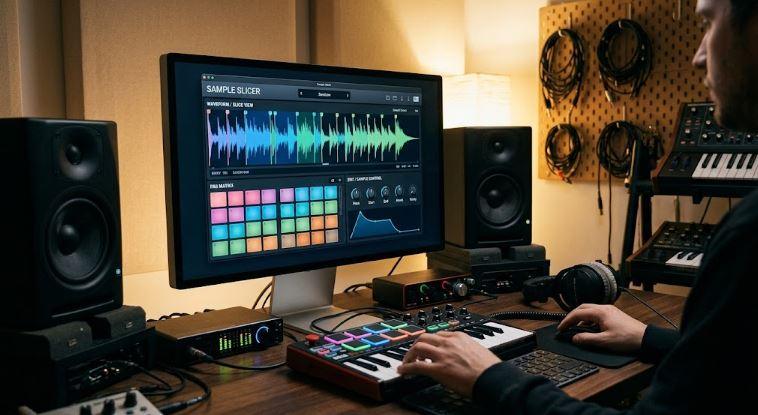
Load a loop into Slice mode and DYSEKT can cut it into as many as 128 slices. Those cuts can come from transient detection, beat divisions, regions, random slicing, or manual edits.
That alone would place it close to many modern sample slicers.
Stem separation changes the structure.
DYSEKT can divide the loaded audio into four broad components: drums, bass, music, and vocals. Processing happens on the user’s computer rather than requiring an upload to a remote service.
Each slice can then choose which stems it plays.
The sample therefore gains a second organizational layer.
The first layer asks where the recording should be cut.
The second asks what each cut should contain.
One Loop Can Become Several Different Instruments
Imagine loading a full song section rather than an isolated drum break.
The original audio contains drums, bass, instruments, and vocals together.
A conventional slicer would divide that complete mix into pieces. Trigger slice seven and everything present during that moment plays back together.
DYSEKT can behave differently.
Slice seven could keep only drums.
Slice eight might use the vocal stem.
Slice nine could combine bass and music.
Another slice could bring the entire mix back.
The producer can build a new performance from several internal versions of the same recording without first exporting four separate stem files.
That is why per-slice separation is more interesting than placing stem extraction beside a sampler.
The stems become attributes of individual triggers.
A sequence can move between isolated percussion, instrumental fragments, vocal chops, bass material, and complete sections even though every event came from one imported file.
Local Stem Processing Changes The Sampling Workflow
Stem separation has become common in DAWs and standalone utilities.
The usual workflow is sequential.
First, separate a recording.
Next, export the stems.
Then load the desired files into a sampler.
Finally, slice or arrange them.
DYSEKT folds those stages together.
Its stem process runs locally, and Defuse Audio provides two analysis engines: Fast for trying ideas and Best for higher-quality results.
That division makes sense for sampling.
Early experimentation does not always need the slowest or most detailed analysis. A producer may want to know quickly whether isolating the vocal from one slice creates an interesting phrase.
Once the concept works, a higher-quality separation can make more sense.
This structure treats source separation as an editable stage inside an instrument rather than an offline preparation task.
For producers who resample constantly, removing export-and-import steps can change how freely they experiment.
Stem Selection Can Change From Hit To Hit
The crucial phrase in DYSEKT’s design is “per slice.”
Global stem selection would still be useful, but it would create a simpler instrument. Turn vocals off and every slice loses vocals.
DYSEKT lets each slice behave differently.
That means stem choice becomes part of rhythm.
A four-hit phrase could contain:
- one drums-only slice,
- one vocal-and-music slice,
- one bass-only slice,
- and one full-mix slice.
The source material stays related because all four events came from the same recording, yet each hit has a different spectral role.
That makes arrangement changes possible without loading another sample.
A producer could even create call-and-response patterns between stems from one loop, allowing the drums to answer the vocal or letting bass appear only on selected triggers.
This is less like traditional stem playback and more like reorganizing the internal layers of a recording at note level.
Each Slice Also Gets Its Own Sound Design
Stem choice is only one per-slice parameter.
According to the DYSEKT product listing, each slice can also have its own pitch, envelope, effects, time behavior, and other playback settings.
Pitch and time processing includes Stretch, Tight, Beats, Repitch, and Cyclic modes.
Tempo synchronization can work independently for slices.
Each slice also has an ADSR envelope plus a tempo-synchronized LFO capable of modulating pitch, filter, level, and pan.
Trigger behavior includes One Shot, Gate, and Toggle, alongside reverse, looping, and note-repeat functions with swing.
This means two slices derived from adjacent moments in one sample can become completely different instruments.
One might remain rhythmically intact.
The next could be repitched and reversed.
Another might use only the vocal stem with a short envelope.
A bass-only slice could stretch across several beats.
The original recording becomes a container of smaller sound-design objects.
Sixteen Effects Make Stem Differences More Pronounced
DYSEKT includes 16 effect types.
The available processing includes EQ, filtering, drive, chorus, delay, reverb, compression, and tape-stop effects.
Effects can operate per slice or at the master level.
Per-slice placement is especially useful when combined with stem choice.
A vocal-only slice might receive delay.
A drums-only slice could use drive.
A bass fragment could remain dry and centered.
A full-mix slice might receive a tape-stop effect before the sequence returns to isolated stems.
The contrast no longer depends only on which source component is present.
Each stem combination can have its own production treatment.
This can make a single loop generate far more variation than its original arrangement suggests.
Slice Mode Is Only One Part Of DYSEKT
DYSEKT also contains Drum and Keys modes.
Drum mode provides 128 pads arranged as eight banks of 16. Producers can load separate samples onto pads and use choke groups, mute, and solo controls.
Keys mode maps samples across keyboard zones with configurable key ranges, velocity ranges, root notes, and chord memory.
SoundFont SF2 and SFZ instruments can be loaded with their mapping structures.
Those modes broaden the instrument beyond loop slicing.
A producer could begin by dissecting a full loop, then use another instance as a conventional drum sampler or mapped multisample instrument.
The shared architecture means DYSEKT can sit in several roles across one session rather than being restricted to break chopping.
Sixteen Outputs Let A Complex Patch Return To The DAW
A sampler that performs heavy processing internally can create another problem: eventually the producer may want separate mixer channels again.
DYSEKT supports up to 16 stereo outputs.
That provides a route back into conventional DAW mixing.
Groups of slices or instrument elements can leave the plugin on separate channels, where they can receive additional EQ, compression, spatial processing, or automation.
This matters for a per-slice instrument because a complicated performance can quickly contain several sonic roles.
Drum fragments may need one mixer path.
Vocal chops may need another.
Bass material may require separate low-frequency treatment.
The plugin can generate the arrangement while the DAW still handles the wider mix.
Macros Make A Detailed Patch Performable
DYSEKT includes eight bipolar macros with MIDI learn.
Each macro can control several destinations.
There are also 48 host-automation parameters assigned through 16 automation pads.
These features address a common problem with detailed samplers: once dozens of slices have different settings, performing broad changes can become difficult.
Macros create a layer above those individual edits.
One control might increase effects across several selected slices.
Another could change pitch-related parameters.
A third could reshape filters or spatial behavior across different elements.
The detailed patch remains underneath, but performance no longer requires adjusting every slice individually.
That makes the instrument more suitable for live manipulation and arrangement automation.
Per-Slice Stems Turn Sampling Into Reconstruction
RobSonic has already examined another way software can find new material inside an existing track in its article on Parallel Minds Atavism turning tracks into harmonic pads.
Atavism and DYSEKT use very different techniques.
Atavism analyzes persistent spectral information and stretches it into a sustained harmonic layer.
DYSEKT breaks a recording into playable moments, separates those moments into source categories, and lets every trigger choose which categories survive.
Both workflows challenge the assumption that recorded audio has one fixed identity.
A finished loop can become a collection of drum events.
The same loop can become vocal chops.
Bass fragments can appear independently.
Full-mix slices can return whenever the arrangement needs the original weight.
The recording becomes material for reconstruction rather than playback alone.
Stem Separation Does Not Make Every Source Perfectly Clean
Local source separation still has limits.
A dense recording contains overlapping frequencies, transients, reverberation, and harmonics that may belong to several sources at once.
A vocal and synthesizer can occupy similar spectral regions.
Bass information may overlap with a kick.
Reverb from one instrument can spread across the entire mix.
Stem algorithms have to estimate how that material should be divided.
DYSEKT’s separated components should therefore be treated as creative material rather than guaranteed access to pristine original multitracks.
For this workflow, imperfect separation can still be useful.
A vocal slice containing faint instrumental residue may create a more interesting texture than an entirely clean extraction.
The purpose is often transformation, not archival restoration.
Why DYSEKT Makes Stem Separation Feel Like An Instrument
The interesting part of DYSEKT is not simply that it can separate stems.
Many applications can do that.
The change comes from where the separation sits in the workflow.
A producer loads one sample.
DYSEKT cuts it into as many as 128 slices.
The plugin separates drums, bass, music, and vocals locally.
Every slice can select its own combination.
Each slice can then receive independent pitch, time processing, envelopes, modulation, playback behavior, and effects.
The resulting sequence can move between internal layers of the same recording note by note.
That is a very different relationship with stems.
They stop behaving like four files exported from an analysis tool.
They become choices attached to individual musical events.
For producers who already treat chopping, resampling, and rearranging as composition techniques, DYSEKT makes the source itself more flexible.
The question is no longer only, “Which part of this sample should I trigger?”
It becomes, “Which part of this moment should still exist when I trigger it?”