
Mix engineers often describe placement with physical language. A vocal sits forward. A pad lives behind it. Percussion feels wide. A bass stays centered. A backing texture occupies the edges. Those descriptions are spatial, yet the tools used to create them are usually scattered across faders, pan controls, stereo processors, reverbs, delays, and automation lanes.
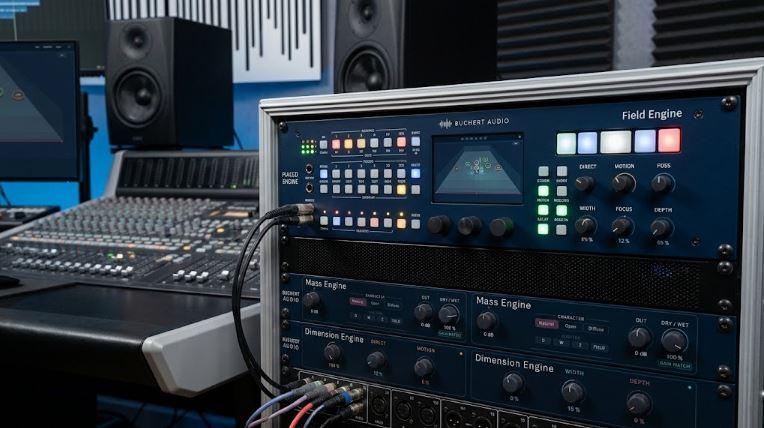
Buchert Audio’s Field Engine tries to collapse those decisions into one visual surface.
Released in September 2026, Field Engine is a macOS mixing plugin that places multiple tracks inside a shared visual field where width and perceived depth can be adjusted together. Instead of treating each channel as an isolated insert, the plugin presents mix elements as objects that can be positioned relative to one another. Buchert Audio lists version 1.0.0 at €129, with AU, VST3, and AAX support on macOS 11 or later.
That interface is the main idea. Field Engine is not trying to replace every fader, pan control, or spatial effect in a DAW. It asks whether producers can make better placement decisions when the mix is represented as one scene rather than a collection of separate channels.
Field Engine Starts With Relationships Instead Of Numbers
Traditional mixing interfaces are numerical.
A track might sit at -8 dB, be panned 22 percent left, feed a reverb at a particular level, and pass through a stereo-width processor set to another percentage. Those numbers can be accurate without making the relationship between instruments immediately obvious.
Buchert Audio’s Field Engine takes a different starting point. Every participating track appears as an object on one visual field. Its position represents perceived depth and width relative to the other sounds.
The producer can look at a bass, vocal, drums, synths, and supporting elements at the same time rather than opening each insert individually.
That changes the mental model.
A mixer no longer has to remember that one guitar is being widened by one plugin while another is pushed back through a separate reverb and gain change. The field presents those placement decisions together.
Buchert Audio describes the system as a way to focus on how sounds belong together rather than thinking only in terms of level or pan values.
That does not make the underlying audio processing less technical. It changes which information is placed in front of the user.
The visible question becomes: where should this sound feel like it is?
Depth Is More Than Turning A Track Down
One of the most useful ideas behind Field Engine is that perceived distance is not the same thing as volume.
A quieter source can still feel close. A louder source can sometimes feel distant if its spectral balance, reflections, and spatial cues suggest a larger distance from the listener.
Buchert Audio had already explored this idea with its earlier Depth Engine, released in June 2026.
Depth Engine is built around perceptual distance rather than a conventional reverb-first workflow. Buchert says it uses cues such as air absorption, early reflections, room behavior, and other distance-related processing to move a source from close to far.
Field Engine carries that concept into a larger mixing environment.
Instead of changing perceived distance on one insert and then trying to remember where every other instrument sits, the producer can compare several sources on one field.
A lead vocal might remain near the front. Backing vocals can move further away. Pads may sit deeper still, while percussion can occupy intermediate positions.
The advantage is comparative rather than purely technical. Depth becomes easier to judge when nearby and distant sounds are visible in relation to each other.
That can be especially useful in dense arrangements where several tracks are individually well processed but still compete because their spatial roles are too similar.
Width And Depth Share The Same Visual Decision
Stereo width is often treated independently from front-to-back depth.
A producer may widen a pad with one plugin, add reverb with another, change panning elsewhere, then make separate gain adjustments afterward. Each decision can work by itself while still producing a confused overall picture.
Field Engine places width and depth in the same space.
This is the central difference between it and a conventional stereo imager.
A wide sound is not represented only by a width percentage. Its relationship to the rest of the scene remains visible. A narrow sound pushed deeper into the mix occupies a different position from a wide sound that remains close.
That combination can make spatial arrangement easier to reason about.
RobSonic’s recent analysis of crusher-X 12.20 and three-dimensional granular sound approaches spatial production from a different direction. crusher-X uses grain-level movement, HRTFs, and binaural room cues to position individual events around a headphone listener. Field Engine is aimed at mix-level organization instead, but both tools reflect the same broader shift: width, depth, and movement are becoming active production dimensions rather than final-stage stereo decoration.
Imagine a mix with lead vocal, piano, pad, guitar, percussion, and bass.
The bass may remain narrow and forward enough to anchor the track. The lead vocal can stay relatively close without becoming excessively wide. The pad may move farther back and spread outward. A guitar can occupy an intermediate position, while percussion uses width without necessarily becoming distant.
The result resembles staging.
The producer is not simply asking whether individual tracks sound good. The question becomes whether the ensemble has a readable spatial hierarchy.
Spread And Smear Shape More Than A Dot On A Screen
Moving an object around the field is only part of the workflow.
When a source is selected, Field Engine exposes controls including Spread, Smear, and Gain.
Spread relates to the width or distribution of the selected sound within the field. Smear adjusts how defined or diffuse its spatial presentation becomes. Gain provides level adjustment without forcing the user back into another window.
These controls matter because spatial placement cannot be reduced to one coordinate.
Two instruments can occupy similar depth positions while having very different edges.
A close vocal may remain tightly defined. A background texture can occupy a broader, softer region. Percussion may use moderate width but retain strong definition, while an atmospheric source becomes more diffuse.
That is where the visual interface becomes more useful than a simple two-dimensional panner.
The field can show the main location, while Spread and Smear change the character of that position.
Buchert Audio’s approach reflects an idea the company has explored across its spatial products: perceived width and depth are listening outcomes rather than abstract parameter values.
Its Dimension Engine, for example, separates Width and Depth controls while adding Focus, Motion, mono-bass management, and mono compatibility tools. Field Engine takes the broader concept and applies it across several tracks at once.
Groups Turn Spatial Placement Into A Mix-Level Operation
A visual field becomes much more useful if objects can be managed together.
Field Engine includes groups for this reason.
Tracks can be assigned to groups and selected collectively, allowing the mixer to adjust related elements as a unit rather than repositioning every source independently.
That matters during real mixing work.
A group of backing vocals might need to move slightly further away after the lead vocal changes. Several percussion elements may need more overall width. A family of synth layers can be repositioned while preserving their internal relationship.
Those changes would normally involve multiple plugin windows or group automation structures.
Field Engine turns them into spatial group decisions.
The plugin includes saved views as well. Different views can represent different stages or perspectives within the same session, making it easier to move between broad balance decisions and detailed work.
This is where the interface starts behaving less like an effect and more like a session-level control surface.
The audio still exists on separate DAW tracks, but the user can inspect those tracks through one shared spatial model.
For large sessions, that overview may be more valuable than any one individual processing parameter.
The Interface Comes From A Much Older Mixing Idea
Field Engine’s visual concept did not begin as a 2026 interface trend.
According to Buchert Audio, founder Morten Büchert began thinking around 2003–2004 about a three-dimensional chessboard on which musical elements could be positioned as objects.
The goal was to express relationships through placement rather than requiring users to translate every musical intention into conventional engineering terminology first.
Research became part of the project’s development.
Buchert Audio says Büchert contacted Steven Gelineck, who was then conducting PhD research at Aalborg University. Jesper Andersen, Associate Professor at the Royal Conservatory of Music in Copenhagen, later joined the work.
The company connects that development history to research associated with the NIME 2013 period.
That background is worth mentioning because Field Engine could otherwise look like a modern graphical skin placed over standard mixing controls.
The deeper idea is older: can an interface correspond more closely to the way musicians imagine a mix?
Many people do not internally describe a desired arrangement as “reduce this channel by 1.8 dB, increase stereo width by 14 percent, and alter the early-to-late reflection ratio.”
They may think, “put this behind the singer.”
Field Engine attempts to start with that instruction.
Visual Mixing Can Reduce Parameter Switching
Modern DAWs expose enormous amounts of information.
That flexibility creates another problem: producers can spend significant time switching between parameter domains.
A spatial decision may involve gain first, then pan, followed by EQ, a stereo tool, reverb, delay, and automation. Each window represents one piece of the final perceptual result.
Field Engine does not remove those tools, but it can reduce how often the producer has to translate between them during broad placement decisions.
If a sound feels too close, the user can move it deeper. If two instruments appear to occupy the same width and depth region, one can be repositioned visually.
When a supporting element feels too dominant spatially, Spread, Smear, Gain, or placement can change together.
The value is not necessarily speed in the sense of making fewer calculations.
It is continuity.
The producer stays focused on one question: how should the elements relate spatially?
That can prevent a common mixing habit where a producer starts solving one problem, opens several processors, and eventually loses track of the perceptual goal that motivated the changes.
Field Engine keeps the scene visible.
A Visual Field Does Not Replace Listening
The strongest criticism of any visually driven mixing tool is also the most obvious one: music is heard, not viewed.
Field Engine does not change that.
A perfectly organized screen can still produce a poor mix if the spatial result does not translate to speakers, headphones, mono playback, or different listening environments.
The visual field is therefore useful as a control model, not as proof that a mix is correct.
Buchert Audio itself frames Field Engine around listening relationships. The product page encourages users to focus on one passage, hear the element they care about, then listen to everything around it before deciding what should change.
That listening-first framing is important.
Visual organization can support judgment, but it cannot replace it.
A producer still needs to check whether the lead remains intelligible, whether width survives mono playback, whether low-frequency material stays stable, and whether depth cues work at realistic listening levels.
The visual map is most valuable when it reflects decisions the ears already want to make.
Why Field Engine Feels Different From A Multi-Effect Rack
Field Engine could easily have been presented as another channel-strip-style product combining stereo width, reverb, panning, and gain.
Buchert Audio chose a different structure.
The main interface is not a row of modules.
It is the mix.
That changes the hierarchy of information.
The plugin’s individual controls matter, but they sit underneath the spatial relationship between tracks rather than becoming the first thing users see.
This is important for sound designers and producers who think spatially.
Electronic music can contain dozens of synthetic elements with no predetermined acoustic location. Unlike a traditional recording where musicians may already have occupied physical positions in a room, synthesized sounds can begin without any natural depth or width relationship at all.
A visual placement system can become part of arranging those sounds.
One texture can form the rear layer. Another can stay narrow and forward. Supporting material can spread around a central lead, while short effects occupy temporary positions without permanently changing the main structure.
This is why Field Engine feels closer to composition and orchestration than a normal utility plugin.
Spatial relationships become part of the arrangement.
Why Turning A Mix Into A Field Could Change Mixing Habits
Field Engine’s most important contribution may not be a new spatial algorithm.
It is the attempt to make several familiar mix decisions visible at the same time.
Width already exists in modern DAWs. Depth can already be created through gain, filtering, reflections, reverb, delays, and other tools. Groups and automation are standard features too.
What usually does not exist is one interface showing those decisions as a shared perceptual scene across multiple tracks.
Field Engine makes that overview its primary workflow.
That can change how a producer notices problems.
Two sounds competing for the same spatial role become easier to recognize. A mix where every element sits close to the listener becomes visually obvious. Excessive width across too many layers can reveal itself as a structural pattern rather than a problem discovered one track at a time.
Groups can move as musical families, and saved views can preserve different working perspectives.
The result is less about turning audio into graphics and more about making the producer’s internal image of a mix explicit.
Buchert Audio’s original question from more than two decades ago still sits underneath the software: what if the interface looked more like the musical space people already imagine?
Field Engine’s answer is to place depth and width on one field and let the producer arrange sounds as relationships rather than isolated parameters.
For mixers accustomed to thinking in numbers, that may require an adjustment.
For producers who already think in phrases such as “closer,” “behind,” “wider,” “tighter,” and “around the vocal,” the interface may feel surprisingly literal.