
A drum loop already contains a musical structure even when it has no pitched notes. Every kick, snare, rimshot, and hi-hat defines a pattern of attacks through time. touski’s GrooveBloom takes that rhythmic information and uses it as the trigger system for melodies, chords, and arpeggios.
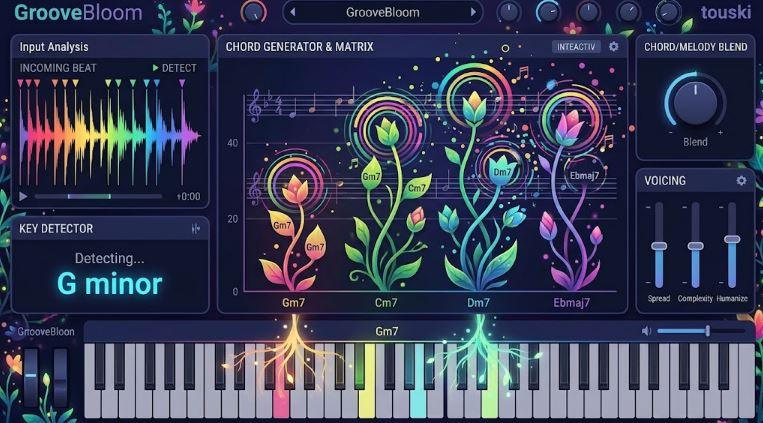
Released on October 13, 2026, GrooveBloom is a VST3 effect for Windows and macOS. The plugin listens to an incoming beat or sample, detects its transients, analyzes key and chord information, and generates pitched notes on the detected hits. Those notes can be played through GrooveBloom’s internal sounds or sent as MIDI to another instrument.
The result is a different way to write around drums.
Instead of programming a melody beside the beat, GrooveBloom asks what melodic line the beat’s own accents could produce.
The Transient Engine Turns Rhythm Into Note Triggers
GrooveBloom begins with transients.
Put the effect on a drum loop, full beat, or other rhythmic recording and its analysis engine looks for individual attacks. Each detected hit becomes a potential moment for a note or chord.
The official GrooveBloom page gives producers control over sensitivity, gate behavior, and rhythmic grids ranging from quarter notes to thirty-second notes, including triplet divisions and swing.
Those controls matter because drum recordings are rarely uniform.
A loud kick is easy to identify.
A quiet ghost note may or may not deserve to trigger a melody note.
Hi-hats can generate extremely dense patterns if every small attack becomes an event.
Sensitivity determines how much of that rhythmic detail enters the melodic system. Gate and grid settings can restrain the result further.
The drum pattern therefore supplies the timing skeleton, but the producer decides how much of that skeleton should become pitch.
GrooveBloom Also Needs To Know Which Notes Make Sense
Rhythm alone cannot create a coherent melody.
GrooveBloom also analyzes key and chord information.
touski says the plugin can detect key and chords live, with an Auto mode that follows changes in the incoming material. Producers can also choose the harmonic information manually.
Once a key is established, triggered notes stay connected to that scale.
This separates timing from harmony.
The drum hits determine when events occur.
The detected or selected key determines which notes are available.
That division is what lets a non-melodic rhythmic source become a pitched part without simply converting drum frequencies directly into notes.
A kick does not become a low note because its fundamental happens to sit near one pitch. It becomes a rhythmic instruction inside a harmonic system.
Four Play Modes Change The Role Of The Beat
GrooveBloom provides four main play modes: Melody, Chords, Both, and Arpeggio.
Melody assigns single notes to detected hits.
A busy hi-hat pattern can therefore create a fast melodic figure, while a sparse kick-and-snare loop can generate a much simpler phrase.
Chord mode uses hits to trigger complete harmonies.
That changes the relationship immediately. A drum groove that originally supplied only rhythm can begin articulating a chord progression with exactly the same accents.
Both combines melodic and chordal behavior.
Arpeggio breaks the harmonic material into sequenced notes instead of presenting each chord as one block.
KVR Audio’s GrooveBloom release report also notes chord options running from basic triads through Add9 voicings, with a strum control for less mechanical chord attacks.
One beat can therefore support several completely different musical roles without changing the original drum pattern.
A Kick Pattern Can Become A Bassline
One of the most practical uses for GrooveBloom is bass generation.
Kick patterns already describe where a producer often wants low-frequency emphasis.
If GrooveBloom follows those kick transients and sends scale-aware MIDI to a bass synth, the rhythm of the bass line can become tightly connected to the drums from the beginning.
That does not mean every kick must trigger the same root note.
Melody mode can move through different scale tones while retaining the rhythmic placement of the detected hits.
The result may feel more connected than writing a bass line independently and adjusting its timing afterward.
A producer can still edit or replace the generated phrase. GrooveBloom simply provides another starting point.
This is especially relevant in trap, drill, R&B, and other styles where drum placement and bass phrasing often interact closely.
The plugin’s own sampler also supports pitch detection and 808-style glides, reinforcing that use case.
Snare And Percussion Patterns Can Suggest Countermelodies
The same process becomes more unusual when GrooveBloom listens to something other than the kick.
A snare pattern contains accents that differ from the low-end rhythm.
Percussion may contain syncopations absent from the main beat.
Hi-hats can provide fast subdivisions.
Any of those patterns can become melodic timing.
A producer could feed a percussion loop into GrooveBloom and route its MIDI output to a pluck synth. The resulting line would inherit the percussion’s rhythmic identity without sounding like percussion.
That makes the plugin useful for countermelodies.
Instead of inventing another rhythm for the secondary musical part, the producer can borrow one that already exists inside the groove.
The arrangement gains another layer, but its timing remains related to the beat.
Loop Lock Turns A Generated Idea Into A Repeatable Motif
Generative systems become difficult to arrange if the result keeps changing.
GrooveBloom addresses that with Loop Lock.
The plugin can lock a generated line for one, two, four, or eight bars. Freeze can hold the motif as well.
That means the producer can explore until an interesting phrase appears, then preserve it.
This is an important difference between continuous generation and composition.
Generation supplies possibilities.
Locking chooses one.
Once a motif is stable, it can function like any other repeated musical phrase. The producer can build sections around it, automate its sound, print MIDI, or change the surrounding harmony.
The beat may have created the initial idea, but the chosen phrase can become part of a deliberate arrangement.
MIDI Output Makes GrooveBloom More Than Its Factory Sounds
GrooveBloom includes 32 internal sounds and 25 presets.
The onboard selection covers leads, bells, keys, pads, strings, choir-like sounds, basses, plucks, and other production-oriented material. Effects include drive, chorus, delay, reverb, and pump.
Those sounds make it possible to hear the generated material immediately.
MIDI output is the more flexible feature.
touski lets GrooveBloom send every generated note to another instrument. That could be a wavetable synth, FM instrument, sampler, hardware synth routed through the DAW, or almost anything capable of receiving MIDI.
This separates composition from timbre.
GrooveBloom can decide what notes should happen and when.
Another instrument decides what those notes sound like.
That distinction makes the plugin useful even for producers who never use its internal sound library.
Your Own Samples Can Become The Instrument Too
GrooveBloom also includes a sampler.
Users can load WAV or MP3 files, and the plugin detects pitch information so the sample can be played melodically.
This opens another route from rhythm into sound design.
A producer might load a vocal chop, bass hit, found sound, or short instrument recording, then let drum transients perform that sample across the scale.
The source sound can remain highly recognizable while its rhythmic behavior comes from an unrelated beat.
That creates a three-part relationship:
the drums provide timing,
the scale provides pitch constraints,
and the loaded sample provides timbre.
The same rhythmic analysis can therefore produce very different results simply by changing the sound source.
Auto Harmony Can Follow A Changing Sample
GrooveBloom’s Auto mode is designed to react when the harmonic context changes.
That matters when the source is more than an isolated drum loop.
A complete beat may contain chords, bass, or melodic material alongside percussion. If the harmonic content shifts through a progression, Auto mode can follow that change rather than forcing one fixed chord across the whole section.
This gives generated notes a better chance of remaining related to the source.
Manual control remains useful when the producer already knows the desired key and progression.
Auto is more interesting when the goal is discovery.
The plugin can listen to the arrangement and let the rhythm drive new notes inside the harmonic context it detects.
The limitation is straightforward: automatic analysis should still be checked by ear. Complex samples, ambiguous chords, or heavily processed material may not always produce the interpretation a musician wants.
Zero Latency Keeps The Rhythm Relationship Tight
touski specifies zero-latency operation for GrooveBloom.
That is important for a tool built around transient detection.
If generated notes consistently appeared late, the entire concept would lose its connection to the beat.
The developer also states that exported results match playback regardless of audio buffer size.
That makes the plugin practical for real-time experimentation as well as rendering.
A producer can change transient sensitivity and hear the melodic consequences immediately.
Different grids can be auditioned without printing audio first.
MIDI can drive another synth in real time.
The relationship between drum hit and generated note remains the central interaction rather than an offline analysis step.
GrooveBloom Fits A Wider Shift Toward Reusing Existing Musical Information
RobSonic has covered a related approach in its article on Parallel Minds Atavism turning a track into its own harmonic pad.
Atavism and GrooveBloom work very differently.
Atavism finds persistent spectral material and stretches that information into a harmonic bed.
GrooveBloom extracts rhythmic events and uses them to trigger new pitched material.
One listens for what lasts.
The other listens for what hits.
Both point toward the same creative idea: a recorded track may contain more compositional information than its obvious surface role suggests.
A drum part can contain the rhythm of a melody.
A finished track can contain the harmonics of a pad.
Software can expose those relationships without requiring the producer to rebuild everything manually.
The Plugin Does Not Replace Writing Melodies
GrooveBloom can generate useful material, but a generated line is not automatically a finished melodic idea.
The rhythm may be excellent while the note order feels unmemorable.
A detected chord may be technically compatible but less interesting than another voicing.
A busy percussion pattern may create too many melodic events.
Loop Lock can preserve a promising result, but selection still matters.
That is where GrooveBloom works best as a compositional partner rather than a replacement for musical judgment.
The plugin can propose.
The producer can keep, edit, simplify, reroute, or discard.
Its strongest contribution is narrowing the distance between rhythm and pitch.
Why Drum Hits Can Become A Writing System
GrooveBloom changes the question a producer asks of a beat.
Normally the drum pattern answers a rhythmic question:
Where should the hits happen?
GrooveBloom uses those same events to ask a melodic one:
What if every important hit also became a note?
Transient detection finds the events.
Key and chord analysis provides the harmonic boundaries.
Melody, Chords, Both, and Arpeggio modes decide how those events become pitched material.
Loop Lock preserves useful discoveries.
MIDI output lets another instrument perform them.
The sampler can replace the factory timbres with the producer’s own audio.
Nothing about the original drum performance needs to change.
The beat simply takes on another role.
That is why GrooveBloom’s concept is more useful than calling it a random melody generator. Its timing already belongs to the track.
The melody grows from the groove that was there first.