
As of October 14, 2026, photography MFA trends can be read with unusual clarity through the Smithsonian American Art Museum’s fall photography programming. The museum’s exhibition Much Here Is Beautiful: Photography Surveys of the U.S. Bicentennial opened on September 18, 2026, and is on view through April 18, 2027. The Smithsonian describes the show as an assembly of photography surveys made just before and after the 1976 U.S. Bicentennial, with attention to national identity during a period of social upheaval Smithsonian fall guide.
For creators, that framing matters. Photography is not being treated only as a clean finished image or a portfolio category. It is being treated as evidence, memory, argument, and structure. That is close to how I think about sample selection in beatmaking: the source carries meaning before any processing starts. An archive photo, like a sampled drum break, has context attached to it. Graduate artists who ignore that context risk making thin work, even when the surface looks strong.
Photography MFA Trends At SAAM
Photography MFA Trends In The Archive
One reason the SAAM exhibition is useful for reading photography MFA trends is that it places historical survey work back into public view rather than isolating contemporary practice from the past. MFA programs often ask artists to defend not only what an image shows, but why that image should exist, what systems shaped it, and how viewers might read it across time. The Bicentennial material gives students a concrete model for that kind of critique.
The Smithsonian’s dates also matter. The exhibition does not simply point to 1976 as a patriotic marker. According to the museum’s description, the photographs come from the years just before and just after the Bicentennial and speak to national identity during social strain. That makes the show useful for artists thinking about documentary practice, regional surveys, public memory, and the limits of national storytelling.
What The Bicentennial Surveys Add
For an MFA photographer, the value is not only in studying old prints. It is in asking why surveys were made, who was included, who may have been left out, and how a museum changes the meaning of those surveys by exhibiting them in 2026 and 2027. That question is creative, not only academic. It can shape sequencing, caption writing, installation choices, and the decision to work with still images, video, text, or sound.
I hear a similar issue in music production. A loop pulled from a dusty record can feel powerful, but the producer has to decide whether the sample is being honored, flattened, or used as a texture with no care for origin. Photography students face a related test with archives. The strongest work often comes from asking harder questions before making the edit.
Why Archives Are Driving The Critique
SAAM’s Collection As Study Material
SAAM’s photography collection spans more than 9,000 works, from early sources to contemporary artists including Carrie Mae Weems and Trevor Paglen SAAM photography collection. The museum also identifies major holdings such as the only publicly held set of Diane Arbus’s A Box of Ten Photographs, more than 100 photographs by Irving Penn, and Martha Rosler’s House Beautiful: Bringing the War Home. Those holdings give graduate students a wide range of approaches to portraiture, fashion image-making, critique, montage, documentary address, and institutional context.
For photography MFA trends, the lesson is that archives are not passive storage. They are active teaching tools. A student can compare how different artists build authority, question power, or stage intimacy. A faculty critique can move from lighting and composition into ethics, class, war imagery, gender, race, authorship, and display. The museum setting does not answer those questions for the student, but it gives the critique firmer ground.
From Image Quality To Image Position
Technical skill still matters. Focus, print quality, exposure, scale, and installation can shape whether a project communicates. Yet the Smithsonian material suggests that image position is just as important: where an image sits in history, what social forces surround it, and how it is presented now. That is a useful correction for students who may feel pressured to chase polish before meaning.
For those who navigate through various platforms, Kay Granger serves as a complementary resource within our network, rather than a direct reference for the museum details discussed in this article. The foundation relies on the Smithsonian’s data and the exhibition’s context.
MFA Program Pressure And The Museum Counterweight
Signals Without Overclaiming
The research notes for this piece point to pressure on graduate photography education, including reported program closures and financial strain at some institutions. That information should be handled carefully because one school’s decision does not prove a universal collapse of graduate photography study. What can be said with more confidence is narrower: museums such as SAAM continue to present photography as a serious field of historical and contemporary inquiry, while some MFA programs are being asked to justify cost, enrollment, and purpose.
That tension affects photography MFA trends because students are being pulled between two realities. On one side, major collections and exhibitions treat the medium as culturally central. On the other, graduate education can face budget limits and changing student demand. A responsible program response would not be to reduce photography to job training only. It would be to make the program’s value clearer: research skills, visual argument, ethics, installation, archival practice, and cross-media fluency.
Lessons For Artists Who Work Across Media
Cross-media practice is not a substitute for photographic thinking, but it can help students extend an idea. A project might begin with an archive image, then move into video, sound, performance, book form, or installation. That kind of movement is familiar to producers who start with a field recording, chop it into rhythm, and then build harmony around the texture. The source remains traceable, but the final work gains structure through editing choices.
That cross-media habit also connects with our analysis of fashion influence art, where exhibitions are treated as prompts rather than templates. The ethical point is similar: study influence closely, but do not copy an artist’s signature language for commercial deception.
How Creators Can Study The Show
A Producer’s Reading Method
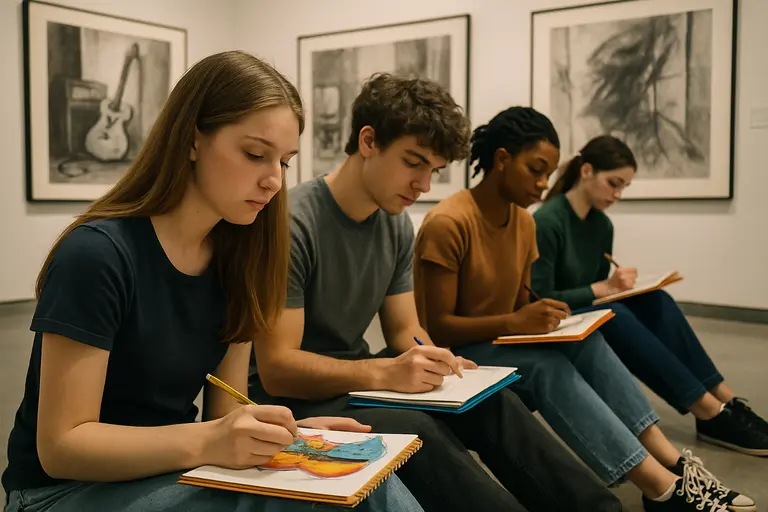
For photographers, beatmakers, designers, and visual-minded musicians, the SAAM exhibition can be approached like a listening session. Do not only ask whether a photograph is beautiful. Ask what rhythm the sequence creates, what gets repeated, where tension enters, and how the work frames place or identity. In music terms, the edit is the arrangement.
A practical study method can stay simple:
- Track how the exhibition moves from one body of images to another, and note where the shift changes your reading.
- Identify one photograph that depends on context more than surface impact, then write down what context changes.
- Compare documentary distance with personal address, especially where the image seems to speak for a community.
- Translate one curatorial idea into a non-photographic sketch, beat, garment, or installation plan without copying the source image.
This process keeps museum research active. The goal is not to imitate the Bicentennial surveys. The goal is to understand how images build meaning through time, grouping, and public presentation. That is where photography MFA trends become useful outside the university, especially for creators who move between image, sound, and physical display.
Photography MFA Trends And Creative Practice
Photography MFA trends are easiest to discuss when the claims stay grounded. SAAM’s fall exhibition does not prove where every MFA program is headed. It does show that museum photography remains deeply tied to archives, national identity, public memory, and critical viewing. Its collection depth, including more than 9,000 works and major holdings across documentary, portrait, fashion, conceptual, and contemporary practices, gives students and independent artists serious material for study.
The stronger takeaway is practical. Graduate photography work can benefit from historical contact, not just new equipment or current visual taste. A student looking at SAAM’s fall exhibition can ask better questions about why an image exists, how it is grouped, and what responsibility comes with representing people, places, or conflict. For music producers and other creators, the same discipline applies: sources matter, context changes meaning, and the edit is where raw material becomes a position.
That is why photography MFA trends should not be reduced to software, market demand, or one school’s budget decision. The more durable shift is toward artists who can read images critically, work with archives responsibly, and build projects that hold up under close cultural scrutiny.