
A sampler usually preserves a recording. Load a piano note, field recording, vocal fragment, or metallic hit and the instrument plays that audio back at different pitches. AudioThing’s Materia starts from a more radical question: what if the sample could be dismantled into the harmonic components that make it recognizable, then rebuilt as a new synthesizer?
AudioThing released Materia 1.0 on October 12, 2026, with broader release coverage appearing on October 13. The company describes it as an additive re-synthesizer that analyzes a loaded sample into as many as 96 harmonic partials. Each partial carries its own frequency, amplitude, phase, and evolving envelope.
Those components become editable synthesis material.
The source can remain recognizable, but Materia also lets producers redraw partial behavior, change spectral balance, add resonant physical-material characteristics, apply filtering and modulation, then play the reconstructed result polyphonically.
That is what makes Materia more interesting than another sample-based instrument. The recording stops being one fixed waveform and becomes a map of interacting harmonics.
Resynthesis Starts By Taking The Sample Apart
AudioThing’s Materia additive re-synthesizer begins with analysis.
Load a sound and the plugin examines its harmonic structure. Materia then represents that source through individual partials rather than relying only on conventional sample playback.
A partial can be thought of as one sinusoidal component contributing to the larger sound.
A simple tone may contain a relatively clear fundamental plus harmonics above it. A complex recording can contain many interacting spectral components whose levels change continuously over time.
Materia tracks those differences.
AudioThing gives each analyzed partial its own frequency, amplitude, phase, and complex envelope. The plugin supports up to 96 partials, with 128-point envelopes available for shaping their evolution.
The result is not simply a photograph of the sample’s spectrum.
It is a reconstruction model.
When the producer changes that model, Materia resynthesizes the sound from the altered components.
That creates a different editing relationship from cutting or stretching a waveform.
The Spectrum Becomes Something You Can Redraw
Traditional sample editing works primarily in time.
A producer chooses where the sample begins, moves loop points, reverses a region, changes playback speed, or rearranges slices.
Materia shifts attention toward spectral structure.
If one region of the harmonic map is too strong, it can be reshaped. Partials can evolve differently from the original analysis. The balance between lower and upper harmonics can change, altering the perceived brightness and character of the reconstructed instrument.
This means a familiar sound can retain some of its identity while losing the precise spectral behavior that originally defined it.
A recorded metal object could become smoother.
A vocal-like sample could turn into a sustained synthetic texture.
A short acoustic note might develop a harmonic envelope that lasts far beyond the original recording.
The interesting part is that the transformation still begins with real source material.
Materia is not asking the producer to construct every oscillator manually.
The sample provides a spectral blueprint, and the user decides how closely the new instrument should follow it.
Ninety-Six Partials Make Additive Synthesis More Approachable
Additive synthesis is conceptually straightforward but can become tedious.
In its pure form, a sound is constructed by combining multiple sine-wave components. Each component can have its own frequency and amplitude, and changing those relationships changes the resulting timbre.
The challenge is scale.
Programming dozens of individual partials by hand quickly becomes impractical.
Materia avoids that blank-page problem by starting with analysis.
The sample supplies the first set of relationships.
Instead of asking a musician to determine where 96 harmonics should begin, the plugin extracts an initial structure from the recording.
The producer can then exaggerate, simplify, distort, or reorganize it.
This makes additive synthesis feel closer to editing than mathematical construction.
A sound designer does not need to know the exact harmonic recipe for a struck piece of glass before starting. Record or load something with the desired character, let Materia analyze it, and work outward from the resulting structure.
That approach can make an otherwise technical synthesis method much easier to explore.
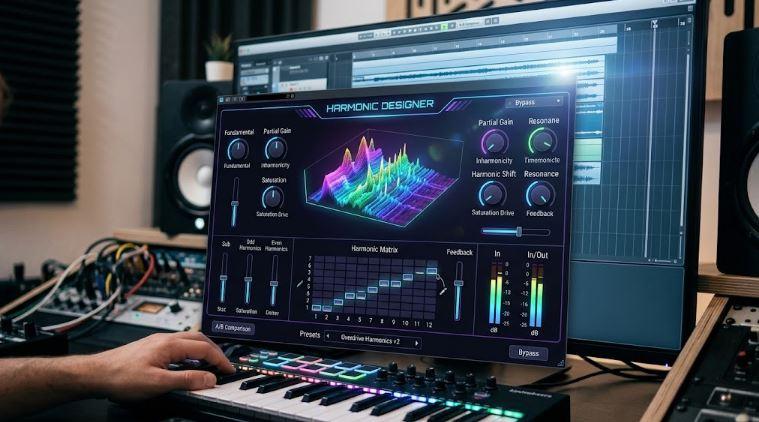
Every Partial Can Change Over Time
A static spectral snapshot is not enough to recreate most real sounds.
A piano note changes after the hammer strike.
A plucked string starts with bright transient energy before settling.
A vocal vowel develops as the mouth and vocal tract move.
Materia accounts for that time dimension by giving analyzed partials complex envelopes.
AudioThing lists 128-point envelope resolution, allowing partial behavior to change throughout a note rather than remaining fixed.
This is where resynthesis becomes especially useful for transformation.
The producer can preserve the frequencies that identify a sound while changing how quickly their amplitudes appear or disappear.
A percussive source can become slow and sustained.
A smooth source can gain more sharply articulated spectral motion.
Upper harmonics may fade differently from lower ones.
The resulting instrument can therefore keep spectral traces of the sample while developing an envelope that the original recording never contained.
The sample becomes a starting state rather than an unchangeable performance.
The Resonator Adds Physical Character After Analysis
Materia also contains an algorithmic resonator.
AudioThing provides material-inspired models including pipes, plates, glass, wood, stone, gongs, membranes, and springs.
These do not change the original sample recording itself.
They act on the resynthesized material, adding another layer of resonant behavior.
This creates interesting combinations because the spectral identity and physical-material character do not need to come from the same source.
A soft vocal analysis could feed a metallic resonator.
A noisy field recording might acquire plate-like resonance.
A short synthetic sample could develop qualities associated with glass or a membrane.
That separation is useful for sound design.
The source determines one layer of identity.
The harmonic edits reshape it.
The resonator then introduces another acoustic suggestion.
Materia can therefore move increasingly far from the recording while still retaining a traceable path back to it.
Filters And Modulation Push The Resynthesis Into Synth Territory
Once Materia reconstructs the source, it behaves increasingly like a synthesizer.
AudioThing includes a filter section with 10 types, two envelopes, and two LFOs with fully drawable waveforms.
The LFOs are particularly useful because a resynthesized spectrum does not need to remain stable.
Harmonic brightness can move.
Filter behavior can shift.
Other parameters can evolve across a sustained note.
The instrument also includes four effects: resonator, tap echo, multi-stage phaser, and waveshaper.
Those processors can make the distinction between sampled source and synthesized result increasingly difficult to hear.
That is part of the appeal.
A producer can begin with an easily recognizable recording, manipulate its spectral model, then process the reconstructed sound until only fragments of the original identity remain.
Materia turns sampling into a route toward synthesis rather than treating synthesis and sampling as separate workflows.
Polyphonic Playback Changes The Role Of One Recording
A normal recording represents one event.
Materia turns its analysis into a playable polyphonic instrument.
That matters because the original sample may never have been intended to function melodically.
A single struck object can become a keyboard patch.
A vocal fragment can become a chord instrument.
A field recording can provide harmonic material for sustained notes.
A short acoustic sound may turn into a playable pad after its partial envelopes are reshaped.
The transformation works because Materia is not simply stretching the same audio file across the keyboard.
It reconstructs the analyzed harmonic model at different pitches.
That gives producers another route for turning unusual recordings into pitched instruments.
The best source does not necessarily need to sound musical before analysis.
It needs to contain spectral information worth exploring.
Brightness And Contrast Work Like Spectral Macro Controls
Editing dozens of partials individually can still become complicated.
Materia includes Brightness and Contrast controls that provide broader access to the analyzed spectrum.
Brightness changes the overall relationship between lower and higher spectral information.
Contrast can make differences across the partial structure more pronounced or restrained.
These kinds of macro controls are useful because detailed additive editing and performance-oriented editing require different levels of precision.
A sound designer may spend time redrawing envelopes for individual components.
During arrangement, the same patch may only need to become darker, sharper, softer, or more pronounced.
Broad spectral controls make those adjustments faster without forcing the user back into partial-level editing every time.
This is another way Materia makes additive resynthesis feel more like an instrument and less like an analysis laboratory.
Materia Can Sit Between Sampling And Spectral Sound Design
Materia fits a wider change in experimental music software: recorded audio is increasingly treated as a structure that can be reorganized rather than simply played back.
RobSonic’s existing guide to creative sound processing with reverb, delay, and distortion examines the same broader creative principle from an effects perspective. Processing becomes interesting when it changes the role of a source instead of only polishing it.
Materia moves that transformation deeper into the sound.
Reverb changes what surrounds a recording.
Distortion changes its harmonic content.
Materia first analyzes the harmonic content, reconstructs it, and then lets the producer alter the components used in that reconstruction.
That gives the instrument a particularly direct relationship with timbre.
The producer is not only processing the finished sound.
The producer can edit part of the structure from which the new sound is rebuilt.
The Original Sample Still Defines What Materia Has To Work With
Resynthesis does not make source choice irrelevant.
A harmonically rich recording provides different information from a simple sine tone.
A sustained source gives the analysis different temporal behavior from a sharp transient.
Noise-heavy recordings can produce different reconstruction challenges from clearly pitched instruments.
Materia can transform those sources aggressively, but the initial analysis still matters.
That creates a useful workflow for sound designers.
Instead of searching only for a sample that already sounds like the finished patch, they can search for one with interesting harmonic behavior.
A bell does not need to remain a bell.
A voice does not need to remain a voice.
A mechanical recording does not have to stay mechanical.
The question becomes whether the source contains a spectral structure worth rebuilding.
Materia Arrives As A Cross-Platform Instrument
AudioThing lists Materia for macOS, Windows, and Linux.
Formats include VST2, VST3, AU, AAX, and CLAP, with AU available on macOS. The minimum specifications list a 2 GHz processor and 4 GB of RAM.
Version 1.0 launched with an introductory price of $39 through October 31, 2026, compared with the regular $69 price. KVR Audio’s October 13 Materia release report independently confirms the additive resynthesis workflow, supported platforms, formats, and launch pricing.
AudioThing also offers a demo, though saving is disabled and the demo periodically inserts silence.
For producers interested in spectral sound design, that makes the underlying workflow straightforward to test with their own source recordings.
Why Materia Makes A Sample Feel Editable At The Harmonic Level
Materia’s strongest idea is not simply that it can turn a sample into a synthesizer.
Samplers have done that for decades.
The difference is what happens between loading the recording and playing it.
Materia analyzes the source.
It separates the sound into as many as 96 partials.
Those partials receive frequency, amplitude, phase, and envelope information.
The producer can reshape their spectral balance and evolution.
Resonators, filters, modulation, and effects can then move the reconstruction further from its origin.
That changes what “editing a sample” means.
The waveform is no longer the only object available for manipulation.
Its harmonic construction becomes editable too.
For producers who hear an interesting texture in an everyday recording but wish they could reach inside it and rearrange the parts that create its timbre, Materia makes that idea unusually literal.
The sample becomes a map.
The harmonics become the material.
The finished instrument can go somewhere the original recording never could.