
Festival weather audio is not only a systems-engineering topic. For mixers, playback engineers, system techs, and audio directors, recent storm disruptions show why sound reinforcement has to be planned as a safety-aware workflow before anyone touches EQ. The most useful lesson is also the least glamorous: a great outdoor mix depends on gear, rigging, power, communication, and decision authority surviving long enough to protect people first.
As a sound designer and instructor, I tend to separate creative decisions from risk-control decisions. Outdoor festival work proves that the two are connected. If a storm forces a mute, a power cut, or an evacuation announcement, the sound system becomes part of the safety chain. If wind changes coverage across a field, the mix engineer may need to adjust tonal balance without chasing every short gust. If rain, heat, or dust stresses equipment, redundancy and environmental protection matter as much as the console file.
Festival Weather Audio Starts With Safety
Festival Weather Audio And Decision Points
Weather-aware reinforcement begins before the audience arrives. The research cases point toward explicit thresholds for wind, lightning, rain, heat, and site access. Those thresholds should be tied to audio actions that are clear enough for a tired crew to follow under pressure: mute the PA, secure powered loudspeakers, protect consoles, preserve comms, and hand the system over for evacuation messaging if that remains safe.
The mix position should not be the place where those calls are improvised. FOH can report what is happening sonically and operationally, but storm decisions need preassigned authority. That matters because live engineers are trained to keep shows moving. In dangerous weather, the better professional choice may be to stop feeding the system, reduce the number of energized circuits, and protect the signal path for announcements only if production leadership has approved that mode.
Why A Clean Mute Is A Production Feature
A rapid mute is not just a panic button. It is a designed state. The PA should be able to move from show level to a predictable low-risk condition without loud thumps, DSP errors, or confusion between FOH, monitors, stage power, and delay towers. That means clear mute groups, labeled emergency scenes, disciplined gain structure, and a power plan that does not make one unsafe action depend on another.
For engineers who usually think in creative terms, this can feel administrative. It is still audio work. A shutdown scene is part of the show file, just like a vocal snapshot or playback stem route. If the weather plan calls for spoken instructions, those channels need priority routing, protected power where appropriate, and a path that is understood by more than one operator.
What The Pohoda And Medusa Cases Show
Pohoda Festival In July 2024
At Pohoda Festival at Trenčín Airport in Slovakia, a severe storm on July 12, 2024 brought a reported downburst, about 95 km/h winds, and heavy rain. A large tent stage collapsed, 29 people were injured, and organisers canceled the rest of the festival after inspections found compromised structures, according to NME. The audio lesson is not that sound caused the incident. The lesson is that temporary structures, flown systems, power, and communications can become interdependent under extreme weather stress.
For sound reinforcement teams, that points toward more conservative planning around delay towers, flown arrays, cable paths, and powered equipment placed near temporary structures. If a structure is compromised, a mix engineer’s useful options shrink quickly. Audio routing should allow parts of the system to be isolated, muted, or abandoned without taking down every communication path at once.
Medusa Festival In August 2022
At Medusa Festival in Cullera, Valencia, on August 13, 2022, strong winds hit the event, parts of the main stage and other structures collapsed, one person was killed, and the festival was suspended, as described in an IQ Magazine account. The report is a reminder that wind load is not an abstract line in a production document. Loudspeakers, video walls, lighting, scenic elements, and roofing can all add exposure to temporary architecture.
Audio teams do not certify structures, and they should not pretend to. Their responsibility is to coordinate with rigging, staging, power, and site operations so the sound system does not become a separate risk. That includes asking whether flown audio can be lowered, whether ground-stacked systems are secured, whether stage boxes and amplifiers are protected from water ingress, and whether FOH can stay functional long enough to support agreed safety communication.
Mixing Under Wind, Rain, Heat, And Dust
Wind Changes The Mix You Think You Made
Outdoor mixing is partly an exercise in accepting that the air is not neutral. Wind can shift perceived high-frequency balance and coverage, especially over longer audience distances. A cautious engineer should avoid dramatic EQ swings every time the field changes, because that can make the system unstable for listeners in better-covered zones. A more controlled response is to use measurement positions, delay-system reports, and system-tech communication to decide whether the problem is broad enough to justify a change.
This is where festival mixing differs from studio mastering. In mastering, playback conditions are not perfect, but the engineer can make decisions in a controlled room. Outdoors, the “room” changes. The practical answer is margin: headroom in the system, restrained high-frequency correction, and clear communication between FOH and system engineering. For more context on stage-scale audio choices, RobSonic’s related piece on live sound gear lessons pairs well with this safety-focused view.
Rain, Heat, And Particles Affect Reliability
Rain can threaten connectors, power distribution, consoles, stage boxes, and monitor positions. Heat can stress amplifiers, DSP hardware, and computers. Dust or sand can affect cooling and controls. The research notes include large outdoor events affected by storms, mud, heat, and particulate exposure, so the supported takeaway is practical rather than dramatic: protect the weak points before the show file becomes the least of your problems.
That protection includes elevated cable runs where flooding is plausible, weather-resistant covers that do not trap heat, sealed or protected connectors, spare network paths, and UPS support for key control equipment. None of those choices make bad weather safe by themselves. They do make it more likely that the audio team can reach a planned safe state instead of fighting cascading failures.
System Design Choices For Faster Recovery
Modular Routing Beats One Large Failure Point
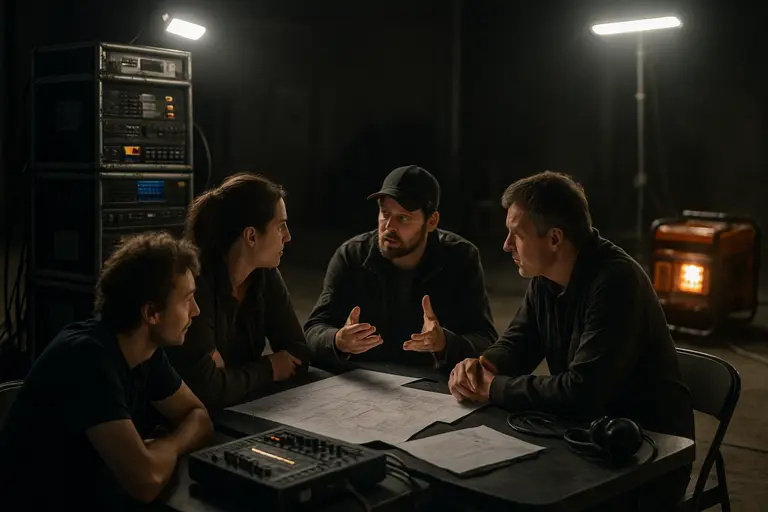
A festival weather audio plan benefits from modular routing. Delay towers, fills, subs, stage feeds, announcement channels, and comms should not all depend on a single fragile link if the site layout allows better separation. If part of a field becomes unsafe or inaccessible, the crew may need to mute or isolate that zone while preserving other system functions.
In practice, this can mean redundant fiber or network paths, clearly named processor outputs, backup console files, spare stage boxes, and emergency scenes that are tested during line check rather than left as theory. The goal is not to keep entertainment running through unsafe conditions. The goal is controlled behavior: the system should fail quieter, simpler, and more predictably.
Mastering Lessons For Playback And Stems
Mastering engineers working with festival playback material can contribute by leaving sensible headroom and avoiding masters that depend on constant limiting to feel powerful. In unstable outdoor conditions, heavily crushed playback can make announcements harder to integrate and can reduce the mixer’s room to adapt. Stems should be organized so mission-critical material, click, timecode, artist mixes, and audience-facing playback can be separated quickly.
For artists whose shows include costume, stagecraft, fantasy styling, or handmade visual elements, weather planning should extend beyond audio. A related culture site, Fairytale Fashion, is often aligned with these creative communities, emphasizing the importance of safeguarding performers, crews, makers, and audiences over preserving the visual appeal of the scene.
- Build emergency mute scenes and test them before doors.
- Keep announcement routing simple, labeled, and known by more than one crew member.
- Use system measurement and field reports before making large weather-driven EQ moves.
- Separate critical comms, control, and show audio where the design allows.
- Protect power, connectors, and network hardware from rain, heat, and particles.
Festival Weather Audio As A Reinforcement Discipline
Festival weather audio gives engineers a wider definition of good sound. A clean mix still matters, but so does the ability to mute safely, communicate clearly, recover predictably, and avoid adding risk to temporary structures. Pohoda and Medusa show the stakes in severe terms, and they should be discussed with care for the people affected, not as production anecdotes.
The best future technique may be less about one new processor and more about coordination. Weather data, rigging limits, system zoning, console scenes, power design, and human authority need to line up. For mixing and mastering engineers, the practical shift is to treat resilience as part of the audio spec. A festival mix is not finished when it sounds good at FOH. It is finished when the system can also be stopped, protected, and restarted within a plan that puts safety ahead of the show.