
Reverb normally begins after a sound. A vocal ends and a tail follows. A guitar chord strikes and reflections spread outward. Wavefold Labs’ Gaussian Blur changes that familiar sequence by inserting granular processing before a plate-style reverb, allowing fragments of the source to gather, reverse, overlap, and swell before the long tail fully emerges.
Wavefold Labs released Gaussian Blur on October 1, 2026 for macOS, Windows, and Linux. The plugin is available in VST3 and Audio Unit formats, with an introductory price of $32 through October 26 before moving to its regular $40 price.
The unusual part is its Bloom system. Rather than deciding only how long a reverb lasts, producers can determine when the granular material reaches maximum strength. The resulting space may appear immediately, build gradually, or arrive several seconds after the original sound.
That turns reverb from a static response into an event with its own internal timeline.
Gaussian Blur Breaks The Source Apart Before The Reverb
The signal path explains why Gaussian Blur behaves differently from a conventional plate reverb.
According to the official Gaussian Blur page, incoming audio is divided into overlapping grains before those fragments enter the plate-style tail.
Those grains can be short enough to break a source into tiny particles or long enough to preserve recognizable pieces of the original phrase.
Grain Size ranges from 20 milliseconds to one second.
A short setting can blur attacks into dense granular activity. Longer settings retain more of a vocal syllable, guitar chord, synth note, or other source before the pieces overlap.
Only after this granular stage does the signal enter the reverb tail.
That order matters.
A normal reverb receives a largely intact source and creates reflections from it. Gaussian Blur can first reorganize the source in time, then reverberate the altered material.
The space therefore inherits the behavior of the grains.
Bloom Controls When The Reverb Feels Largest
The central Bloom curve defines when the granular material reaches its strongest concentration.
Wavefold Labs gives the control a range from 20 milliseconds to five seconds, with tempo synchronization including dotted and triplet divisions.
Move the concentration toward the beginning and the effect behaves closer to a conventional pre-delay relationship. The dry source arrives, followed shortly by a concentrated reverb response.
Move the peak later and something more unusual happens.
The source can play first while the processed layer gradually assembles behind it. Grains accumulate, overlap, and become more prominent until the reverb reaches a delayed maximum several seconds later.
KVR Audio’s October 1 release report describes this as a way to move between an almost immediate response and a slow swell whose strongest point comes well after the original sound.
That makes Bloom more than another decay control.
Decay asks how long a sound disappears.
Bloom asks when the transformed sound arrives.
A Reverb Can Now Have An Attack Envelope
Producers often think about synthesizers in terms of attack, decay, sustain, and release.
Reverb is usually treated differently. Its main temporal controls are pre-delay and decay.
Gaussian Blur starts to blur that boundary.
When the Bloom point is moved later, the processed sound develops something resembling an attack stage. Instead of appearing at full strength immediately and fading away, the effect can grow toward a peak.
A short piano chord might become a slowly emerging texture.
A vocal phrase can leave behind a cloud that grows after the singer stops.
A guitar hit can transform into a background layer that becomes more obvious several beats later.
This is why “bloom reverb” is a useful description.
The processed sound does not simply trail behind the source.
It develops.
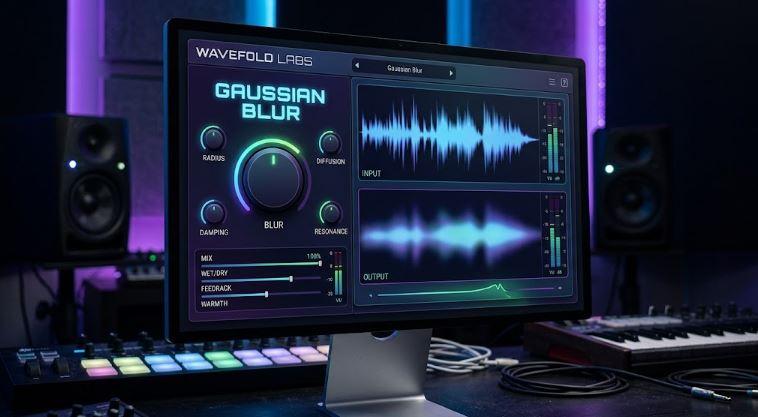
Forward And Reversed Grains Change The Shape Of The Swell
Gaussian Blur includes a Direction control that balances forward and reversed grains.
Reversing grains changes the envelope of the material before it enters the reverb.
A forward fragment retains the source’s normal temporal direction.
A reversed fragment moves toward its original attack rather than away from it.
Mixing the two creates swells that can resemble reverse reverb while remaining tied to the granular engine.
The difference becomes especially clear on material with sharp attacks.
A plucked guitar, piano note, percussion hit, or short vocal consonant provides a clear temporal shape. Reverse some of its grains and those attacks can become rising gestures.
Placed before a delayed Bloom peak, they can form a texture that appears to pull itself toward a later point in time.
That provides a practical route to reverse-style transitions without manually reversing and printing separate audio clips.
Shimmer Happens At The Grain Level
Gaussian Blur also includes Shimmer, but its placement inside the architecture matters.
Wavefold Labs shifts a proportion of the grains upward before they reach the reverb tail.
The processor can emphasize octave-up material or combine fifths and octaves.
This creates a different behavior from placing a conventional pitch-shifting shimmer after a complete reverb.
Individual fragments can acquire higher pitches before they diffuse into the longer plate tail.
The result can become increasingly detached from the original source as the grains overlap.
A guitar chord may retain its harmonic identity near the beginning but develop a brighter, more synthetic cloud as shifted grains accumulate.
On vocals, subtle shimmer can add an upper halo without requiring a separate harmony track.
Strong settings can move the effect further toward sound design and away from realistic room simulation.
Grain Tone Controls What Reaches The Plate
Granular processing can easily produce excessive high-frequency activity.
Gaussian Blur addresses this before the reverb stage with Grain Tone.
This control changes the brightness of the grains before they feed the tail.
That placement gives producers an important distinction.
Darkening the grain layer means the plate receives softer material from the beginning.
Bright grains can produce a more detailed and airy tail.
This becomes particularly useful when Shimmer is active because pitched-up material naturally pushes energy higher in the spectrum.
A producer can therefore add octave information while preventing the effect from becoming overly sharp.
The source, grain stage, and reverb do not have to share the same tonal balance.
Forty Seconds Of Decay Can Turn One Event Into A Background Layer
Gaussian Blur’s plate-style reverb offers decay times reaching 40 seconds.
At the upper end, the tail can last across multiple musical phrases.
This makes short sources surprisingly useful.
A pluck can generate a background layer that continues underneath the following notes.
One chord can blur across a transition.
A short vocal phrase can become an atmospheric bed.
Long decay alone is not unusual in ambient reverb. The difference is that Gaussian Blur feeds its tail with granular material whose timing, direction, tone, and pitch may already have changed.
The long decay preserves a transformation rather than merely stretching the original event.
RobSonic has examined a related idea in its live article on Parallel Minds Atavism turning tracks into harmonic pads. Atavism creates sustained material by retaining persistent spectral components. Gaussian Blur reaches a similar destination through fragmented time, delayed bloom, and a long reverb tail.
Both demonstrate how an effect can create a new layer from audio that already exists in the arrangement.
Recirculate Sends The Grains Through Another Pass
Gaussian Blur includes a Recirculate control that routes material through the granular stage again.
Wavefold Labs distinguishes this behavior from a standard feedback control.
Instead of simply returning the delayed signal to the same point, Recirculate gives the granular processing more opportunities to reshape the material.
Each pass can increase the sense that the tail is moving away from its source.
Fragments become increasingly smeared.
Directional relationships become less obvious.
Pitch-shifted material can accumulate.
Long Bloom and decay settings can turn those repeated passes into dense ambient clouds.
This is where Gaussian Blur moves furthest from conventional reverb.
The processor stops sounding like a room attached to a source and starts sounding like an environment built from pieces of that source.
Tempo Sync Makes Bloom Part Of The Arrangement
The Bloom stage can synchronize to the host tempo.
This feature is easy to overlook, but it makes delayed swells much easier to integrate into structured music.
A producer can time the peak so it arrives on a musically useful division rather than guessing with milliseconds.
Dotted and triplet values provide less rigid relationships than straight note divisions.
Imagine a synth chord at the beginning of a bar.
The granular layer can build through the following beats and reach maximum strength near the next section.
A vocal throw might bloom into an instrumental gap.
A guitar layer could appear progressively across several beats rather than requiring volume automation on a separate printed reverb track.
The reverb becomes part of arrangement timing.
Gaussian Blur Works Best When The Transformation Is Meant To Be Heard
Gaussian Blur is not primarily about recreating realistic acoustic rooms.
Its architecture points toward creative production.
Wavefold Labs lists ambient and cinematic pads, vocal throws, reverse swells, guitar and synth textures, shoegaze, post-rock, transitions, and live electronic performance among its intended uses.
Those applications share a characteristic: the effect itself is audible as part of the composition.
A transparent room reverb tries to make a source feel convincingly located in a space.
Gaussian Blur can make the space feel like another musical layer.
That makes source choice important.
Sharp transient material exposes the bloom and reverse behavior clearly.
Sustained chords supply rich material for long granular clouds.
Vocals provide recognizable fragments that can gradually dissolve.
Simple sounds may become surprisingly complex after several granular and reverberant stages.
The goal is transformation rather than acoustic invisibility.
Why Gaussian Blur Makes Reverb Feel Like A Granular Instrument
Many reverbs give producers control over size, decay, pre-delay, damping, modulation, and tone.
Gaussian Blur changes the question by inserting granular time manipulation before the tail.
Grain Size controls how much of the source survives inside each fragment.
Direction decides how much material moves forward or backward.
Shimmer introduces new pitch relationships.
Grain Tone changes what spectral material enters the plate.
Bloom determines when the cloud reaches its strongest point.
Recirculate gives that cloud additional passes.
Decay determines how long the resulting environment remains.
Those controls create a temporal shape that can be performed and arranged.
The original sound may still be recognizable at the beginning, but the processed layer can continue developing long after the source has finished.
That is the appeal of Gaussian Blur.
It does not treat reverb as the final reflection of an event.
It treats the event as raw material for something that can fragment, gather, rise, and bloom on its own.