
Collage sound design can give a Surrealism-inspired score the same useful tension that cut paper, unexpected scale, and displaced imagery bring to a wall work. Because the research supplied here does not confirm the venue, dates, checklist, or curatorial text for an exhibition titled Surrealism (on Paper), I will not treat those details as verified. Instead, I am using the title as a creative prompt: how can producers translate paper-based collage thinking into audio without pretending that every surprising edit is automatically Surrealist?
As a producer, I find the strongest answer in process rather than decoration. A collage approach asks us to select, cut, place, mask, and reframe fragments. In sound, those fragments might be field recordings, performed noises, short instrumental gestures, spoken syllables, tape artifacts, or synthesized textures. The aim is not chaos for its own sake. The aim is a controlled mismatch that makes the listener question what belongs together.
Why Collage Sound Design Fits Surrealist Paper Work
Collage Sound Design As Editing Discipline
Collage sound design begins with editing decisions. A paper collage depends on edges, scale shifts, gaps, overlaps, and the pressure between source images. Audio can use similar pressure through hard cuts, abrupt room changes, mismatched reverbs, layered speeds, and sounds that seem to come from conflicting physical spaces. A dry pencil scrape can sit against a cavernous organ tone. A close breath can interrupt a distant street bed. A bowed metal texture can behave like a shadow behind a human voice.
The caution is simple: Surrealism is not a preset. If the piece is inspired by works on paper, the audio should respect that material logic. Paper suggests friction, tearing, folding, lightness, opacity, and surface. Instead of reaching first for giant cinematic impacts, a producer might record paper handling at several distances and then recombine those recordings with quieter tonal material. The result can feel strange without becoming inflated.
From Visual Fragments To Audio Fragments
A useful historical comparison comes from outside Surrealism. Romare Bearden’s collage The Block from 1971 was originally paired with an eight-minute audio collage that included street noise, church music, and children playing; the sound component was commissioned for the work’s debut at MoMA and was later rediscovered, according to The Metropolitan Museum of Art. That example matters because it shows how exhibition sound can extend collage logic rather than merely accompany an image.
For a Surrealism-on-paper setting, the lesson is not to imitate Bearden’s subject matter. The lesson is structural. Sound can create a block, a room, or a mental street by layering fragments that carry different social, spatial, and emotional information. A fragment does not need to explain itself fully. It can work because its relationship to another fragment changes the listener’s reading.
What Film Sound Reveals About Layered Making
Post-Production Is Often Construction
Film post-production gives producers a grounded way to think about collage. Jay Jennings, supervising sound designer for A Minecraft Movie, said that at least 90% of production audio in modern film is replaced or enhanced in post-production, through practices that include layering, sampling, and synthetic recreations, in a Berklee feature on film sound design. That figure does not mean every project should bury the original recording. It does show that convincing sound often comes from constructed layers, not a single untouched source.
That is a helpful reminder for gallery-inspired audio. A paper collage can be physically flat but psychologically deep. Sound can mirror that by stacking layers with different degrees of realism. One layer might preserve a believable room tone. Another might introduce a cut-up mechanical rhythm. A third might hold a tonal drone that never appears to have a natural source. The listener accepts the composite because the layers are placed with intent.
Why Layering Needs Restraint
The main risk in collage work is density without purpose. If every fragment is loud, wide, bright, and moving, the ear has no stable reference point. I usually ask three questions before adding a new layer: what does this fragment reveal, what does it conceal, and what does it disturb? If it does none of those things, it may be a decoration rather than a structural piece.
For readers comparing related art-and-sound methods, RobSonic’s piece on surrealist music production offers a useful companion angle on collage, chance, prompts, and rights-aware sampling. A related site in the same network, Kay Granger, also provides insights into the same culture and creator space. It’s important to consider that these production choices here should still be tested against the needs of each work.
Practical Studio Methods For Surrealist Collage
Build A Fragment Palette
Before writing a full cue, build a small palette. I like to collect fragments in families: surface sounds, body sounds, room sounds, pitched material, and impossible sounds. Surface sounds can include paper, graphite, tape, cardboard, dust, and cloth. Body sounds might include breath, mouth clicks, hand rubs, or whispered consonants. Room sounds can be HVAC, footsteps, chair movement, or distant street reflections. Pitched material can be sparse: one prepared piano note, one detuned oscillator, one bowed object, one voice-like synth tone.
- Cut fragments short enough that their source becomes uncertain, then keep a few longer versions for context.
- Place natural sounds beside synthetic sounds, but avoid making every contrast equally dramatic.
- Use silence as a cut edge, not as empty space.
- Print alternate passes so accidental alignments can be judged later with calmer ears.
This approach keeps collage sound design from becoming an endless sample search. The producer is not collecting everything; they are collecting a limited set of fragments that can be recombined with clarity.
Keep Rights And Context In View
Collage practice often raises questions about sampling, found audio, artist influence, and cultural context. This is not legal advice, but a cautious studio habit helps: record original source material when possible, document where sounds came from, avoid using recognizable copyrighted recordings without clearance, and be careful with voices, likeness, and community-specific material. If a fragment carries social meaning, treat it as more than texture.
Respect also applies to stylistic influence. A Surrealism-inspired sound piece does not need to copy a living artist’s signature method or present a false association with an exhibition. It can respond to broader strategies: displacement, dream logic, unlikely proximity, scale confusion, and the unstable boundary between object and symbol.
Mixing Choices That Make Fragment Logic Audible
Use Space As A Collage Layer
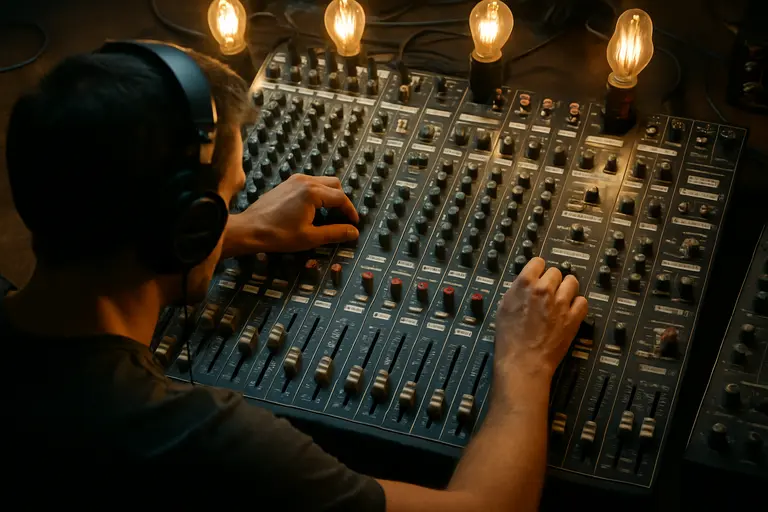
Space is one of the most effective tools in this kind of work. If every fragment shares the same reverb, the piece may feel unified too quickly. If every fragment has a different room, the piece may feel random. The more useful choice is to assign space according to role. A paper scrape might remain close and dry, almost touching the ear. A low drone might sit behind the image as a slow shadow. A voice fragment might appear in a small room for half a second, then disappear before the listener can locate it.
Automation helps preserve the cut-paper feeling. A reverb send can open only on the last syllable of a phrase. A filter can remove the body of a sound while leaving the edge. A pan move can be sudden rather than smooth, like a visual cut. These moves make the listener hear the join between fragments.
Let Timing Stay Slightly Uneven
Perfect grid alignment can weaken a collage if the work needs psychological instability. Try placing some fragments just ahead of the beat, others late, and others outside pulse entirely. The point is not sloppy timing. It is composed imbalance. A short repeated paper tick can act like a clock, while a voice fragment arrives too early, as if memory has interrupted the object.
Frequency balance matters as much as timing. Thin, papery sounds can disappear under drones and low impacts. Give fragile fragments their own spectral window. Sometimes that means subtracting low-mid buildup from the supporting texture rather than boosting the small sound. The more delicate the fragment, the more space it may need around it.
AI Assistance Without Surrendering Authorship
Use Tools For Search, Not Replacement
AI-assisted audio tools can be useful in a collage workflow when they help with organization, cleanup, or variation. A producer might use software to find similar transients, separate noise from a recording, or generate alternate candidates for a texture. Yet the artistic decision still sits in the cut: which fragment enters, which fragment is withheld, and how the join changes meaning.
For this reason, I would treat AI as an assistant rather than the author of the piece. Surrealist influence depends on judgment, not only surprise. A generated sound can be strange, but strangeness becomes musical when it is placed in relation to silence, repetition, contrast, and memory. If the system produces too much material, reduce the palette. Scarcity can make the collage sharper.
Test The Emotional Reading
After building a draft, listen away from the screen. Ask what the piece seems to imply. Does it feel playful, anxious, erotic, mechanical, devotional, domestic, or archival? Do those readings serve the work? If a fragment feels exploitative, too literal, or merely shocking, remove it or reframe it. The best collage does not depend on surprise alone. It creates a relationship that keeps changing as the listener spends time with it.
This is where collage sound design becomes more than layering. It becomes a form of criticism. Each cut asks what belongs together, who gets heard, and what kind of space the listener has entered.
Collage Sound Design After Surrealism On Paper
For a sound piece inspired by Surrealism (on Paper), the most convincing method is not to imitate visual collage literally. It is to think like a maker of fragments. Record small materials. Cut them with intention. Let some edges remain exposed. Build spaces that do not fully agree with one another. Allow silence to behave like blank paper.
Collage sound design works best when the producer balances invention with care. The research available here supports a few firm points: exhibition audio has a documented precedent in collage practice, film sound often relies on constructed layers, and the most persuasive results come from decisions made after the sounds are gathered. That is encouraging. We do not need a massive system to make a surreal audio world. We need ears sharp enough to hear when two fragments create a third meaning.