
Phaseburn One approaches synthesis from a direction that still feels unusual in software instruments: its signature oscillator begins with a phase-locked loop, or PLL, a control system more closely associated with radio electronics and frequency synchronization than conventional subtractive synthesis. Phaseburn Music turns the loop’s attempt to follow a reference oscillator into the musical event itself. Stable locking can produce firm pitch and bass tones; overshoot, drift, relocking, and instability can become timbre.
That idea sits inside a larger groove-focused instrument. As of September 15, 2026, Phaseburn One is available in open beta, with Phaseburn Music listing the v1.0 release for October 15, 2026 at €149. The software combines four sound sources, probability-based sequencing, MIDI output, modulation, an effects rack, external audio input, and modular routing. The interesting part for producers is how those pieces turn an engineering behavior into something that can shape rhythm as much as tone.
Why A Phase-Locked Loop Makes A Different Kind Of Oscillator
A normal synthesizer oscillator is usually expected to generate a waveform at the requested frequency. Phaseburn One’s PLL oscillator behaves differently. One oscillator follows a reference, measures the phase difference between them, then keeps correcting itself. Phaseburn Music describes controls such as TRACK, DAMP, and INFLUENCE as ways of changing how quickly and forcefully the oscillator responds to that reference.
That means the transition into pitch can become part of the sound. A tightly controlled loop can remain close to stable synchronization. Looser settings let the correction process become audible through glides, overshoot, instability, and repeated attempts to recover lock. Phaseburn’s official Phaseburn One details describe this PLL as the instrument’s signature voice rather than a small modulation effect added to a conventional oscillator section.
Phaseburn exposes deeper behavior through parameters including MULT, DIV, CHAOS, RANGE, BURST, INJECT, STEP, GRIT, LAG, and RELOCK. Four phase-detector options — PD, EDGE, XOR, and sample-and-hold — give the loop different ways to react when synchronization becomes less stable.
That makes PLL synthesis valuable for sound design for a reason that differs from adding more waveforms. The producer is adjusting a control system and listening to its response. Pitch correction speed, instability, ratios, detector behavior, and reference material become tone controls.
The PLL LAB makes that process visible through a lock map, phase-error display, strobe-style feedback, and draggable operating points. It gives producers a graphical way to move between stable and unstable regions instead of treating PLL behavior as an invisible technical process.
Groove Comes From Probability Rather Than A Fixed Step Pattern
Phaseburn One becomes more distinctive once the PLL voice is connected to its internal sequencing system. The instrument does not treat groove as a conventional sixteen-step grid with a randomize button attached. Its sequencing model assigns probability to potential events and lets different note lengths compete for space within the same bar.
Phaseburn says the system contains 152 possible slots and can combine straight, triplet, and dotted timing inside one bar. Each position can carry a probability value, so a beat can be certain, unlikely, or absent depending on the rule set. A separate strength map tells the engine which positions matter most musically.
That distinction matters. Random sequencing can easily create material that feels disconnected from meter. Phaseburn attempts to keep chance tied to musical hierarchy. Strong beats, weaker positions, note-length choices, beat links, fills, ratchets, scales, and note probabilities interact before the final sequence appears.
KVR Audio’s September 10, 2026 report described Phaseburn One as a PLL-based groove synthesizer that combines the unusual oscillator design with an internal sequencer and modular effects routing.
The generated notes can leave Phaseburn One as MIDI. That expands the idea beyond using the plugin as a self-contained synth. A producer can use its probability engine to drive another software instrument, letting Phaseburn function as a rhythm and phrase generator even when its own oscillators are muted.
Phaseburn states that its GENERATE system uses deterministic music-theory rules rather than generative AI. VARY can alter the pattern without forcing the producer to rebuild the groove from scratch. The result is less about generating a finished musical idea and more about defining boundaries inside which variation can happen.
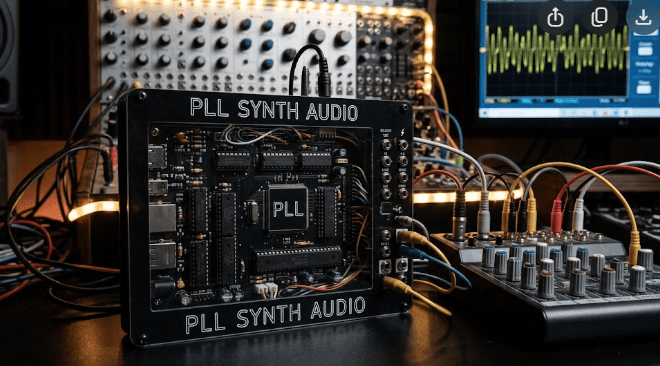
PLL Instability Becomes More Musical When Rhythm Controls It
The strongest part of the design is the interaction between groove and oscillator behavior. A PLL by itself can make unstable tones, sirens, growls, transitions, and nonlinear pitch movement. A probability sequencer by itself can make changing rhythmic phrases. Combining the two means each rhythmic event can trigger a sound whose internal movement already contains tension.
A bass note can begin stable and then slip. A short probabilistic note can interrupt a longer event. Modulation can shift influence, ratio, drive, filter behavior, or oscillator shape differently on strong and weak beats. Instead of building rhythm first and adding movement later, Phaseburn One can make the timbral instability part of the rhythmic identity.
That idea has some common ground with RobSonic’s recent physical-modeling rhythm analysis. In both cases, the interesting production question is what happens when an instrument’s synthesis method contributes to timing and phrasing instead of sitting underneath a MIDI pattern as a passive sound source.
Phaseburn One includes four sound sources in the same voice architecture: the PLL, a VECTOR oscillator based on vector phase shaping, a 12-mode MORPH oscillator, and a dedicated sub oscillator. OSC DRIFT can let those sources receive different notes from the sequencer, creating moving intervals and paraphonic-style stacks without turning the synth into a conventional polyphonic instrument.
True stereo generation gives the pitched oscillators independent left and right behavior at the source. The sub remains centered, which gives the low end a different role from the wider oscillators above it. That architecture fits groove-oriented production well, since stereo movement can come from synthesis rather than relying entirely on downstream widening.
The Patchbay Lets The PLL Chase More Than Its Own Oscillators
Phaseburn One becomes even less conventional once external audio enters the routing system. The PLL reference does not need to come from a fixed internal oscillator. The reference can be another oscillator, a routed effect output, the mix, or audio entering from the host.
This changes the role of the PLL from oscillator architecture into a processing idea. Feed external material into the instrument and the loop can react to that signal. Phaseburn stresses that this is not ordinary pitch tracking: the played note still establishes the oscillator’s operating area, while the reference signal pulls the loop around it.
For producers, that creates several possible relationships between rhythm and synthesis. Percussive material can disturb the loop on transients. Sustained audio can make the PLL react continuously. An effect output can feed back into the oscillator reference, producing a relationship between processing and pitch generation that would normally require a more complicated modular setup.
The Phaseburn One documentation describes the plugin as both an instrument and an effects processor, with the oscillator section, modulation system, filter, mixer, patchbay, sequencer, and effects rack documented as connected parts of one architecture.
Its effects rack includes filtering, delay, reverb, chorus, distortion, bit reduction, granular freezing, and a master section. Routing is node-based, so modules can run in series, parallel, or selected feedback configurations rather than following one fixed signal path.
That matters more than the raw number of effects. The routing makes the effects part of the synthesis structure. A distortion stage can sit inside a delay feedback path. A bitcrusher can run parallel to a cleaner signal. The sub can bypass more aggressive processing. External audio can enter the rack without a note being held.
Why The One-Voice Design Fits The Instrument
Phaseburn One deliberately uses one main voice rather than presenting itself as a large polyphonic synthesizer. That choice gives Phaseburn room to devote processing to independent stereo generation, oversampling, feedback routing, modulation, and the PLL calculations themselves.
The engine uses 64-bit floating-point processing through its core DSP and is written in native Rust. Phaseburn credits published research behind several parts of the design, including vector phase shaping work by Vesa Välimäki, Victor Lazzarini, Joseph Timoney, and others, zero-delay filter methods, nonlinear ladder-filter research, antiderivative anti-aliasing, formant-resonator work, and feedback-delay-network reverb techniques.
The architecture still gives producers ways to create harmonic density. OSC DRIFT can let individual sound sources take different notes chosen by the sequencer. MORPH includes multiple synthesis families, VECTOR adds a separate phase-shaping voice, and the sub provides a stable low-frequency foundation.
That makes the one-voice limitation easier to read as a design choice rather than a missing feature. Phaseburn One is centered on one evolving line whose timing, pitch relationships, stereo behavior, routing, and instability can become unusually detailed.
An August 2026 Synth Anatomy overview reached a similar distinction: the PLL is not presented as another module inside a familiar synth architecture. The loop itself is treated as the central sound generator.
Phaseburn One Makes Failure Modes Part Of Musical Timing
Phase-locked loops were built to correct error. Phaseburn One becomes musically interesting when that error is allowed to stay audible.
Locking, overshoot, unstable ratios, detector behavior, relocking, external references, and controlled chaos give producers a set of movements that conventional waveform selection does not naturally provide. The probability sequencer then gives those movements a rhythmic framework rather than leaving them as free-running sound-design experiments.
That combination explains the “groove synth” label better than the feature count does. Phaseburn One is not simply a PLL oscillator plus a sequencer plus an effects rack. Its design lets the sequencer decide when events occur, the PLL decide how cleanly those events settle into pitch, modulation reshape their behavior, and the patchbay change what the loop listens to.
For electronic producers, the practical appeal lies in that interaction. A groove can change without losing its meter. A sound can stay recognizable without repeating exactly. External audio can become part of the oscillator’s behavior. MIDI output can carry the same probability logic into completely different instruments.
With the open beta active in September 2026 and Phaseburn Music scheduling v1.0 for October 15, Phaseburn One arrives as a clear example of how software synthesis can borrow an old electronics concept without trying to recreate an old synthesizer. The radio-engineering behavior is the source material; groove, probability, routing, and controlled instability turn it into an instrument.