
A spreadsheet normally describes something. Weather data records temperature or rainfall. An image stores pixels. Economic data tracks values through time. Manifest Audio’s Sonification Tools v3 asks a different question: what happens when those numbers stop being information to read and start controlling rhythm, pitch, synthesis, modulation, and effects?
Manifest Audio released Sonification Tools v3 on October 23, 2026. The third-generation system expands the company’s earlier Max for Live approach into AU, VST3, and CLAP plugins that can operate across major DAWs on macOS, Windows, and Linux.
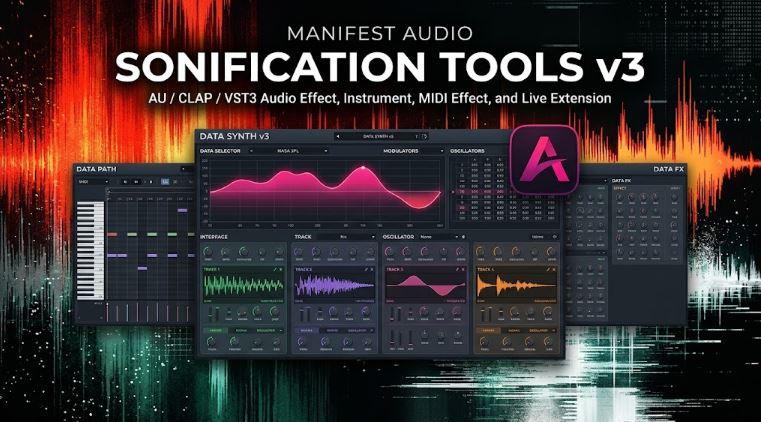
The bundle centers on Data Path, Data Synth, and Data FX, alongside Data Map for Ableton Live and the Data Tap Pro iPhone companion. Together, they can transform weather records, spreadsheets, images, text, audio, video, typed numbers, drawn shapes, mathematical sequences, and live sensor streams into musical control data.
The important change is conceptual. The source material no longer needs to begin as sound.
Sonification Turns Relationships Into Musical Decisions
Sonification is the process of representing data through sound.
Manifest Audio approaches that idea as a composition system rather than only a scientific visualization technique.
On the official Sonification Tools page, the company describes the bundle as a way to transform numeric data, text, images, video, and other information into MIDI, modulation, effects, and waveforms.
A data set can contain rising values, sudden drops, repeated cycles, clusters, or irregular changes.
Those relationships can become musical relationships.
A rising number might move a note upward.
Another series could affect velocity.
A repeating data pattern might produce rhythm.
Image brightness could become numeric information used by a sequence or synthesis engine.
The software does not claim that rainfall inherently “sounds like” a particular melody. It maps numerical structures onto musical parameters chosen by the producer.
That distinction keeps sonification creative rather than mystical.
Data Path Can Turn Rainfall Into A MIDI Sequence
Data Path is the bundle’s sequencing component.
Manifest Audio gives an example as simple as loading a year of rainfall measurements and turning those values into MIDI.
The plugin can map data onto pitch, velocity, note length, probability, and rhythm. It supports as many as eight polyphonic voices and Scala-based microtuning through MPE.
The original measurements therefore do not need to resemble musical notes.
Data Path translates their relative behavior into a sequence.
A month with unusually high rainfall could produce a different pitch or velocity relationship from a dry period.
Earthquake activity, financial data, environmental measurements, or a spreadsheet column can produce completely different contours.
The producer still decides how those values are mapped.
The data supplies structure.
The mapping determines how that structure becomes music.
Spreadsheets Become More Interesting Than MIDI Templates
Spreadsheet support is one of the clearest examples of why Sonification Tools v3 feels different from a conventional generative sequencer.
A producer can load spreadsheet data rather than selecting a built-in melodic algorithm.
That spreadsheet could contain measurements from scientific research, a personal data project, sports statistics, financial information, environmental observations, or almost any numeric series whose license allows the intended use.
Manifest Audio’s FAQ specifically lists Spreadsheet as a supported user-data source for Data Path, Data Synth, and Data FX.
This makes CSV-style information a potential compositional resource.
The resulting pattern is not useful because listeners necessarily recognize the original data.
It is useful because the source supplies a shape that the musician might never have drawn manually.
A sequence can inherit irregularities, cycles, and abrupt changes from something outside music.
That can create a useful escape from familiar piano-roll habits.
Weather Can Drive More Than Pitch
Built-in online sources include categories such as weather, environment, finance, economics, health, ocean-related information, biodiversity, sustainability, and other data collections.
A common mistake would be to assume these values should always become melody.
Sonification Tools v3 allows broader uses.
Temperature could become modulation.
Rainfall could influence note probability.
A changing measurement might move a filter.
Another data series could define rhythmic density.
The same information can therefore affect several layers of a track without ever becoming an obvious melodic line.
This makes weather data less like a novelty “weather song” generator and more like a source of evolving control signals.
The musical result depends on the mapping rather than the subject name attached to the data.
Images Can Become Numerical Shapes
An image may look visual to a person, but software can also describe it as arrays of changing values.
Sonification Tools v3 can use images as input data.
That creates an interesting relationship between visual composition and musical composition.
A photograph with large areas of similar brightness could produce a relatively stable set of values.
An image with strong contrast, sharp edges, or complex texture can produce a more varied numerical structure.
Those values can then become sequence information, modulation, or synthesis material.
The image is not converted into a literal soundtrack of what it depicts.
A photograph of the ocean does not automatically become waves and seagulls.
Its measurable visual structure becomes a source from which musical behavior can be derived.
That limitation is also what makes the process useful. Abstract patterns, drawings, diagrams, and photographs can all become starting points without needing semantic image recognition.
Data Synth Can Turn A Data Set Into The Oscillator
Data Synth moves sonification deeper than MIDI generation.
The v3 release makes it a 16-voice MPE-enabled synthesizer with four data slots and four oscillators.
Those oscillators can interpret data as a single-cycle waveform or as an additive partial bank.
That means information can define part of the actual timbre rather than merely controlling which notes are played.
The same data slots can also feed dynamic LFOs and the internal polyphonic sequencer.
One data set could therefore influence several levels of a patch.
It might shape an oscillator while also driving modulation.
A second set could affect another oscillator or sequencing behavior.
This is where Sonification Tools v3 becomes particularly relevant for experimental sound design.
The data is no longer sitting outside the synthesizer and moving knobs.
It can become part of the sound-generating architecture itself.
Data FX Lets Information Reshape Existing Audio
Data FX takes the same philosophy into processing.
The October 23 Sonification Tools v3 release report describes seven data-driven effect types: convolution, granulation, multi-tap delay, resonator banks, spectral filtering, spectral morphing, and wavefolding distortion.
Different processors interpret data differently.
A data set can define the tuning of a resonator bank.
It can determine how grains spread.
Values can establish the positions of delay taps.
Another pattern can become the mask used by a spectral filter.
This means two producers can load the same source data but create completely different results simply by assigning it to different processes.
A spreadsheet does not have one fixed musical interpretation.
It becomes a control structure whose meaning changes with its destination.
Forty-Seven Math Algorithms Provide Data Without The Internet
Sonification Tools v3 is not dependent entirely on online feeds.
Manifest Audio includes 47 generative mathematical algorithms organized into several families.
These can generate data locally without fetching an external source.
That provides a useful midpoint between traditional generative music and real-world sonification.
A producer can work with chaotic maps, mathematical relationships, or physical-system-style sequences without importing a file or connecting to a remote data provider.
The result still follows the bundle’s core design: values become musical structure through mapping.
It also means Sonification Tools can function as an experimental generative environment even when weather, economic, or environmental data is not part of the project.
Data Tap Brings Phone Sensors Into The Same System
The bundle extends beyond static data with Data Tap Pro for iPhone.
It can send sensor information to Data Path and Data Synth over OSC.
Manifest Audio lists motion, touch, proximity, microphone, camera, hand pose, face tracking, depth, and GPS among the available inputs.
That makes movement itself a possible control source.
Tilting or moving a phone could affect a musical parameter.
Camera-derived information can enter the data stream.
Touch and proximity can become performance controls.
This moves sonification toward live interaction.
The input no longer needs to be a historical spreadsheet or downloaded data set.
It can be something happening around the performer now.
The Source Data Still Needs Context And Permission
Using external data introduces a consideration that does not normally appear when programming a synthesizer from scratch.
Data sets can have licenses.
Manifest Audio explicitly advises users to check whether a chosen source permits the intended use, especially when the resulting music will be released commercially.
The v3 tools display credit information requested by supported providers.
This is a useful limitation to keep visible.
Publicly accessible data is not automatically unrestricted data.
A producer working with a personal spreadsheet or their own image has a different rights situation from someone importing a third-party research data set.
The musical workflow may be experimental, but source permissions still matter.
Sonification Changes Where A Musical Idea Can Begin
RobSonic’s guide to creative effects chains looks at how familiar audio can acquire a new identity when processors interact creatively.
Sonification Tools v3 moves the starting point even earlier.
There does not have to be audio yet.
A melody can begin with a weather series.
A modulation curve can begin with pixels.
A rhythm can begin with spreadsheet values.
A waveform can emerge from numerical data.
A resonator can receive its tuning from information collected for an entirely different purpose.
That widens the definition of source material.
For a producer, inspiration no longer has to begin with a chord, sample, oscillator, or recorded sound.
It can begin with a pattern found somewhere else.
Why Sonification Tools v3 Makes Data Feel Compositional
The most interesting aspect of Sonification Tools v3 is not that it can make a spreadsheet produce notes.
That alone would be a novelty.
Its stronger idea is that the same data can operate at several musical levels.
Data Path turns information into sequences.
Data Synth lets it shape oscillators, additive partials, modulation, and polyphonic patterns.
Data FX applies it to convolution, granulation, delays, resonators, spectral processing, and distortion.
Images and text provide user-generated sources.
Online services supply real-world measurements.
Mathematical algorithms create local data.
Phone sensors introduce live information.
Together, those systems make data behave less like an unusual MIDI generator and more like another category of musical material.
The producer still makes the artistic decisions.
Manifest Audio supplies the translation layer.
Weather does not write the track.
A spreadsheet does not compose by itself.
An image does not contain one hidden melody waiting to be discovered.
What they contain are structures, changes, and relationships.
Sonification Tools v3 gives musicians a way to decide what those relationships should become.