
Fashion Exhibitions can teach producers a lot about sound without asking us to copy a garment, a designer, or a community style. As a producer, I treat these shows like reference rooms: places where texture, pacing, space, and emotional contrast are arranged with intent. The strongest production lessons are not about chasing a look. They are about noticing how materials and bodies move through a room, then asking what that motion could mean for drums, synths, sampling, arrangement, and mix depth.
That approach fits the current set of 2026 fashion shows and exhibitions, many of which connect clothing with science, music, street culture, art, architecture, and performance. The key is caution. A museum label, runway soundtrack, or installation can start an idea, but it does not grant permission to imitate an artist, sample protected audio, or flatten a community’s work into a mood board. For producers, the better move is to study structure: contrast, density, silence, repetition, surface, and symbolic weight.
How Fashion Exhibitions Translate Into Sound
Fashion Exhibitions As Texture References
Texture is the easiest bridge between garment and beat. A sheer fabric can suggest filtered noise, airy pads, or brushed percussion. A sculptural silhouette can suggest sharp transient design, wide stereo space, or a low-end shape that feels architectural. A distressed textile can point toward tape wear, granular fragments, vinyl noise, bit reduction, or unstable modulation. None of that requires copying the visual work. It means asking what physical qualities the eye detects and how a track might represent similar tension through timbre.
The Brooklyn Museum’s Iris van Herpen: Sculpting the Senses, on view from May 16 through December 6, 2026, is a strong example because the exhibition places couture near scientific artifacts, including a dinosaur skull and marine biology references, and includes a custom soundscape by Salvador Breed, as reported in this Fashionista review. For a beatmaker, that does not mean making a track that sounds like the exhibition. A more useful exercise is to build a palette around contrasts: bone-like dryness against liquid modulation, precise percussion against soft ambient drift, or a synthetic lead that feels almost biological.
Reading Garments Like Arrangement Cues
Recent Fashion Exhibitions are also useful because they organize time. A gallery visitor moves from object to object, and each placement can create a sense of reveal, pause, or escalation. Producers can borrow that logic for arrangement. Instead of stacking every element at bar one, a track can introduce a single texture, add a counter-shape, remove the low end, then let a new color enter after the listener has learned the first one.
The Metropolitan Museum of Art’s Costume Art, listed in the research notes as running from May 10, 2026 through January 10, 2027, juxtaposes garments with artworks across a long time span. Even without treating that as a direct sound brief, the curatorial idea is helpful: place unlike references side by side and listen for the relationship. A brittle percussion loop might sit against a warm string sample. A club kick might support a fragile vocal chop. The goal is not random collision. The goal is controlled contrast.
Case Studies From 2026 Exhibitions
Iris Van Herpen And Ambient Space
The van Herpen exhibition points toward one of the most practical lessons for producers: space can be composed before melody. If an installation includes garments, scientific forms, lighting, and a custom sound environment, then sound is not background decoration. It becomes part of the way visitors measure scale and attention. In production terms, that suggests starting a cue with room tone, reverb length, stereo width, or filtered movement before writing the main motif.
For example, a producer could build a sketch with three layers: a close, dry pulse for the body; a slow modulated pad for the room; and a brighter, irregular accent for surface detail. That method is especially useful for ambient rap intros, electronic interludes, fashion film scoring, and live set transitions where the track needs to create an environment rather than only a hook.
Harmonic Threads And Emotional Mapping
FIT’s Fashion Design AAS exhibition Harmonic Threads ran from April 8 to April 15, 2026, and presented 51 garments that translated emotional responses to music into silhouette, texture, color, and movement, according to the FIT Newsroom. That is a clean reference point for producers because it reverses our usual process. Instead of asking how visuals can inspire audio, it shows how music can become visual form.
I would use that as a writing drill. Pick one emotion without naming a genre: restraint, pressure, release, nostalgia, agitation, tenderness. Then assign production choices to it. Restraint might mean fewer drums, shorter decay, and less harmonic movement. Pressure might mean rising noise, denser midrange, and narrowed stereo space. Release might mean a wider chorus, longer reverb, and a bass note that finally resolves. This can keep a beat from becoming a preset parade because every sound has a reason to be in the arrangement.
Producer Workflows For Visual Influence
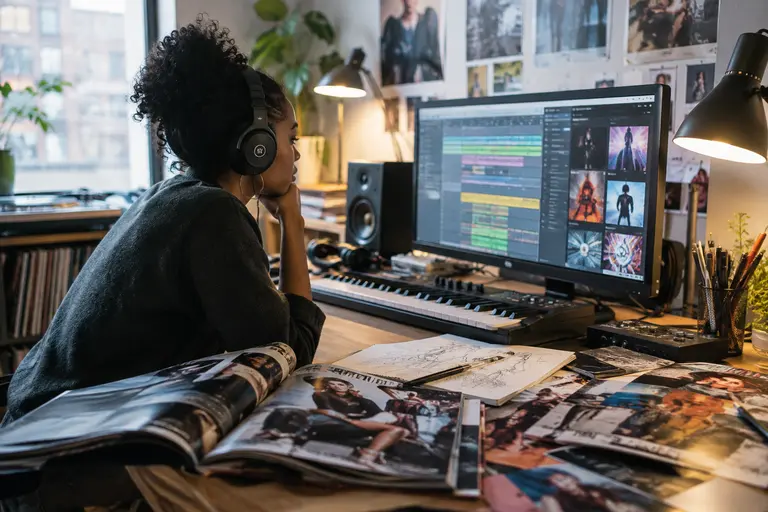
Build A Palette Before The Beat
A producer does not need to visit every show in person to learn from the way these exhibitions are framed, but the evidence should stay clear. Use verified dates, official exhibition descriptions where available, and reputable reporting. Avoid making claims that a scene, designer, or artist has caused a movement unless the record supports it. The safer creative practice is to turn visual cues into private studio prompts, then build original sound from there.
Here is a practical workflow I would use after studying a fashion exhibition, a runway recap, or a museum review:
- Write down three material cues, such as glassy, frayed, rigid, fluid, metallic, soft, or translucent.
- Match each cue to one sound-design move, such as FM brightness, tape saturation, low-pass filtering, short room reverb, or granular delay.
- Choose one arrangement behavior, such as slow reveal, sudden cut, repeated gesture, or layered contrast.
- Record a short beat sketch before adding visual references to the project folder, so the session stays music-first.
- Check rights before using any audio, image, name, likeness, garment photo, or branded reference in public-facing work.
That last point matters for sellers, sample-pack makers, and artists building merch around visual references. General inspiration is different from using protected imagery, logos, recorded music, or living artists’ names to market a product. This is not legal advice, but it is a useful creative boundary: take ideas from structure and feeling, not from protected identifiers. For a broader cross-media angle, RobSonic’s piece on fashion and art lessons for music creators connects similar exhibition thinking to production, visuals, staging, and audience trust.
Rights And Respect In Reference Work
Respect is not a side issue here. Styled by the Streets: Black Women in Hip-Hop Fashion, which opened on September 19, 2026 according to the research notes, centers Black women’s role in hip-hop style through clothing, hairstyling, and beauty artifacts. A producer can learn from the presence of performance, identity, rhythm, and texture in such a show, but the work should not be treated as a grab bag of signs. Community-rooted aesthetics carry history, labor, and authorship.
The same caution applies to references from club culture, cosplay, fantasy fashion, handmade costume work, and creator-commerce spaces. A related site in the same network, such as Fairy Tale Fashion, can be useful for thinking about fantasy clothing as culture and craft, but producers still need to separate inspiration from imitation. If a beat, video, sample pack, or merch drop depends on a recognizable protected character, celebrity likeness, or artist signature, slow down and get proper clearance guidance.
Capturing Unique Aesthetic Influences From Fashion Exhibitions
From Fashion Exhibitions To Session Decisions
Other 2026 examples widen the production lens. H&M’s London Fashion Week show on September 17, 2026 used a soundtrack by Labrinth and combined spoken word, digital visuals, and sculptural form, according to the research notes. Tate Britain’s The ’90s: Art and Fashion opened on October 16, 2026 and runs through February 14, 2027, with a focus on the collision of art, fashion, music, and nightlife in early-1990s Britain. The Codes: Virgil Abloh was announced to open at The Shed on December 10, 2026, with nearly 1,000 objects across fashion, music, art, design, and cultural production. Taken carefully, these examples show that music can sit beside clothing as an equal part of presentation, not as a late add-on.
Fashion Exhibitions work best for producers when they sharpen decisions. If an exhibition suggests architecture, use form: tension, release, negative space, and scale. If it suggests biology, use modulation, small irregular movements, and evolving texture. If it suggests street culture, study rhythm, authorship, locality, and respect before using the reference. If it suggests archival time, let era guide arrangement, instrumentation, or mix finish without reducing the past to a filter preset.
For beatmakers, the studio takeaway is simple and useful: build a sound palette from evidence, not hype. Let the exhibition teach you how objects relate, how a room controls attention, and how texture carries emotion. Then make an original record that can stand on its own even after the mood board is closed.