
Digital fashion music lessons from New York Fashion Week are useful because fashion and record production share one basic pressure: expensive public work has to be tested before it is released. As a sound engineer, I hear the runway less as a separate art world and more as a high-stakes pre-production lab. Designers test silhouette, fabric, styling, motion, and audience framing; producers test arrangement, tone, mix balance, translation, and emotional pacing.
The caution is that fashion technology should not be treated as a simple template for music. A runway show, a single, and an album campaign have different budgets, labor structures, rights issues, and audience habits. Still, the recent NYFW examples are useful because they show a practical shift: digital tools are strongest when they help artists make decisions earlier, not when they replace taste, craft, or human approval.
Digital Fashion Music Lessons From AI Previewing
Digital Fashion Music As A Testing Mindset
During NYFW Spring/Summer 2027, held September 10–15, 2026, Jane Wade and Sergio Hudson worked with Google’s Envisioning Studio through Flow, using AI tools for pre-visualization to test colorways, fabrics, and styling combinations before physical production, as reported by Vogue. The music parallel is not that a producer should ask software to finish a record. The stronger lesson is that low-cost previews can expose weak decisions before studio time, session players, video crews, or mastering revisions become expensive.
In a mix room, that means making fast comparison passes before committing. A producer might audition two drum balances, three vocal reverbs, a brighter master reference, or an arrangement with the second chorus cut in half. None of those tests should be confused with final judgment. They are sketches. The value is speed and contrast: hearing several believable options side by side can reveal which idea supports the song rather than the plug-in chain.
Pre-Visualization Is Not Authorship
The strongest digital fashion music lesson here is restraint. AI previewing can narrow choices, but it cannot explain why a vocal take feels honest or why a bass note pulls against the lyric in a useful way. Those calls still belong to artists, producers, engineers, and collaborators. In production terms, a preview pass should answer practical questions: Is the chorus too dense? Does the kick mask the bass? Does the master collapse on small speakers? Does the bridge need silence rather than another texture?
That last question matters. Faster tools can tempt producers to add more layers because options appear instantly. Good production often moves the other way. If the song already communicates, the best technical move may be removing a synth, shortening a tail, or leaving a vocal dry for four bars.
Personalization Without Losing The Artist
What Styling AI Suggests For Mix Assistants
In September 2025, The Washington Post reported that Ralph Lauren used a conversational AI tool called “Ask Ralph” for styling suggestions, while LoveShackFancy and others used virtual try-ons; the same report said Imah’s platform claimed 99 percent accuracy in virtual sizing detection The Washington Post. For music, the direct comparison is not clothing size. It is preference detection: mix assistants, mastering tools, and recommendation systems can suggest tonal curves, loudness targets, vocal balance, or reference matches.
That can be useful, especially for independent artists who do not have a large technical team. A careful assistant could flag harsh upper mids, phase issues, low-end buildup, or inconsistent vocal level. But personalization has a limit. If every system optimizes toward what a listener already prefers, music risks becoming too predictable. The producer’s job is partly to respect taste and partly to challenge it.
Human Trust Is Part Of The Signal Chain
In mastering, I often think of trust as part of the signal chain. If an artist does not trust the process, even technically clean results can feel wrong. Digital suggestion tools need clear approval points: the artist hears the option, understands the tradeoff, and chooses. A tool may recommend a brighter master, but the artist may want warmth because the song is intimate. A system may suggest a tighter vocal tune, but the emotional take may depend on slight pitch movement.
This is where fashion’s digital fitting idea becomes useful as a metaphor. A preview can show fit, but it does not decide identity. For musicians, mix previews can show translation and impact, but they should not erase the performance choices that make a record feel specific.
Video, Runway Logic, And Release Planning
The Track Now Has A Visual Room
NYFW reminds producers that a creative work is often received through a staged environment. Clothes are seen with lighting, motion, casting, venue, pacing, camera angle, and soundtrack. Music now often reaches audiences through short video, live clips, visualizers, performance footage, and social excerpts. That does not mean every release needs an expensive video. It means the sonic identity should have a visual room that fits it.
A dark, close-miked vocal record may need minimal lighting and restrained edits. A club track may need movement, but not visual noise that competes with the groove. A folk recording may benefit from a single live performance clip if the selling point is phrasing and lyric presence. The same thinking applies to fashion soundtracks: cue timing, restraint, and atmosphere can shape perception as much as volume. For a closer production-focused angle, RobSonic’s piece on fashion soundtracks after New York Fashion Week connects runway pacing with musical choices.
Do Not Confuse Visibility With Impact
One production mistake is treating every platform as if it needs the same asset. A full mix, a phone-speaker edit, a thirty-second live clip, and a visualizer loop do different jobs. The main mix should protect the song. The short clip should communicate the hook without flattening the arrangement. The live version should prove the performance. The visualizer should support mood without pretending to be cinema.
Readers who follow costume culture, handmade presentation, and fantasy fashion through related arts networks such as Fairytale Fashion will recognize this same principle: presentation can frame the work, but it should not overwhelm the craft.
Practical Studio Takeaways From NYFW Tech
A Producer Workflow Built On Early Testing
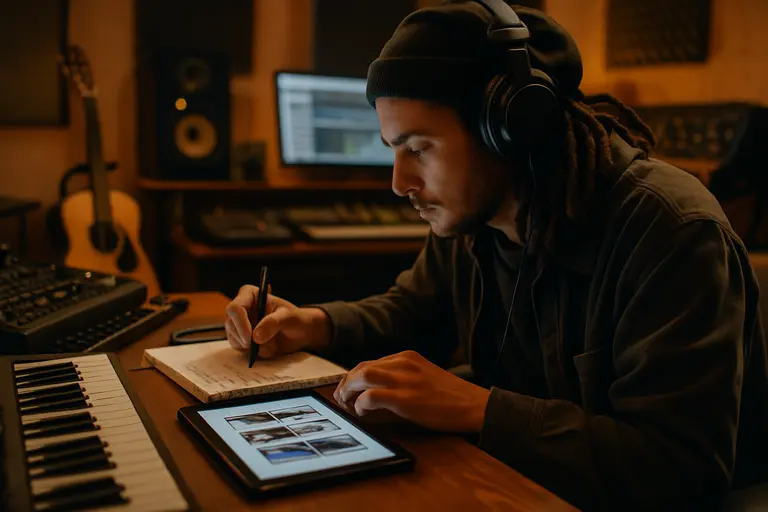
The most useful studio response is simple: move more decisions into the demo stage. Before booking a final vocal day, print rough arrangement versions. Before sending a master, test tonal references. Before spending on visuals, define the sonic palette. This does not make the process colder. Done well, it gives artists more room to make emotional choices before the schedule tightens.
- Use AI or fast rendering tools to compare options, not to approve final taste.
- Keep labeled mix versions so artists can hear tradeoffs instead of vague promises.
- Test a chorus, bridge, or intro in short video form before building a full campaign.
- Protect rights and likeness concerns by avoiding prompts or visuals that imitate living artists or protected characters for commercial deception.
- Print stems and instrumental passes early so visual teams and collaborators can work without altering the final mix.
None of these steps require producers to chase every new tool. The value is disciplined listening. If a digital preview helps a singer choose the right vocal space, it earned its place. If it creates ten unnecessary alternatives and delays the record, it did not.
Digital Fashion Music Lessons For Producers
A cautious digital fashion music takeaway is that technology works best as a decision aid. NYFW’s AI previews and styling tools show how creative teams can test form before final production, but they also remind us that public work depends on human taste, trust, and context. For music producers, that means using AI, visual planning, and release assets to clarify the record rather than bury it.
The strongest records still come from choices: which take stays, which frequency gets softened, which section breathes, which visual frame matches the song, and which tool gets turned off. Fashion’s digital experiments are worth studying because they make that tension visible. In the studio, the lesson is not to sound futuristic. It is to make better decisions earlier, then leave enough human grain for the song to feel alive.