
Audience engagement can teach beatmakers a lot about arrangement because festivals and exhibitions test how people respond to pacing, participation, sensory cues, and shared purpose in real spaces. As a producer, I pay attention to these events the same way I listen to a strong beat switch: not only for the sound, but for how the audience is moved from one state to another.
The recent examples in the research point to a practical idea: attention is rarely held by volume alone. It is shaped by sequence, contrast, agency, and context. A festival rollout can work like a long intro. An interactive exhibition can work like call-and-response. A benefit festival can tie music to values without separating the social mission from the show. For beatmakers and arrangers, those lessons are useful whether the final piece is a two-minute loop, a live set, a beat tape, or a gallery installation with sound.
Why Audience Engagement Starts Before The Drop
Audience Engagement Through Staged Reveal
In spring 2026, Coachella introduced a multi-phase lineup rollout rather than announcing the full lineup at once, a strategy described in Forbes. The useful production lesson is not that every artist needs a festival-scale campaign. It is that anticipation can be arranged. A beatmaker can release a drum break, then a hook fragment, then a behind-the-scenes clip showing the main texture. Each piece gives the audience a role before the finished track arrives.
That mirrors arrangement inside the track. If the whole pattern appears in bar one, the listener has little left to discover. If the drums, sample chop, counter-melody, and bass movement enter in phases, the beat creates small reasons to keep listening. Audience engagement in this sense is not a marketing layer pasted on after the music is done. It starts with how the producer controls disclosure.
Programming Beyond One Entry Point
Treefort Music Festival, held March 25-29, 2026 in Boise, expanded beyond music with related programming such as Artfort, Hackfort, and Dragfort, according to the same Forbes reporting. That model matters because different listeners enter a culture through different doors. Some people care about the headliner. Some care about visual identity, technology, drag performance, local food, wellness, or community gathering.
A beat project can borrow that structure without imitating a festival. A producer might build one release around stems for remixers, one short video on sample ethics, one live performance version, and one breakdown aimed at other producers. The core track remains the center, but the surrounding material gives more people a legitimate way in. That is especially relevant for independent creators who do not have large ad budgets but do have process, personality, and technical choices worth sharing.
Participation Makes Arrangement Feel Social
From Spectator To Contributor
The July 2026 New Orleans event Becoming Together replaced passive spectatorship with participation across programs involving DJ sets, dance, song, tarot, costume, and voice. The research notes say half the attendees were New Orleans locals, which is significant because participation can feel extractive if it is not grounded in place. The lesson for creators is to design with the community, not simply for an abstract crowd.
For beatmaking, participation can be musical and ethical. A live set might invite call-and-response vocals, but it should also credit collaborators clearly. A workshop might let attendees choose drum samples, but the source material still needs rights clearance. A gallery beat installation might let visitors trigger loops, yet the producer should avoid using copyrighted characters, celebrity likenesses, or unclear fan assets as the hook. Participation works best when people are invited into a clear creative frame.
Interactive Systems And Musical Agency
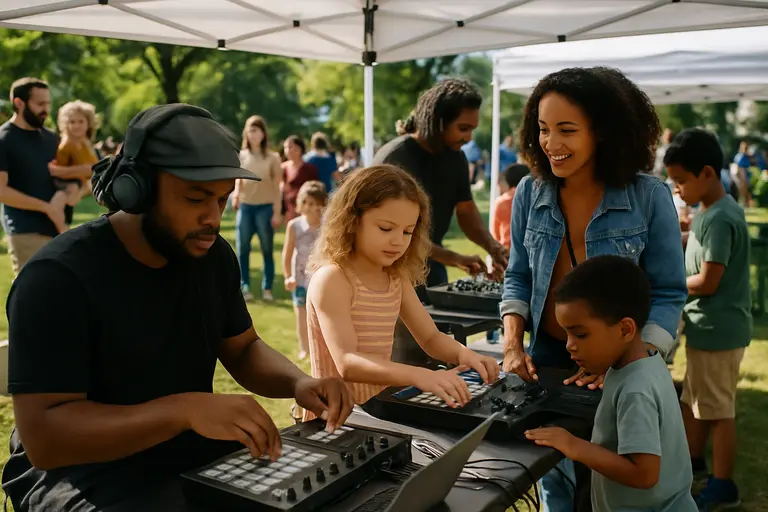
The FlowJam AR installation described in the research allowed people to touch objects that generated synchronized audio-visual feedback, enabling collaborative musical improvisation. Participants reported feeling more creative and socially connected. For a producer, that finding lines up with a common studio truth: people connect faster when they can affect the sound.
This can be translated into beatmaking setups through simple design. Map one controller to percussion density. Let a vocalist trigger delays during a live hook. Build an installation where visitors add one note, clap, or filtered noise burst into a shared loop. The point is not to let randomness take over. The point is to decide which musical parameters are safe for the audience to touch while the groove stays coherent.
Sensory Design Turns Beats Into Space
Sound And Sight Shape Mood Together
A study published on January 12, 2026 in the International Journal of Event and Festival Management found that sensory design, especially sound and sight, strongly shapes attendee perception, with sound influencing mood and multisensory cues leaving stronger impressions when activated together. That tracks with how producers think about mix depth. A beat is not only kick, snare, and sample. It has perceived distance, color, pressure, and motion.
The Zurich immersive exhibition Becoming Marilyn Monroe, launched on May 6, 2026, used coordinated audio, video, and interactive systems to move visitors through spaces that shifted from intimate reflective zones to larger immersive environments. That is an arrangement lesson in spatial form. A track can move from close dry drums to wide pads, from mono grit to stereo width, from a sparse verse to a dense bridge. These decisions help the listener feel a change in room, even through headphones.
For readers exploring different perspectives on live audio experiences at festivals, you may find the related insights on festival soundscapes at RobSonic’s site very informative. It discusses aspects such as low-end control and dynamic mixing, which directly influence how audiences perceive sound. Those same principles can be applied within a beat’s smaller scope to ensure each element is heard clearly.
Agency Inside Immersive Narratives
The Immersive Cleopatra Exhibition opened in London on March 25, 2026 with interactive VR, AI-hologram presentation, mirror interfaces, and headphone-based visitor audio. The research describes the exhibition as giving visitors choices about which parts of Cleopatra’s narrative to engage with. That choice-based structure can inform beat arrangement by encouraging alternate paths through the same material.
A producer can create a main mix, an instrumental, a stripped-down percussion edit, and a live stem set that exposes different parts of the composition. None of those versions has to replace the others. They can function like different rooms in the same exhibition. For creators selling handmade audio packs, performance merch, or educational material, related creator-culture coverage at Shimply can align with this strategy by exploring how audiences engage with content beyond just consuming a final product.
Cause, Community, And Careful Value Design
Philanthropy As Part Of The Experience
Olivia Rodrigo’s benefit festival Daisy Chain Fields took place in Irvine, California on August 29-30, 2026 and raised $20 million through a women-led lineup and an integrated Philanthropy Village where attendees collected pins, visited booths, and learned about nonprofits, as the Associated Press reported. The engagement lesson is that cause-driven design works best when it is not treated as a side table outside the music. It was built into the attendee path.
Beatmakers should approach this carefully. A cause cannot be used as a mood board without responsibility. If a release supports an organization, the creator should be clear about the beneficiary, the dates, and what portion of proceeds is involved. If community stories are part of a sample-based project, consent and attribution matter. Respectful value design can deepen audience engagement, but vague charity language can damage trust.
Local Presence Beats Generic Energy
The Philadelphia FIFA Fan Festival ran from June 11 to July 19, 2026 and drew 575,304 attendees, with a single-day record of 55,000 on June 19 for Brazil vs. Haiti. Large attendance numbers can create atmosphere, but the beatmaking takeaway is not simply “bigger is better.” Size can amplify a moment; it cannot replace a clear emotional arc.
Small rooms can produce strong memory when the arrangement fits the people present. A local DJ night, beat battle, store pop-up, or gallery performance can use chants, neighborhood references, guest percussionists, or locally sourced visual art in ways that would feel more specific than a generic hype script. The caution is to avoid reducing a community to a texture. Local presence should involve real collaborators, fair credit, and a clear reason for each reference.
Audience Engagement For Beatmaking Practice
The strongest lesson from these 2026 festivals and exhibitions is that audience engagement is designed across time. It begins before the release through staged reveals. It deepens during the experience through participation, sensory contrast, and clear movement from one section to another. It continues afterward through stems, edits, recaps, credits, and community memory.
- Arrange the reveal: introduce drums, hooks, textures, and visuals in phases instead of giving everything away immediately.
- Give listeners agency: let them vote, remix, trigger, respond, or choose a version, while protecting the core groove.
- Design space in the mix: use width, filtering, silence, room tone, and density changes to create emotional zones.
- Build with communities, not around them: use local voices and collaborators with consent, credit, and context.
- Connect values clearly: if a project supports a cause, state the structure plainly and avoid vague claims.
For producers, this is less about copying festival marketing and more about thinking like an arranger of attention. Every beat asks the listener to stay. The recent festival and exhibition examples show that people stay longer when they can anticipate, participate, recognize themselves in the space, and feel the music changing with purpose.