
Most pads we hear are just background noise. They might be nice, but they don’t stick with us.
We aim to create, not just add sound. A great pad is more than a simple sound. It’s a living, breathing environment. Imagine it like a Rothko painting, full of depth and profound emotional weight.
Does it have texture, like ‘Waterway’s’ ‘granular textures & rich Ambient drones’? Or does it build tension, note by note? The key is whether it grows or stays the same.
Think of ‘Dawn’s’ ‘radiant Ambient bliss’ or ‘Ceremony’s’ ‘iridescent rays of sonic sunshine’. These aren’t just sounds. They’re statements that define the space. This is what we’re striving for: purpose beyond presets.
Synthesis Walkthrough
Let’s break down the process: making ambient pads is like building a world, layer by layer. It’s not just making noise. It’s creating a new reality.
Forget the simple sounds of a lone oscillator. That’s just a start. Modern ambient music needs a more complex approach. It’s like being a conductor, not just a musician.
The Dronar engine is a great example. It treats a pad like a band, not a solo artist. You have an Expert Page with four layers: FX, HI, MID, and LO. Each layer is like a track in your music.
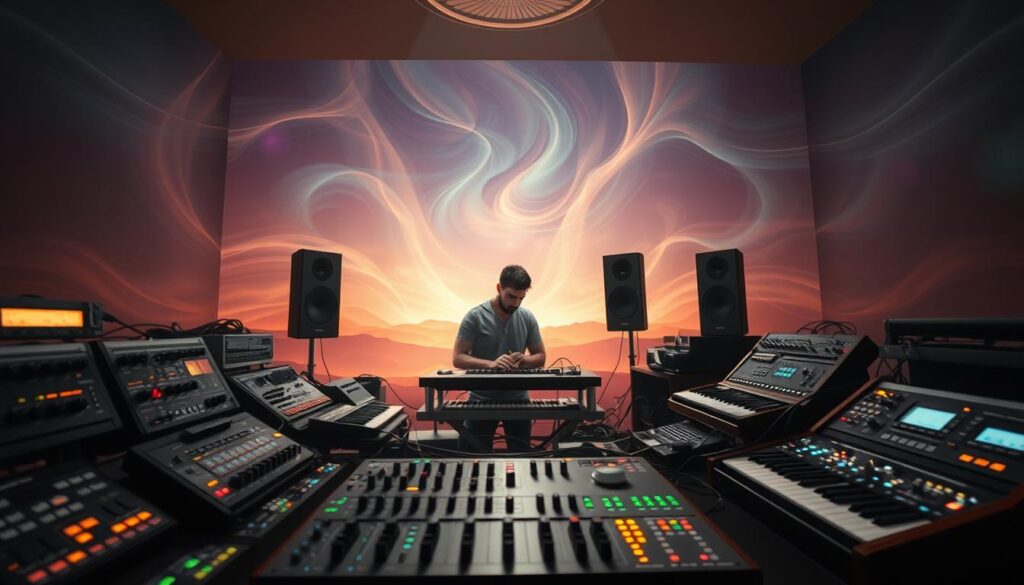
The beauty of this setup is how smart it is. Play a chord, and it spreads across different frequencies. The bass stays low, the mids are in the middle, and the highs shimmer. It’s like autopilot for your music.
Each layer can blend two samples together. This makes your soundscape dynamic and alive. You can turn a field recording into a string section in one note.
The ‘Thick’ button adds depth to your sound. It makes it feel real and powerful. It’s like going from a gentle breeze to a strong gust.
The ‘tone’ control is your secret tool. It’s not just a simple EQ. It can change your sound from deep and rumbling to bright and airy. This is where you add your personal touch to your ambient music.
Why is this important? A flat sound gets boring fast. Adding depth makes your music hypnotic and ever-changing. This layered approach helps you create that effect.
This idea is also behind techniques like granular synthesis. You’re breaking down sounds and putting them back together. It’s like painting with textures, not just colors.
The result is amazing. You’re not just playing a note. You’re leading a whole orchestra. You’re not just using a preset. You’re creating a whole world. That’s the power of this approach. You become a master builder of ambient music.
Layering with FX
Using reverb as an afterthought is like dressing a skeleton for a gala. It looks good but lacks life. Synthesis is the skeleton, and FX are the soul.
FX layering is about blending, not just adding. Adding a lot of reverb to a simple sound is like dressing a mannequin in a tuxedo. It looks nice but lacks soul.
The Dronar module’s design shows the importance of FX. Reverb and delay are right next to “Intensity” and “Movement.” This design says a great pad is born with reverb, not just added.
We’re talking about using reverb to mix harmonics into new textures. Add delay for rhythmic ghost notes. Use modulation FX like chorus for wavering instability.
Listen to ‘Fog’ or ‘Undertow’ packs. They’re built with reverb. The FX section makes your layers swim, merge, and transcend.
Here are three key principles for FX layering:
- FX as a Sound Source: Think “sound within a reverb,” not “reverb on a sound.” Start with the effect enabled and design the synth into it.
- Movement Before Majesty: A static pad with reverb is boring. Use modulated delays and choruses to add subtle motion.
- Intentional Smearing: Use long, dense reverb tails to blur layers into a single texture.
This approach is the next step after mastering layering. It answers the reason to layer synths in the first place: to create something new.
The goal is alchemy. Your synth layers are the base metals. The FX chain is the philosopher’s stone. With it, you turn waveforms into atmospheric gold.
Modulation for Movement
A static pad is just a dead pad. Movement makes your scene come alive. You become a true cinematographer.
Tools like the “Movement” control in a synth are key. They direct the whole scene. LFOs and arpeggiators add depth to your sound.
They make your notes blend smoothly, creating tension. The “Drone keys” let you quickly change your sound. LEAP Motion makes playing the pad a live show.
This adds emotion to your music. It turns a loop into an exciting journey. For more on modulation, check out this guide to modulation effects.
Your music should feel like a discovery. Modulation is like a camera that explores your light. It finds the beauty in the darkness.