
Music residencies have moved from a niche live format into a serious production and business model for major artists. The clearest 2026 examples in the research are Harry Styles’ 30-show Madison Square Garden run, which concluded on October 31, 2026, and Céline Dion’s long residency record in Las Vegas plus her Paris dates across September–October 2026 and May 2027. For producers, stage designers, and live-music crews, the key shift is not only where the shows happen. It is how a fixed room changes sound, lighting, stage architecture, audience travel, and pricing expectations.
How Music Residencies Change Production Logic
Static Rooms, Bigger Design Choices
A touring show has to survive repeated load-ins, freight limits, rigging differences, local rules, and venue-by-venue acoustics. A residency reduces some of those variables because the production remains in one location for a longer run. The New York Times reported that residencies can reduce costs tied to moving elaborate productions between cities, support more immersive and tech-heavy stage design, and create room for larger spectacle in fixed venues such as the Sphere in Las Vegas residency production reporting.
That does not mean every residency automatically becomes more inventive or more accessible. It means the constraints change. A fixed venue can let designers make repeatable choices around sightlines, lighting positions, video cues, automation, and front-of-house translation. From a producer’s seat, that matters because live arrangements can be shaped around consistent staging rather than rebuilt for a new room every night. Music residencies let designers and audio teams refine the same show over multiple performances, which can tighten timing and reduce the guesswork that comes with a moving tour.
What The Mix Has To Support
For an artist operating at the scale of Styles or Dion, the music has to carry both the concert and the destination event around it. The show mix is not only about loudness or clarity. It has to support theatrical pacing, crowd response, visual timing, and long-form repeatability. If a production runs for weeks in one room, every transition, playback cue, band entrance, vocal space, and audience singalong moment can be evaluated under similar conditions.
As a producer, I see that as a useful lesson for smaller creators too. A fixed setup rewards arrangement discipline. If the same room is used again and again, weak transitions become obvious. So do overfilled arrangements. A residency format can expose whether a song’s live version breathes, whether backing tracks leave room for the lead vocal, and whether low-end design works across the venue rather than only at front-of-house.
Harry Styles At Madison Square Garden
New York As A Single-City Run
Harry Styles’ Together, Together tour included a 30-show residency at Madison Square Garden in New York, listed in the research as his only U.S. dates for 2026, and that run concluded on October 31, 2026 NY1 residency report. That choice matters because Madison Square Garden is not being treated as one stop among many. It becomes the U.S. center of gravity for the campaign.
The format changes fan behavior. Instead of a tour moving to meet audiences in multiple American cities, audiences had to move toward New York if they wanted to see those U.S. dates. That dynamic can create a festival-like pattern around hotels, restaurants, transit, and short-term rentals, even though the event is built around one artist rather than a multi-act bill. The research also notes that Styles’ Amsterdam residency in May–June 2026 increased short-term rental demand there by 13.0%, a data point that supports the broader music-tourism reading, though city-to-city comparisons should be treated cautiously.
Pricing Pressure And Fan Expectations
The same fixed-venue logic that helps production can also sharpen pricing tension. The research notes that base seats for Styles reached more than US$1,000 before resale. That figure does not explain every ticket in the room, but it shows how high-demand residencies can still carry premium pricing even when the artist is not transporting a production city by city.
That is where fan expectations and industry economics collide. Some listeners may expect a stable venue to create cost savings that show up in ticket prices. The available research suggests the market did not necessarily work that way for the most in-demand seats. For creators watching from the outside, the caution is simple: production efficiency and audience affordability are not the same thing. Music residencies may reduce certain touring burdens while still operating inside a high-demand ticket market.
Celine Dion As Residency Precedent
Caesars Palace By The Numbers
Céline Dion’s Las Vegas history is central to this discussion because it shows how a residency can become part of an artist’s identity rather than a side project. The research states that her two Caesars Palace residencies, A New Day… from March 25, 2003 to December 15, 2007, and Celine from March 15, 2011 to June 8, 2019, totaled 1,141 concerts at the Colosseum. The reported attendance was 4,555,752, with US$681.3 million in ticket sales.
Those numbers are large enough to frame Dion as a precedent, not only as a participant in a later residency wave. The first run is listed at 714 shows, about 2,814,577 tickets, and US$385.1 million gross. The second is listed at 427 shows, about 1,741,175 tickets, and US$296.2 million gross. The research also states that the average ticket price rose from about US$137 to about US$170 between the two residencies. Any comparison across those long periods should account for changes in market conditions, but the direction is clear: the Las Vegas model supported sustained demand across many years.
Paris Dates In A Different Frame
Dion’s 2026–2027 Paris residency at Plenitude Arena in Nanterre gives the format a different setting. The research lists 26 sold-out shows: 16 from September 12 to October 17, 2026, and 10 scheduled from May 8 to May 29, 2027, in an arena seating about 30,000 per show. As of October 31, 2026, the September–October block had already taken place, while the May 2027 block remained ahead.
The Paris data suggests that the residency model is not limited to Las Vegas or New York. It can be adapted to another major destination city with arena-scale capacity. For production teams, that means the residency idea can sit between a traditional tour and a festival headline slot: longer than a one-night appearance, more fixed than a moving arena tour, but still dependent on intense demand around specific dates.
Audience And City Effects
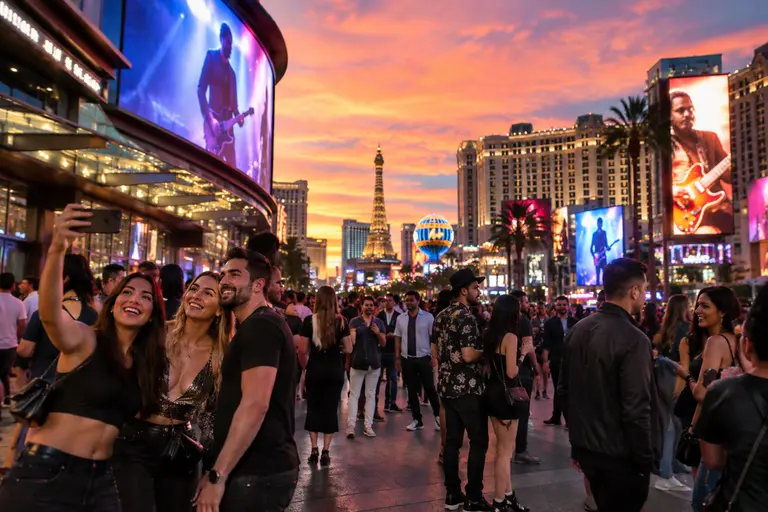
Music Residencies And Fan Travel
Audience travel is one of the strongest cultural signals in the research. Surveys cited in the New York Times reporting found that nearly 60% of fans travel for at least one live show per year, and 91% say a live event influenced them to visit a destination for the first time. Music residencies also change the host city’s role: the city is not just where the show happens, but part of the event’s appeal.
This is a major point for live culture. Fans may plan outfits, hotels, meetups, record-store visits, nightlife, and local food around the concert date. That turns the show into a temporary cultural cluster. It can benefit local businesses, but it can also raise concerns around pricing and access, especially if demand pushes lodging or tickets beyond what some fans can afford.
For readers who track creator culture, fashion, and live-event communities beyond music production, Kay Granger culture coverage sits in the same network and connects with many of these adjacent arts and fan-commerce questions.
Residencies Versus Traditional Touring
The traditional tour spreads access across regions but demands constant movement. A residency concentrates access in one place but can justify deeper investment in a fixed production. Neither model is inherently better for every artist or audience. A newer artist may still need routing that reaches many markets. A global star may be able to ask the audience to travel, especially if the show becomes a destination event.
Live Nation’s reported figure of more than 470 residency shows in 2026, with most in Las Vegas, points to the format’s scale. Still, that number should not be read as proof that all touring is shifting in one direction. It shows that the residency format has become large enough for serious business and production analysis.
Harry Styles And Celine Dion’s Music Residencies
Harry Styles and Céline Dion show two sides of the same format. Styles’ 2026 Madison Square Garden run reflects a modern pop star using a single city as a concentrated U.S. destination. Dion’s Las Vegas history shows how repeated performances in one venue can define a major chapter of an artist’s career, while her Paris dates show the model extending into another arena-scale market.
For producers and live designers, music residencies offer a clear technical lesson: a fixed room can reward more detailed show design, stronger cue discipline, and deeper arrangement choices. For audiences, the same model can create travel rituals and community moments, but it can also intensify pressure around pricing and access. The cultural impact is real, yet it should be discussed with care. The available data supports a measured reading: residencies are not replacing every tour, but at the top of the market they are reshaping how major live shows are built, sold, and experienced.