
LA exhibition sound design can give producers a disciplined way to translate visual art themes into synthesis decisions without claiming that a track “sounds like” an artwork or artist. Two recent Los Angeles examples are especially useful for studio thinking: A New Media Techspressionist Architectures – AR Experiment, which opened on July 9, 2026, and SIDE B: the sounds, which ran from September 19 to October 24, 2026. Both point toward sound as structure, attention, memory, and space rather than decoration.
What LA Exhibition Sound Design Can Borrow From AR
The ACM SIGGRAPH DAC and LACDA collaboration around A New Media Techspressionist Architectures – AR Experiment is useful because the exhibition did not treat sound as a single layer added after the visual concept. The official DAC listing describes six co-created works made by artist, composer, and technologist teams, with themes including granular synthesis, electro-acoustic improvisation, spatialization, remix culture, generative systems, glitch art, and game engines SIGGRAPH DAC listing. For producers, that combination suggests a workflow where synthesis, interaction, and space are planned together.
LA Exhibition Sound Design From Granular Thinking
Granular synthesis fits the AR context because it can turn a fixed source into a field of tiny events. In production terms, that means a sound does not need to remain an obvious sample. It can become a cloud, a surface, or a shifting material. A producer might record a short object sound, split it into grains, then vary density, grain size, pitch spread, and envelope shape until the source feels architectural rather than loop-based. The point is not to imitate any one exhibition work. The point is to adopt the exhibition’s supported theme: sound can be constructed as an environment made of small, changing units.
This approach also helps keep the technical method tied to listening. A grain cloud with no control can become vague quickly. A clearer strategy is to assign each parameter a spatial or visual analogy: grain density as crowding, pitch spread as depth, envelope length as surface roughness, and stereo width as distance. That creates repeatable decisions, which is useful for producers building cues, installation sketches, or experimental tracks.
Spatialization Without Overstating The System
Spatialization is another supported theme in the AR exhibition, but it does not require a producer to claim access to a gallery-scale rig. A studio version can start with panning, early reflections, filtered delays, and automation. If the visual idea is architectural, the mix can mark near, middle, and far zones. A dry transient can sit close to the listener, a filtered reflection can suggest a side wall, and a longer diffuse layer can imply a larger volume.
For LA exhibition sound design, the useful lesson is proportionality. Not every sound should move. If every layer spins, the listener loses orientation. A better method is to keep one element fixed as a reference point while other layers pass around it. That fixed element might be a pulse, a low drone, or a repeated noise gesture. Motion becomes meaningful because the ear has a stable point for comparison.
Listening Rooms, Jazz Memory, And Rights-Aware Sound
SIDE B: the sounds at David Zwirner LA offers a different kind of lesson. The Gallery Platform LA listing identifies it as an exhibition of Roy DeCarava’s photography with a bespoke listening room and live programming, including focus days centered on John Coltrane, Miles Davis, and Billie Holiday, designed to examine the visual-aural relationship between everyday life and jazz culture Gallery Platform LA listing. Since the exhibition closed on October 24, 2026, it is best discussed retrospectively, as a completed example of how a gallery setting can frame listening as part of seeing.
From Photography To Timbre
For synthesis, the DeCarava context suggests restraint. A photograph can hold shadow, grain, posture, timing, and social presence without spelling out a narrative. A sound designer can respond to that kind of visual attention with timbral choices rather than direct musical quotation. Soft saturation, brushed noise, narrow-band room tone, muted transients, and slow envelope movement can all suggest intimacy without borrowing protected recordings or copying a musician’s performance language.
This is where rights awareness matters. Referencing jazz history in a respectful way does not automatically grant permission to sample famous recordings, use artist likenesses, or present a commercial work as connected to a specific musician. A safer studio exercise is to write original material, record your own performances, or use cleared material where the license is clear. The creative challenge then becomes more interesting: how do you evoke close listening, night air, room depth, or photographic contrast using synthesis and original audio?
Designing A Listening Room In A Mix
A listening room is not only a physical space. In a track, it can be an arrangement principle. The SIDE B example shows how curated sound can sit beside visual work without becoming mere background. In a DAW, that can mean leaving gaps, allowing a tone to decay fully, or placing a single noise layer behind a melodic fragment so the listener has time to inspect it.
A practical method is to create a three-layer room sketch. The first layer is the “image plane”: a close sound with limited reverb, such as a muted pluck or soft key click. The second layer is “air”: filtered noise, vinyl-like crackle made from original noise, or a breathy synthesizer pad. The third layer is “memory”: a delayed fragment that returns only at phrase endings. This keeps the mix from becoming crowded while still giving the listener a sense of place.
Translating Exhibition Themes Into Studio Systems
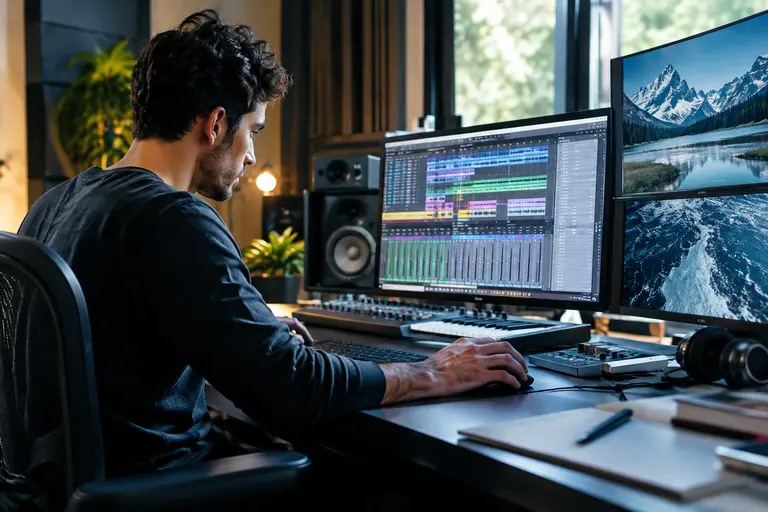
The strongest studio translation is not a preset list. It is a system for deciding what sound should do. The AR exhibition’s themes point toward motion, interaction, and runtime variability. The SIDE B exhibition points toward listening, memory, and relation between image and music culture. Together, they suggest a production method that starts with a concept, then assigns each sonic layer a job.
- Granular layer: Use short original recordings, then vary grain density and size to suggest surface, crowding, or distance.
- Improvised layer: Record one take of electro-acoustic gestures, then edit lightly so human timing remains audible.
- Spatial layer: Use pan, delay, filtering, and reverb to define near, middle, and far positions.
- Glitch layer: Apply interruptions sparingly, so errors read as structural events rather than constant decoration.
- Generative layer: Let probability affect one or two parameters, not the entire track, so the piece stays legible.
This connects with RobSonic’s recent notes on current sound design across U.S. art shows, where generative systems, embodied listening, analog objects, and cautious AI use appear as recurring production concerns. For coverage related to sound design and other arts in the same network, check out the broader editorial perspective provided by Kay Granger.
Parameter Mapping That Keeps Meaning Clear
Parameter mapping is where many concept-driven tracks either gain focus or drift. If an exhibition theme is “architecture,” do not automate every spatial control at once. Map height or distance to one parameter, such as reverb pre-delay. Map surface to another, such as high-frequency damping. If the theme is “memory,” avoid making every return identical. Let a delayed phrase lose brightness or change envelope shape each time it appears. These choices make the mix readable.
For LA exhibition sound design, I would keep a short written map next to the session: what each layer represents, which parameter carries that idea, and what the listener should notice. This may sound simple, but it prevents a concept from becoming a pile of effects. It also helps collaborators understand why a sound moves, fractures, or stays still.
LA Exhibition Sound Design Strategies
LA exhibition sound design is most useful to producers when it becomes a set of constraints rather than a claim of direct translation. The AR example supports strategies around granular synthesis, spatialization, electro-acoustic improvisation, generative behavior, glitch, remix culture, and game-engine thinking. The SIDE B example supports strategies around curated listening, visual-aural relation, everyday life, jazz culture, and the ethics of influence.
A good studio response is modest and specific. Build original source material. Let spatial choices reflect a concept. Use generative tools where variation has a clear purpose. Treat jazz-related references with care, especially around recordings, names, and likenesses. Leave silence and decay in the arrangement so the listener can perceive detail. That is where exhibition thinking becomes practical for producers: it teaches us to design not only the sound, but the conditions for attention.