
Artist showcase strategies feel more practical when they start with real event structure, not abstract promotion advice. Confluence Music Fest in Charlotte gives beatmakers and arrangers a useful case study because its 2026 edition started on October 7, 2026, and was scheduled to run through October 10 with a larger conference-plus-festival model. Reported details show a move from about 35 acts and seven shows in 2025 to more than 45 artists across 13 venues in 2026, with attendance expected to rise from about 1,200 to between 3,000 and 4,000 people, according to Exposed Vocals.
That does not prove every expanded showcase creates better outcomes for every artist. Showcase results can vary by genre, room, time slot, fan capture, booking fit, and post-event follow-up. Still, the Confluence expansion points toward a grounded lesson: beatmakers should treat a showcase less like one performance slot and more like a short-form arrangement system. The set, the room, the story, and the next fan action all need to connect.
Artist Showcase Strategies Start With Format
What Confluence’s Expansion Shows
A hybrid conference and festival format changes the pressure on an artist. A club set inside a multi-venue program is not only a place to play songs. It is also a live audition for collaborators, fans, local organizers, and other artists moving between rooms. For producers, that means the set has to communicate identity quickly. A beat may be well mixed, but if the first two minutes do not clarify the artist’s voice, the room may not know what to listen for.
The Confluence model matters because it spread attention across venues rather than placing every act inside one continuous stage order. That can be useful for discovery, but it also makes audience attention less predictable. Someone may hear only ten minutes of a set. A&R-style listeners, writers, beatmakers, vocalists, and casual fans may all enter with different expectations. Artist showcase strategies should account for that uneven attention by making each section of the set legible on its own.
Why Artist Showcase Strategies Need A Set Arc
A beat showcase should not feel like a folder of instrumentals played in sequence. Arrangement is the producer’s best tool for making a short slot feel intentional. A strong set arc can begin with a clear sonic signature, shift into contrast, include one stripped-down moment that reveals the musical idea, and end with the most memorable hook, groove, or collaborative moment.
For beatmakers, the arrangement question is simple: what can the room understand without a long explanation? If the answer is bass design, let the low end become a recurring anchor. If the answer is sample collage, make the edits clear enough to be heard on a club system. If the answer is drums, build a section where the groove changes in a way listeners can feel. Artist showcase strategies work better when the production choices are staged as musical events, not just playback.
Turn Venue Spread Into Arrangement Choices
Build Versions For Different Rooms
A multi-venue showcase asks producers to think like arrangers and live engineers. A small room may reward detail, silence, and texture. A louder club may reward drum contrast, vocal chops, and simpler low-end movement. An outdoor setting may need clearer transitions and less dependence on tiny stereo details. The facts from Confluence do not tell us how each venue sounded, so any exact room-by-room claim would be speculative. The safer production lesson is to prepare adaptable versions before the show.
One practical method is to create three versions of the same core set: a full version, a tighter drum-forward version, and a stripped version with fewer midrange layers. This is not about watering down the music. It is about protecting the idea under different playback conditions. If a beat only works when every detail is audible, it may struggle in a crowded showcase room. If the hook, rhythm, and arrangement still read through a simplified version, the music has a better chance of landing.
Keep The Identity Clear
Producers often want to show range, especially in rooms full of peers. Range helps, but too much contrast can make a short set feel scattered. A 20-minute slot can include tempo shifts, guest vocals, beat switches, or genre references, but the listener should still hear a through-line. That through-line might be drum swing, synth palette, vocal processing, chopped guitar, or a recurring transition motif.
This connects with the same practical logic behind audience engagement lessons: listeners need cues that help them follow the performance. A beatmaker can use risers, mutes, call-and-response moments, or visible pad performance, but those choices should serve the track. The goal is not to force crowd reaction. The goal is to make the arrangement readable in real time.
Make Education And Follow-Up Part Of The Show
Teach One Production Decision
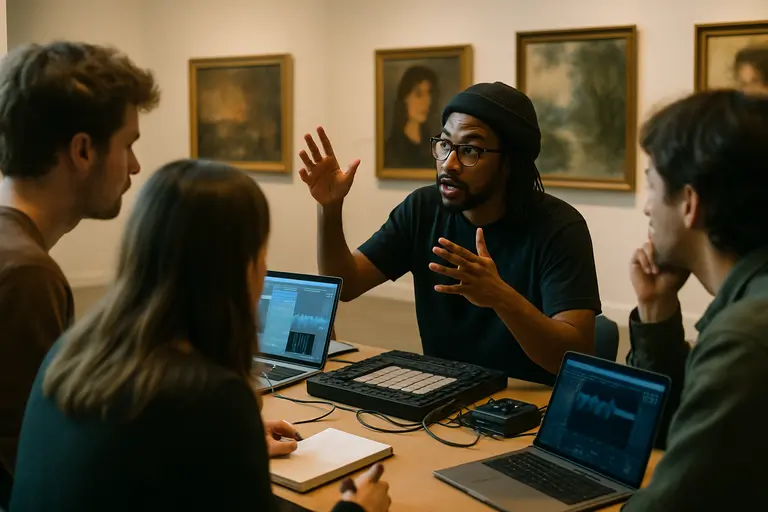
Showcases attached to conferences often place artists near panels, workshops, and professional conversations. That setting gives beatmakers a chance to frame the music without turning the set into a lecture. A short spoken setup can work if it teaches one production decision: why the drums drop out before the chorus, why the bass avoids the kick, why a vocal texture returns in every transition, or why a sample was replayed rather than simply looped.
That framing should be brief and respectful. It should not over-explain the art or make claims the music cannot support. For example, saying “this next section is built around one kick-and-bass relationship” gives the audience a listening point. Saying it is the future of a genre would be unsupported. Analytical restraint matters because music communities do not need hype to be taken seriously.
Capture Attention Without Overpromising
The National Independent Venue Association’s State of Live research gives useful context for why local showcases deserve serious planning. Its June 2025 report said independent live stages in the United States supported $153.1 billion in economic output, $51.7 billion in wages, directly paid 31% of expenses to artists, and that 62% of independent live music venues host showcases featuring local artists, according to NIVA’s State of Live study. Those numbers describe the scale of the live ecosystem, not a guarantee for one artist’s payout.
Because outcomes are not guaranteed, follow-up should be part of the arrangement plan. A beatmaker can end a set with a QR code on merch, a clearly named project, a mailing list, or a limited beat tape. The best follow-up is simple and honest: one place to hear the music, one place to support it, and one reason to remember the project. For creators thinking about product presentation beyond the stage, Shimply offers resources in the same network focused on creator needs.
- Open with the clearest sonic identity, not the most complicated beat.
- Build one visible arrangement change every few minutes: mute, drop, switch, or live trigger.
- Prepare alternate set versions for small rooms, loud clubs, and outdoor playback.
- Use one short explanation to frame a production choice, then let the music prove it.
- End with a direct next step for listeners who want to follow or buy.
Creative Strategies For Artist Showcases Inspired By Confluence Music Fest
Confluence Music Fest’s 2026 expansion suggests a useful framework for producer-led showcases: format shapes arrangement. A beatmaker playing inside a larger, multi-venue event cannot assume every listener arrives with context. The set has to provide that context through structure, sound design, pacing, and follow-up. Artist showcase strategies should start with the question a listener might ask after five minutes: who is this producer, and what makes this music identifiable?
The answer does not have to be loud or obvious. It might be a patient groove, a restrained sample palette, a distinctive snare pocket, or a live controller routine that makes the production process visible. What matters is consistency. Each beat should either reinforce the identity or create contrast that makes the identity clearer.
For RobSonic readers, the production takeaway is direct. Do not build a showcase like a playlist. Build it like a compact arrangement with sections, tension, release, and a final memory point. The Confluence example shows how a larger event structure can create more points of contact across artists, venues, and audiences. The cautious lesson is that access alone is not the strategy. The strategy is making the music understandable, repeatable, and easy to follow after the room goes quiet.