
Granular sequencers usually decide when a grain should play with clocks, probability tables, envelopes, LFOs, or conventional step grids. NEXTALE Audio’s GranularBreaker replaces much of that logic with something more physical: balls bouncing around a brick-breaker playfield.
Released on September 19, 2026, GranularBreaker connects a granular synthesizer to a real-time physics engine. Producers load a sample, draw structures on a grid, launch balls, and let collisions trigger spatialized grains. Gravity zones, repulsion areas, unbreakable bricks, scale restrictions, quantization, and multiple operating modes determine whether the result behaves like a sequencer, a generative instrument, or controlled chaos.
NEXTALE Audio currently lists GranularBreaker at €39 as a one-time purchase for Windows and macOS, with VST3, Audio Unit on macOS, and standalone versions. KVR Audio’s September 19 launch coverage described an introductory $35 offer from a $45 launch price through October 10, showing that regional storefront pricing has differed since release.
The deeper idea is more interesting than the game interface: rhythm is created by simulated motion.
Every Collision Can Become A Musical Event
The defining rule inside GranularBreaker is simple.
A ball hits something, and the collision can produce a grain.
NEXTALE Audio’s GranularBreaker product page describes the instrument as a meeting point between granular synthesis and brick-breaker physics. Users can import their own samples or begin with factory material, then construct a playfield that determines how balls move.
Those collisions replace the predictable left-to-right motion of a conventional sequencer.
A step sequencer knows that step five follows step four. GranularBreaker knows where a ball is moving, what it collides with, how the physics system changes its trajectory, and whether another collision follows.
The timing can still be disciplined. Events may be quantized to the DAW grid, and Scale and Mode controls keep generated notes inside a selected pitch structure.
Remove that discipline and the same playfield can produce far less predictable timing.
This creates a useful continuum between composition and emergence. The producer establishes the environment, but the moving objects decide many of the individual events.
The Grid Is Both A Game Board And A Sequencer
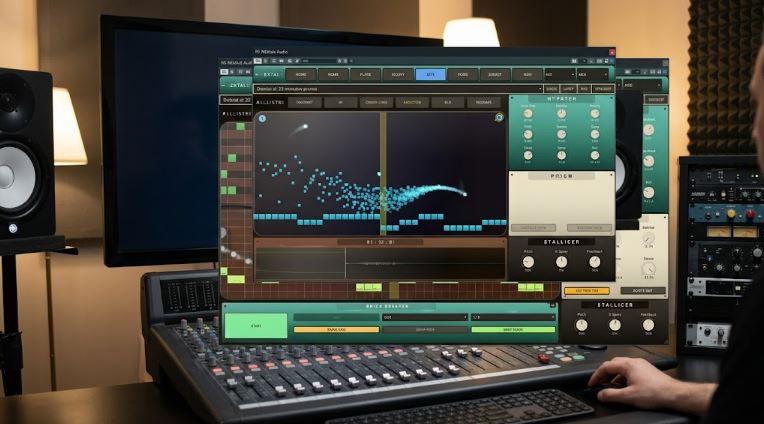
GranularBreaker’s grid is not decorative animation placed on top of a hidden MIDI generator.
It is part of the sequencing system itself.
The full version provides a 40-by-22 grid and supports as many as 20 simultaneous balls and their associated spawners. The free demo limits the playfield and sequencer to a 10-by-10 area with four balls, while retaining the complete granular sound engine.
NEXTALE supplies several brick and zone types: Normal, Gravity, Repulsion, Unbreakable, and No-Spawn.
Those categories change movement rather than simply changing appearance.
Gravity can pull balls into altered trajectories. Repulsion pushes them away. Unbreakable objects can function as permanent parts of the rhythmic geometry. No-Spawn areas restrict where new motion can begin.
A producer can therefore compose by shaping movement.
Place obstacles closer together and collisions can become denser. Create open regions and events may become sparse. Add forces and repeating trajectories can destabilize.
The grid is effectively a graphical rule system. Instead of entering every note in advance, the producer designs conditions under which notes can happen.
Granular Synthesis Makes Physics More Than A MIDI Trick
The collision model would still be interesting if GranularBreaker produced only MIDI notes, but granular synthesis gives each impact another dimension.
NEXTALE provides controls for grain size, life, pitch, spread, scan position, and a full ADSR envelope. Users can drag their own sample into the engine and let the collisions extract short fragments from that material.
This means identical rhythmic events do not have to produce identical sounds.
One collision may play a short fragment. Another can access a different section of the source. Pitch and spread settings can transform the grain further, while modulation creates continuing variation.
The relationship between physics and granular synthesis is especially natural because grains are short events.
A collision already has a clear beginning. Mapping that moment to a grain turns a physical impact into a sonic impulse without requiring a long sustained voice.
Dense bouncing patterns can create clouds. Sparse trajectories can expose individual fragments. Repeated rebounds may form recognizable rhythms before a changed angle pushes the sequence somewhere else.
KVR Audio’s GranularBreaker release coverage describes the result as emergent rhythm and evolving texture generated from the interaction between the playfield and the imported source.
Quantization Decides How Much Physics Reaches The Groove
Pure physics does not automatically produce useful musical timing.
A ball does not care whether its next impact lands neatly on a sixteenth note.
GranularBreaker addresses that problem through quantization and DAW synchronization. A producer can let collisions happen according to the simulation, then constrain the resulting events to a musical grid.
This creates two layers of time.
The physics engine determines why an event happens. Quantization determines when that event becomes musically aligned.
That distinction is valuable.
Strict quantization can turn complicated trajectories into recognizable patterns without removing the movement that generated them. Looser settings preserve more of the irregularity. With quantization removed, the collision timing itself becomes the rhythm.
Scale and Mode controls perform a similar job for pitch.
The physics system can remain unpredictable in its event generation while the note output stays inside a chosen harmonic framework.
This lets the producer separate unpredictability from unusability. Rhythm can be chaotic without necessarily becoming disconnected from tempo, and pitches can vary without automatically leaving the composition’s tonal system.
Different Modes Change What The Physics Engine Means
GranularBreaker does not force every patch into one brick-breaking behavior.
NEXTALE includes several modes built around different relationships between movement and sequencing.
Breaker mode is closest to the obvious game concept. Balls travel through the playfield and collide with structures.
Marble Drop changes the way motion develops, making gravity-driven movement more central.
A sample-accurate step-sequencer mode provides a more disciplined alternative for producers who want the visual environment without surrendering precise rhythmic control.
The software can also generate evolving break patterns.
These modes are important because “physics sequencer” could otherwise become a novelty that works for one type of random pattern.
A conventional sequence may be the right starting point for a kick or bass line. Marble-like motion may work better for scattered percussion. Free bouncing can create background texture, while changing break structures can produce longer evolving phrases.
The instrument is strongest when the producer chooses how much responsibility to give the simulation.
MIDI Output Turns GranularBreaker Into A Controller For Other Synths
GranularBreaker is not limited to its internal grain engine.
Every collision can produce MIDI output.
That turns the playfield into a sequencing source for another synthesizer or sampler. A physics-generated pattern can trigger an FM synth, drum instrument, wavetable synth, hardware device routed through the DAW, or any other MIDI-controlled destination.
This broadens the concept significantly.
The grain engine demonstrates the relationship between collisions and sound directly, but MIDI output lets the same simulation become compositional infrastructure.
A bouncing ball might trigger a short granular texture internally while simultaneously producing a note for another instrument. Producers can record the resulting MIDI into a DAW and edit it later, turning an emergent performance into conventional sequence data.
RobSonic has examined another unusual approach to granular interaction in its Iota II sampling workflow. Iota II makes drawing through spectral material part of sample playback. GranularBreaker replaces drawing with simulated physical movement, but both instruments ask the same broader question: what happens when a sample is explored through an interface other than a standard timeline?
Three LFOs Keep The Sound Moving After The Collision
Physics controls when events happen, but GranularBreaker includes conventional modulation as well.
The full version provides three LFOs assignable to almost every knob. The free demo includes one.
That combination is significant because a collision can determine the initial event without determining its complete sonic character.
An LFO can move grain parameters continuously while the physics engine supplies irregular triggers. A bouncing pattern may therefore remain recognizable rhythmically even as the grain size, scan position, filter response, spatial characteristics, or another destination evolves.
This separates event generation from timbral modulation.
The physics engine handles structure.
The granular engine determines the fragments.
LFOs introduce slower or periodic change around both.
That layered approach prevents GranularBreaker from becoming dependent on the visual game mechanic for every form of variation.
Producers can create a highly controlled playfield but make the sound itself unstable, or let the grid generate unpredictable rhythms while the underlying grain parameters stay restrained.
Spatial Audio Makes The Ball Movement Audible Beyond Timing
GranularBreaker includes spatial processing as part of its internal effects system.
That is an obvious match for a visual instrument built around moving objects.
If a ball changes position across the grid, spatialized grains can reinforce the impression that the event occupies a changing location rather than merely changing its trigger time.
NEXTALE also includes low-pass and high-pass filtering, bitcrushing, saturation, synchronized delay, and reverb.
The reverb section accepts user impulse responses.
Importing an IR lets the producer place the granular output inside captured or designed acoustic responses rather than relying only on a fixed algorithmic room. More experimental impulse responses can turn the reverb itself into another sound-design stage.
GranularBreaker therefore has two kinds of space.
The playfield provides simulated geometric space for movement.
The audio engine provides stereo and reverberant space for listening.
Those two spaces do not need to correspond literally, but joining them strengthens the basic idea that location and motion can contribute to composition.
Version 1.0.3 Shows The Instrument Is Already Moving Past Launch
GranularBreaker launched on September 19, and current KVR product information lists version 1.0.3.
That is worth noting for an instrument whose workflow depends on a combination of real-time graphics, physics, granular playback, MIDI, and plugin-host interaction.
KVR currently lists Windows 10 or 11 support and macOS 11 Big Sur or later. The macOS build is Universal, supporting Apple Silicon and Intel systems.
The software needs approximately 80 MB of disk space. NEXTALE recommends 8 GB of RAM when user samples and impulse responses are being loaded, though 4 GB is listed as the minimum.
The interface uses GPU acceleration and requires OpenGL support on Windows.
GranularBreaker needs an internet connection once for license activation and can then operate offline.
The standalone edition adds optional microphone input for live granular processing, opening another route beyond imported files. A performer could feed live material into the instrument and let the physics environment reorganize fragments of an incoming source.
That pushes the design closer to an instrument than a preset-generating utility.
Game Physics Changes The Meaning Of A Sequence
The most interesting part of GranularBreaker is not that it looks like a game.
Music software has used game imagery before.
The important change is that the game rules are generating musical causality.
A ball hits a brick because of its previous position, velocity, trajectory, and interactions with the environment. That collision becomes a sonic event. The event changes the emerging pattern, and the next physical interaction continues the process.
A conventional sequencer repeats instructions.
GranularBreaker simulates consequences.
The producer still has substantial control. Grid design, ball count, zones, samples, quantization, scales, modes, modulation, effects, and operating modes all constrain what can occur.
Yet the exact path between those decisions and the resulting pattern can remain partly unpredictable.
That is where the instrument becomes more than a playful interface.
GranularBreaker offers a way to compose systems instead of writing every event.
For producers interested in generative rhythm, granular sound design, evolving textures, or unconventional MIDI sequencing, the brick-breaker metaphor provides a readable way to watch those systems operate.
The screen shows why a note happened.
The granular engine determines what that event sounds like.
The physics decides where the sequence may go next.