
Live performance gear had a clear showing across Los Angeles-area exhibitions in 2026, but the useful story is narrower than a hype cycle. The most relevant examples were practical stage tools: compact modeling processors, AI-assisted tone capture, neural sampling concepts, monitor-recording systems, wireless stage products, and software updates that could help creators manage tighter production timelines. As of October 17, 2026, the Los Angeles Synth & Pedal Expo and Cine Gear Expo LA had already taken place, while NAMM Show 2027 remained scheduled for January 26–30, 2027, at the Anaheim Convention Center.
For producers and performers, the question is not whether every new tool deserves a slot in a live rig. The better question is whether the tool solves a repeatable problem: faster setup, smaller carry weight, more reliable routing, better recall, clearer monitoring, or more expressive control. That is the frame I would use before putting any new box on a pedalboard, DJ table, hybrid stage rig, or playback station.
Why Live Performance Gear Moved Toward Smaller Systems
Live Performance Gear At LA Synth & Pedal Expo
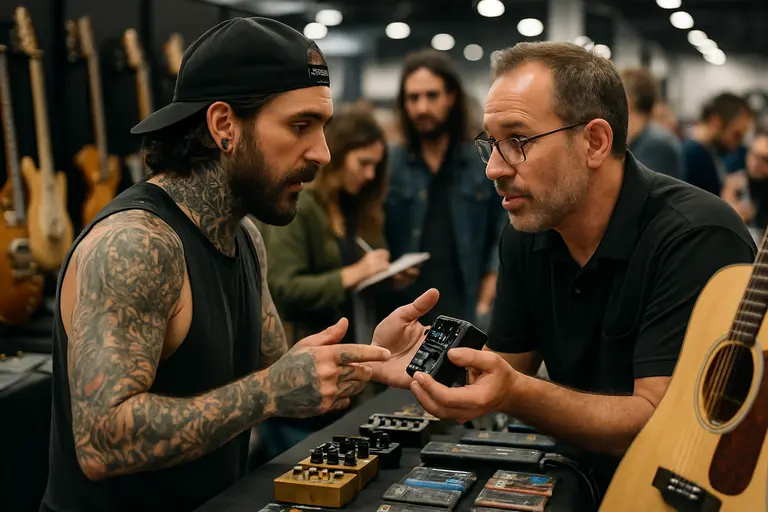
The Los Angeles Synth & Pedal Expo 2026 was held on June 6–7, 2026, at DAF Studios in Los Angeles. The event was built around hands-on testing, which matters because live tools should be judged by feel, setup speed, footswitch behavior, latency perception, output routing, and failure points as much as by feature lists. IK Multimedia showed TONEX ONE+, TONEX Pedal, TONEX ONE, and TONEX plug at the event, with the company describing the line around AI Machine Modeling for realistic amp and pedal tones through its LA Synth & Pedal Expo post.
That matters for guitarists, bassists, synth performers, and beatmakers using outboard chains. A compact modeling pedal can reduce the need for multiple amp, cab, and drive devices, but only if the player trusts the captured tones and can manage presets under stage pressure. The research does not provide independent latency numbers, failure-rate testing, or blind listening results, so it would be too strong to claim that one platform has replaced traditional amps or pedalboards. The supported takeaway is more modest: AI-based tone modeling was visible in a Los Angeles performance-gear setting, and the tested products were presented as tools for amp and pedal tone recreation.
From a producer’s angle, the best use case may be repeatability. A beat set with live guitar, a rap tour with a direct guitar rig, or an electronic act adding processed bass can benefit from saved tones that travel with the player. The caution is that saved sounds still need gain staging, front-of-house checks, and backup routing. Compact does not automatically mean safer; it just changes what has to be checked before doors open.
Neural Sampling As A Stage Concept
Roland Future Design Lab and Neutone unveiled Phase 2 of Project LYDIA on May 7, 2026, presenting an AI-powered neural sampling pedal concept moving toward a fully self-contained, performance-ready hardware platform, according to the Roland announcement. The phrase “concept” is important. Based on the research, this was not framed as a standard shipping pedal with full retail details, but as a project being advanced toward standalone performance hardware.
For live performance gear, a self-contained approach is worth watching because computer-free systems can simplify a stage plot. A pedal that handles neural sampling internally could appeal to performers who want AI-assisted sound behavior without depending on a laptop. Still, the research does not provide price, release timing, third-party testing, or long-term reliability data. A cautious review has to stop there. The concept points toward where performance processors may go, not what every touring artist should use right now.
What Cine Gear Expo LA Suggested For Stage Media
Monitor-Recorder-Switcher Tools For Hybrid Shows
Cine Gear Expo LA 2026 was scheduled for June 5–6, 2026, at the Universal Studios Lot in Universal City, California, and the research describes a show with more than 200 exhibitors covering film, lighting, camera, and monitoring tools. Although Cine Gear is not a traditional music-instrument show, its products matter for artists who combine live sound, video playback, camera feeds, LED surfaces, and remote production workflows.
During the June 5–6 event, Atomos revealed the Sumo Pro-19, described in the research as a 19-inch 4K monitor-recorder-switcher with built-in WiFi and Ethernet for remote collaboration, support for NDI HX3 video over IP, and AirGlu wireless timecode. Those functions sit close to modern performance needs. A live electronic act may use cameras for stage screens. A theater-style concert may need timecode alignment. A festival content team may need cleaner ways to monitor and record feeds. The point is not that a film product instantly becomes a touring standard. The point is that the boundary between stage, broadcast, and content capture kept getting thinner during 2026 exhibitions.
This connects with RobSonic’s earlier reporting on live sound gear lessons, where control, wireless systems, and mix translation were treated as practical problems rather than aesthetic extras. Video gear belongs in that discussion when the artist’s show depends on screen timing, camera direction, or post-show content delivery.
Post-Production Software As Performance Support
Blackmagic Design introduced DaVinci Resolve 21 at Cine Gear Expo LA 2026, according to the research. The listed updates included AI tools such as IntelliSearch for content finding, CineFocus for focal point adjustment, enhanced facial refinement, and improvements in Fusion graphics, Fairlight audio foldering, and keyframing. Those features are post-production oriented, yet they still affect performance teams.
Live creators often need fast edits after a show: social clips, tour recaps, sponsor deliverables, behind-the-scenes material, and projection content revisions. Better media search and cleaner audio organization can shorten the distance between capture and publish. For a producer, that is not the same as a compressor, sampler, or synth, but it still belongs near the live workflow. The show does not end when the last kick drum fades; for many artists, the captured material becomes the next promotional asset or visual reference.
Rights and likeness clearance should stay part of that workflow. If footage includes audience members, collaborators, fashion designers, dancers, or copyrighted visuals, creators should avoid assuming that technical access equals permission to sell or reuse everything. That is not legal advice, but it is a practical reminder for anyone treating performance footage as creator-commerce material. For readers comparing culture and creator coverage across related sites, Kay Granger provides insights on creator-commerce material and is part of a broader publishing network that delves into these topics.
How NAMM 2026 And NAMM 2027 Frame The Next Buying Cycle
Performance Categories Seen At NAMM 2026
NAMM Show 2026 took place on January 20–25, 2026. The research identifies Best in Show examples that included the Neural Quad Cortex Mini, Yamaha M-6300 Power-Lite series, Boss GX-1 Guitar Effects Processor, Electronic Stage One Wireless Speaker, Fox 5800 Clarinet, and Cannonball Black Sapphire (30) Saxophone. These examples spread across multi-effects processing, amplification, wireless speaker design, and premium wind instruments.
That spread is useful because it reminds us not to define live performance gear only as pedals and plug-ins. A working stage can include horn players, wireless monitoring, power amplification, speaker deployment, guitar processing, playback systems, and acoustic instruments with premium build goals. NAMM attendee interest also leaned strongly toward pro audio, according to the research, with pro audio drawing interest from more than 40% of attendees and guitars following behind. Accessories, software and plug-ins, amplifiers, and live-sound technology also showed strong engagement in the post-show material summarized in the research.
The safe interpretation is that performance workflows were receiving attention across several product families. The unsafe interpretation would be to claim a single market direction without sales data, adoption studies, or tour-rider evidence. Exhibition interest can tell us what companies are showing and what attendees are exploring. It does not prove which products will become standard on stages.
NAMM 2027 As A Pending Checkpoint
NAMM Show 2027 is scheduled for January 26–30, 2027, at the Anaheim Convention Center, with exhibits listed for January 28–30. The research states that the event is expected to unite more than 60,000 industry professionals from 122 countries with $9.8 billion in buying power. Since that event had not happened as of October 17, 2026, it should be treated as a pending checkpoint, not a completed source of results.
For buyers, NAMM 2027 may be the place to compare claims that appeared earlier in 2026: smaller processors, AI-assisted modeling, wireless stage tools, lighter amplification, and integrated software workflows. I would not recommend pre-judging products before hands-on testing. A spec sheet can miss footswitch spacing, screen readability, preset load behavior, heat, noise floor, and how a device reacts when the venue power is less than perfect.
Producers preparing for 2027 purchases should build a test list before the show. That list should include input and output needs, MIDI or USB control, balanced outputs, stereo behavior, patch spillover, backup options, and whether the device can be reset quickly after a mistake. The flashiest demo is rarely the same as a reliable stage routine.
What These Exhibitions Mean For Working Creators
Practical Criteria Before Buying
The strongest through-line across these exhibitions is integration. Modeling pedals try to fold amp and pedal tone into smaller boxes. Neural sampling concepts aim to move AI processing closer to standalone hardware. Monitor-recorder-switchers connect video capture, switching, networking, and timecode. Post-production software uses AI and organization tools to speed the work after a performance. NAMM examples spread the same pressure across processors, amps, speakers, and instruments.
Before replacing proven live performance gear, creators should ask a few grounded questions:
- Does the new device reduce setup time without creating a harder troubleshooting path?
- Can the performer operate it under low light, pressure, and stage noise?
- Does it improve recall, routing, tone consistency, monitoring, or capture quality?
- Is there a practical backup if the device freezes, loses power, or receives the wrong preset?
- Can the team test it in rehearsal before using it at a paid performance?
That kind of checklist keeps gear reviews honest. Innovation is not only a new feature. It is a feature that survives the realities of load-in, line check, cramped stages, and short changeovers.
Live Performance Gear From LA Exhibitions
The 2026 Los Angeles-area exhibition cycle showed a useful split. The Los Angeles Synth & Pedal Expo put compact AI tone modeling in a hands-on music context. Cine Gear Expo LA showed how monitoring, recording, switching, networking, and editing tools can support hybrid performance production. NAMM 2026, while in Anaheim rather than Los Angeles, supplied a wider industry snapshot of processors, amplification, wireless speaker tools, and instruments. NAMM 2027 remained scheduled for January 26–30, 2027, and should be judged after its exhibits open and products can be tested.
For working musicians, beatmakers, stage designers, and creator-commerce teams, the best reading is cautious optimism. The tools are getting smaller, more connected, and more dependent on AI-assisted processes, but the core job has not changed. A live rig has to sound good, behave predictably, and support the performer rather than distract them. The most promising live performance gear from these exhibitions is not the gear with the longest feature list. It is the gear that lets artists deliver a repeatable show while keeping room for expression.