
A MIDI clip normally represents a finished sequence of decisions. The notes have positions, lengths, velocities, and pitches, and any new version usually requires editing or duplicating that clip.
Abyzor’s IZZY Bass starts from a different idea. Instead of treating one bassline as the final object, it stores the generative state behind that bassline as a shareable seed.
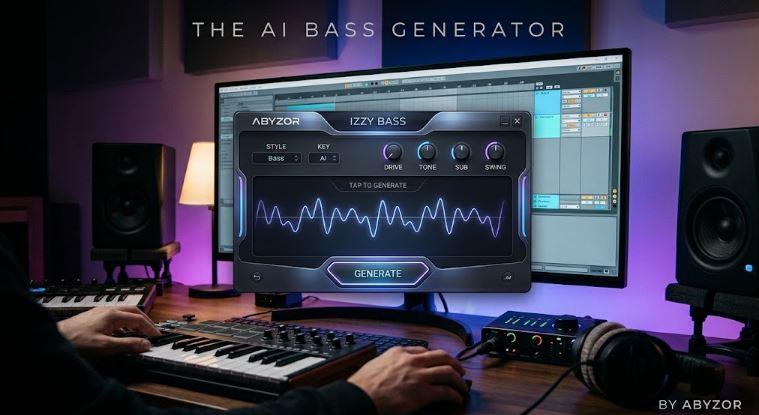
Released on October 16, 2026, IZZY Bass is a dedicated bassline generator for Windows and macOS. It combines seed-based generation, eight take slots, groove controls, style blending, musical constraints, built-in bass sounds, and MIDI or audio export.
The seed system is the most interesting part because it makes a generated bassline reproducible. A producer can return to the same idea, share its seed, then explore related variations without immediately reducing the result to one frozen piano-roll clip.
A Seed Represents The Starting State Behind The Bassline
Abyzor describes IZZY Bass as a focused generator built around a simple workflow: generate, shape, choose a take, then drag MIDI or audio into the DAW.
The official IZZY Bass page also states that every bassline has a SEED code that can be copied and shared.
That changes how an idea can be stored.
A conventional MIDI file preserves the resulting notes.
A seed preserves enough information for the generator to reproduce the idea inside IZZY Bass.
The difference is similar to saving a recipe instead of only saving the finished meal.
The MIDI clip tells you exactly what happened.
The seed gives the generator a way back to the musical state that produced it.
That becomes useful when experimentation begins, because producers can move away from the original pattern without necessarily losing the route back.
Reproducibility Makes Generative MIDI More Practical
Generative tools are most useful when successful accidents can be recreated.
If pressing Generate produces a strong bassline but that exact idea disappears as soon as another variation is created, experimentation becomes risky.
Seed-based generation reduces that problem.
The October 16 KVR Audio release report specifically identifies seed-based generation as a way to reproduce and share bassline ideas.
That gives the producer more freedom to explore.
A strong pattern can be preserved through its seed.
New takes can then be generated.
Groove can change.
Notes can change.
Rhythmic density can shift.
If the experiment becomes less useful, the earlier idea is still identifiable rather than buried inside a growing collection of duplicated MIDI regions.
For generative composition, that sense of reversibility matters.
Eight Takes Turn One Seed Into A Small Idea Workspace
IZZY Bass includes eight take slots.
This moves the workflow away from repeatedly overwriting one pattern.
A producer can generate several approaches, compare them, and keep promising versions visible at the same time.
That encourages selection rather than commitment after the first result.
One take might have the strongest rhythm.
Another may use better note movement.
A third could contain an interesting fill or octave change.
The producer can compare those options before deciding which idea deserves further development.
This is a more deliberate workflow than clicking Generate until something acceptable appears.
The generator becomes a source of candidates.
The musician remains responsible for deciding which candidate belongs in the track.
Regroove Changes Rhythm Without Replacing The Whole Idea
One of the most useful editing concepts in IZZY Bass is Regroove.
The name describes the purpose clearly: change the groove while retaining enough of the existing idea for the result to feel related.
This is especially useful with basslines because rhythm often defines their identity as strongly as pitch.
A pattern may contain exactly the right notes but feel too straight.
Another may have a useful contour but leave too little room for the kick.
Starting again from zero would throw away the useful parts.
Regroove creates a middle option.
The bassline can remain recognizably connected to its earlier version while its rhythmic character changes.
That is one reason seed-based generation is more interesting than simple randomization. The goal is not always to create something unrelated.
Often the producer wants a nearby alternative.
Renote Separates Pitch Decisions From Rhythmic Decisions
Renote approaches the same problem from the opposite side.
Instead of changing the groove, it changes the note choices.
This separation between rhythm and pitch is valuable because producers often like one without liking the other.
A bassline may lock beautifully with the drums but repeat an uninteresting root pattern.
Renote gives the producer a way to reconsider pitch without automatically discarding the rhythmic structure that already works.
IZZY Bass reinforces this separation with Lock Groove and Lock Notes.
If the groove is the important part, lock it and continue exploring pitches.
If the note contour is strong, preserve those notes and search for another rhythmic treatment.
The generator becomes more surgical.
It can vary one dimension while holding another steady.
Lock Groove And Lock Notes Make Generation Less Destructive
Random generation is easy.
Controlled variation is harder.
Lock Groove and Lock Notes address that distinction.
Suppose a producer generates a bassline with a compelling syncopation but weak melodic movement.
Lock Groove preserves the timing structure.
The note layer can then change around it.
The reverse works too.
A strong sequence of notes can remain fixed while rhythmic alternatives are explored.
This resembles how musicians work manually.
They rarely abandon every successful part of an idea at once.
They keep what works and rewrite what does not.
IZZY Bass builds that logic into the generative interface.
That makes iteration feel closer to composition and less like rolling dice.
Vary Creates Related Versions Instead Of Starting Over
The Vary function provides another path between duplication and complete regeneration.
A variation should remain close enough to the original idea that the listener can perceive a relationship.
That relationship is useful in arrangement.
A verse bassline might become slightly more active in the pre-chorus.
A second drop could use the same core movement with altered accents.
A later section might retain the groove but introduce octave jumps.
Generating an entirely unrelated pattern for every section can weaken continuity.
Small variations can create development while preserving identity.
A reproducible seed provides the anchor.
Vary provides movement around that anchor.
Shape Controls Decide How Busy The Bassline Becomes
IZZY Bass includes a set of Shape controls labeled Density, Groove, Movement, Jumps, Slides, and Evolve.
These controls describe musical behavior rather than technical MIDI operations.
Density changes how much activity enters the pattern.
Movement influences how much the line travels rather than remaining static.
Jumps increases larger interval changes.
Slides introduces glide-oriented behavior.
Evolve pushes the pattern toward more change over time.
This macro-style approach makes the generator easier to direct without editing every note manually.
The producer can ask for a more active, more mobile, or more sliding bassline through musical concepts.
That keeps the workflow focused on how the bassline behaves rather than how the algorithm is implemented.
Feel Controls Change Performance Without Rewriting The Notes
The Feel section includes Swing, Gate, Accent, and Human.
These parameters shape performance characteristics after the main pattern exists.
Swing changes the rhythmic relationship between subdivisions.
Gate affects note duration.
Accent creates dynamic emphasis.
Human introduces less rigid timing or performance behavior.
These controls help distinguish composition from interpretation.
Two basslines can contain the same pitches and broad rhythm while feeling completely different because of note lengths, accents, and swing.
That is particularly relevant for low-end parts, where small timing changes can alter how the bass interacts with the kick.
RobSonic’s existing guide to bassline patterns, sound, and mix space explores this relationship in more detail. IZZY Bass approaches the same problem from a generative angle: the notes matter, but so does how those notes sit around the rest of the groove.
Sixty-One Presets Cover Twenty-Nine Genres
Abyzor currently lists 61 presets across 29 genres.
Presets provide a quicker way to define a starting direction before generation begins.
The plugin also supports 20 musical styles with style blending, according to its current product information.
That means one bassline does not have to remain inside a single rigid style model.
A producer can move between stylistic characteristics or blend them before generating takes.
Musical controls for key, scale, root movement, and pattern length establish additional boundaries.
These constraints matter because generation becomes more useful when it operates inside a musical context.
A random collection of bass notes is easy to produce.
A line that fits the harmony, groove, length, and stylistic role of a track requires more structure.
Quick Edits Keep Useful Ideas Moving
IZZY Bass also includes Fill, Roots, Half, and Double controls.
These are small features, but they address common arrangement tasks.
Fill can create extra activity.
Roots can simplify the line toward its harmonic foundation.
Half can reduce rhythmic activity.
Double can increase it.
Those changes let a producer create section variations without rebuilding the bassline from scratch.
A busy generated pattern might work in the chorus but need to become simpler in the verse.
Half offers one route.
A sparse pattern might need extra momentum entering a drop.
Double or Fill can push it forward.
The generator therefore supports development after the initial idea appears.
Built-In Sounds Make Ideas Audible Before Sound Design
IZZY Bass contains eight bass sound categories: Sub, 808, Reese, Acid, Rolling, Pluck, Analog, and Growl.
These are useful for auditioning a pattern immediately.
The generated MIDI does not need to remain attached to those internal sounds.
The plugin can export MIDI or audio directly into the DAW, and KVR also lists support for external VST3 instruments.
That separation is useful.
IZZY Bass can handle the pattern-generation stage.
Another synthesizer can handle the finished timbre.
A producer might audition with the built-in Reese sound, then drag the MIDI into a preferred wavetable or FM synth.
The compositional idea survives even when the sound changes completely.
A Seed Is Most Valuable Before The MIDI Becomes Final
Eventually, many producers will drag the chosen pattern into the DAW.
At that point the bassline can be edited like any other MIDI clip.
Notes can move.
Velocities can change.
Entire sections can be rewritten.
The seed remains useful earlier in the process because it preserves the generated origin.
That creates two distinct stages.
The first is exploratory and reproducible.
The second is fixed and editable.
IZZY Bass does not eliminate the piano roll.
It delays the moment when the producer has to treat one particular MIDI arrangement as final.
That makes generation less disposable.
Why IZZY Bass Treats A Bassline More Like A System Than A Clip
IZZY Bass is not unusual simply because it generates notes.
Many tools can generate MIDI.
Its more interesting idea is how it organizes variation around a reproducible starting point.
A seed identifies the generated bassline.
Eight takes provide alternatives.
Regroove changes rhythm.
Renote changes pitches.
Lock Groove and Lock Notes preserve successful parts.
Vary creates related versions.
Shape and Feel controls adjust musical behavior.
Fill, Roots, Half, and Double provide fast structural edits.
MIDI and audio export eventually turn the chosen idea into normal DAW material.
That workflow treats a bassline as something that can branch without immediately losing its identity.
A conventional MIDI clip is a result.
A seed is closer to a set of instructions capable of recreating that result.
For producers who generate several versions before committing, that distinction can make experimentation feel far less temporary.