
Absynth 6 Legacy matters because Native Instruments did not bring back a standard subtractive soft synth on December 9, 2025. It revived a long-running instrument associated with hybrid synthesis, animated modulation, and sound design that sits between music production, scoring, ambient texture, and experimental electronic work. For producers building beats, cues, transitions, or atmospheres, the question is not only whether Absynth 6 sounds nostalgic. The better question is whether its older design ideas still help modern sessions move faster and sound more personal.
Why Absynth 6 Legacy Still Matters
Absynth 6 Legacy After Discontinuation
Native Instruments officially announced Absynth 6 on December 9, 2025, describing the return of a hybrid instrument that combines subtractive, FM, wavetable, granular, sample-based elements, and wave-morphing Native Instruments announcement. That release date matters because Absynth 5 had been discontinued in 2023, according to the research notes, and the gap gave the return a different weight than a normal version update.
The first Absynth version was released in 2000 as shareware by Rhizomatic. The research notes indicate that several traits associated with later versions were already present early: semi-modular thinking, multiple synthesis types, and envelope shaping. That history helps explain why producers still talk about Absynth less like a preset box and more like an instrument for building unstable pads, synthetic percussion layers, sound effects, and evolving textures.
A Return Built On Familiar Strengths
The phrase Absynth 6 Legacy can sound sentimental, but the more useful reading is technical. A synth earns a lasting role when its structure encourages results that are still hard to reach quickly elsewhere. Absynth’s mutation and modulation systems have long been associated with combining patches, harmonics, and textures in unusual ways. The research notes also connect its influence to ambient, soundtrack, game audio, and experimental electronic production, which are areas where motion, tone, and atmosphere can matter as much as chord progression.
For beatmakers, that translates into practical use. Absynth 6 can be treated as a source for pads, risers, drones, bass movement, one-shot textures, and resampled layers. It does not need to sit as the main synth in every track. Sometimes its strongest role is to create a moving layer that gets printed to audio, chopped, filtered, reversed, or tucked behind drums.
How The Hybrid Engine Shapes Sound Design
Hybrid Sources Without One Fixed Lane
Absynth 6 revives a multicore hybrid engine rather than forcing one synthesis method to solve every task. The research notes list subtractive, FM, wavetable, granular, sample-based elements, and wave-morphing. That combination matters because different sound-design jobs need different kinds of motion. Subtractive shaping can give a patch weight and focus. FM can add glassy or metallic tension. Granular tools can stretch a source into a cloudy or unstable texture. Wavetable and wave-morphing behavior can give a sound internal movement before effects are added.
Native Instruments lists more than 2000 factory presets, including more than 350 new patches for Absynth 6, on the current Absynth 6 product page. Preset count alone does not prove depth, but it does matter for working producers. A large library lets a user audition starting points across pads, effects, keys, basses, and atmospheric material, then adjust the patch rather than build every sound from zero.
The 68-Point Envelope As A Production Tool
One of the most important reported design features is the 68-point multi-stage envelope generator. The research notes describe loop options, breakpoint curves, sustain stages, and built-in LFOs. That is especially relevant for producers who want a sound to move through an arrangement without relying on automation lanes for every change.
In a beatmaking session, a static pad can crowd the midrange once the drums and vocals enter. A long envelope can let the patch change brightness, level, or motion across a bar, four bars, or a full section. In scoring or ambient writing, that same envelope depth can create slow gestures that feel composed rather than pasted under the track. The point is not complexity for its own sake. The point is giving a single sound enough internal behavior to stay useful after the first chord.
What Changed After The December 2025 Release
Presets, Compatibility, And Version 6.1
Backward compatibility is a major part of the return. The research notes state that presets from Absynth 4 and Absynth 5 are usable in version 6, and that the original audio engine from earlier versions was largely preserved. That is a practical issue for long-term users, not just a marketing detail. Sound designers often have project-specific patches, old libraries, and personal banks that are tied to earlier sessions. A new version that breaks those sounds can become risky in professional work.
Version 6.1 followed on April 8, 2026. According to the research notes, it added 32 new instrument presets, 100 new samples, Undo and Redo, LFO retrigger, an audio modulator, improved save functionality, standalone support for up to 8 audio output channels, dry/wet parameter controls, waveform renaming, metadata editing, and improved granular engine density. Those are not all equally glamorous, but several of them address normal production friction. Undo and Redo help experimentation feel safer. Better saving and metadata tools help producers manage growing personal sound libraries.
Practical Limits For Beatmakers
Absynth 6 Legacy is not a promise that every older workflow is automatically better. A producer still has to decide whether its interface and architecture fit the session. If the goal is a simple 808 sub, a fast mono lead, or a drum-machine part, a simpler tool may be faster. Absynth 6 makes more sense when the sound needs motion, layered behavior, or tonal ambiguity.
That is where I would place it in a modern studio template: not as the only synth, but as a specialist. Use it for the parts that benefit from hybrid source design and extended modulation. Record the output. Edit the strongest moments. Treat it like a sound-design instrument that feeds the arrangement rather than a plug-in that must remain live until mixdown.
Why Spatial And Expressive Control Matter
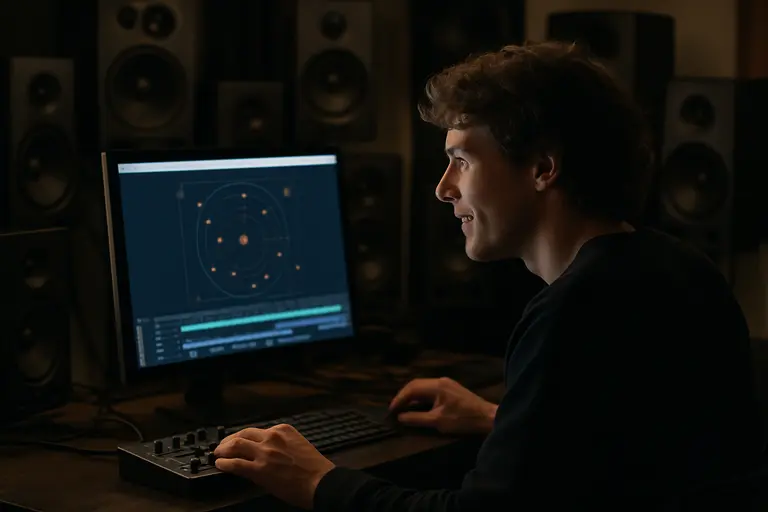
MPE And Polyphonic Aftertouch In Performance
Absynth 6 added support for Polyphonic Aftertouch and full MPE workflows, according to the research notes. That matters because many evolving patches become more musical when expression is tied to individual notes rather than a single global control. With a compatible controller, one held note can open, bend, or intensify differently from another. For pads and soundtrack-style textures, that can create a more performed feel than drawing one filter curve over the full chord.
This is also relevant for producers who do not think of themselves as keyboard players. Expressive control can be recorded slowly, edited afterward, or sampled into audio. A single MPE pass may become a transition effect, intro bed, or chopped melodic layer. The musical value comes from variation that reacts to performance pressure and gesture, not from technical novelty alone.
Surround Routing For Sound Design
The research notes state that Absynth 6 supports surround sound spatialization, including Quadraphonic, 5.1, Octaphonic, and LFE routing. That is not necessary for every beat, but it has clear use in game audio, installation work, spatial composition, and soundtrack design. Even stereo producers can learn from that approach because spatial thinking changes how a sound is built. Width, movement, low-frequency placement, and distance become part of the patch decision.
RobSonic readers working on headphone-focused mixes may also connect this with our related discussion of spatial audio plugins. Absynth 6 is not only about generating a tone; it can also be part of a broader production habit where motion and placement are planned from the start. For creators who pair audio work with costume culture, fantasy visuals, or release aesthetics, our network site fairytalefashion.org explores how these visual elements intersect with music and sound production, offering another layer of creative depth.
Absynth 6 Legacy In Music Production
A Careful Read On Its Modern Role
Absynth 6 Legacy is strongest when viewed as a sound-design instrument with history, not as a universal solution. The supported facts point to a clear profile: a December 9, 2025 release, a restored hybrid engine, more than 2000 factory presets, more than 350 new patches, deep envelope control, backward compatibility with Absynth 4 and 5 presets, MPE and Polyphonic Aftertouch support, and spatial routing for multichannel formats.
That profile explains why the instrument still makes sense for ambient work, soundtrack production, game audio, experimental electronic music, and texture-heavy beatmaking. It also explains why some producers may not need it in every session. If a track calls for clean, direct parts, there are faster paths. If a track needs evolving material with a sense of motion before external effects, Absynth 6 has a clear reason to exist.
For my own production mindset, the most useful takeaway is simple: build with intention, then print to audio. Absynth 6 can generate long movement, but the arrangement still decides what stays. Use the presets as study material, not as a stopping point. Push the envelopes, test MPE gestures if your controller supports them, try granular density changes, and capture the moments that make the beat or cue feel less static. That is where the revived synth’s history becomes practical rather than nostalgic.