
As of November 5, 2026, Krasner and Pollock: Past Continuous was ongoing at The Metropolitan Museum of Art after opening on October 4, 2026, with a scheduled run through January 31, 2027. Krasner Pollock Music is not about turning Abstract Expressionist painting into a preset pack. A more useful reading is structural: The Met says the exhibition traces the full careers of Lee Krasner and Jackson Pollock in parallel, rather than limiting the story to their years together from 1941 to 1956 The Met announcement. For producers, that framing offers a practical model for arrangement, collaboration, catalog reuse, and long-term creative identity.
Christie’s reports that the exhibition is organized into 12 thematic and chronological chapters, with some rooms pairing works by both artists and others focusing on one artist Christie’s exhibition report. That matters for beatmakers and producers because albums, beat tapes, and live sets also depend on sequencing. A project can place two voices in dialogue without flattening either one. It can also create space for contrast, absence, and solo statements.
What Krasner Pollock Music Can Teach Producers
Krasner Pollock Music As Parallel Arrangement
The strongest production lesson from the exhibition’s framing is the value of parallel structure. Instead of treating one artist as the center and the other as supporting context, the show places two careers beside each other across time. In music terms, that suggests a release design where two producers, vocalists, instrumentalists, or sound designers can share a project without forcing a single merged identity.
A practical Krasner Pollock Music translation could be a two-sided EP where side A and side B respond to the same source idea through different methods. One producer might build from chopped percussion and dry room tone. Another might answer with synth drones, negative space, and slower rhythmic movement. The point is not to imitate either painter. The point is to let listeners hear relationship and difference at the same time.
This connects naturally with RobSonic’s earlier look at Krasner Pollock collaboration, especially the idea that creative adjacency should not erase individual agency. In a DAW session, that means labeling contributions clearly, saving alternate versions, and allowing each collaborator’s choices to remain audible rather than mixed into a neutral middle.
Chaptered Sequencing For Beat Tapes
The exhibition’s chaptered structure offers a useful model for longer music projects. Many beat tapes lose focus because every track tries to do the same job: intro energy, main groove, sample flip, or outro atmosphere. A chaptered approach asks each section to carry a different function. One track can introduce a shared motif. Another can isolate a collaborator’s sound. A later track can bring the two approaches together after the listener has heard each voice separately.
For a producer, this can be as simple as planning a project map before making the final track list. Mark which pieces are paired, which are solo, which recycle earlier material, and which create silence or distance. This does not require a concept album with heavy explanation. It only requires sequencing that respects contrast.
Sampling The Past Without Losing The Present
Reworking Unused Material With Care
The research notes for the exhibition point to Krasner’s early-to-mid-1950s collages, including works that recycled her own unsold paintings and, in some cases, Pollock’s discarded drawings. For producers, the clear studio parallel is the unfinished session folder: bounced loops, rejected hooks, voice memos, one-bar drum grooves, and synth patches that never found a home.
Reusing old material is not a shortcut by itself. It becomes creative when the new context changes the role of the source. A four-year-old piano loop might become a texture after time-stretching. A discarded hi-hat pattern might become a gate trigger for a pad. A rejected vocal phrase might become a rhythmic chop, if the rights and permissions are clear. This is a rights-aware habit, not a free pass to use anything sitting on a drive.
For creators building catalog value, documentation also matters. Keep notes on who played what, where samples came from, which versions were approved, and which collaborators need credit. For creator-business resources in the same network, Shimply provides a practical perspective on presentation and commerce around creative work.
Influence As A Two-Way Signal
The Met framing described in the research emphasizes that Krasner and Pollock were not isolated figures outside influence. Their work sat in relation to European modernism, nature, color, Surrealism, and each other. A cautious music-production takeaway is that influence should be named and processed, not hidden behind a claim of total originality.
In beatmaking, influence shows up in swing choices, sample selection, drum-machine habits, harmonic language, and mix aesthetics. A producer can respect those sources by studying how they function rather than copying the surface. If the influence is a breakbeat record, ask why the groove breathes. If it is a noise texture, ask how density changes the emotional weight. If it is a collaborator’s melodic instinct, leave room for that instinct to lead.
Collaboration, Silence, And Studio Limits
Creative Gaps Can Shape The Record
The research notes say the exhibition does not avoid Krasner’s periods of reduced output, presenting gaps in artmaking rather than smoothing them away. That is a useful corrective for producers who feel pressure to post constant snippets or release every session. Silence can be part of pacing. A record with fewer tracks can feel more intentional than a longer project padded with ideas that were not ready.
Inside a beat, silence is also an arrangement tool. Removing the kick for half a bar, muting a sample before the hook, or letting a reverb tail hang without drums can create tension without adding a new plugin. The absence has to be placed with purpose. Random emptiness can feel unfinished, but deliberate space can make the next entry hit harder.
Small Rooms Can Still Produce Large Ideas
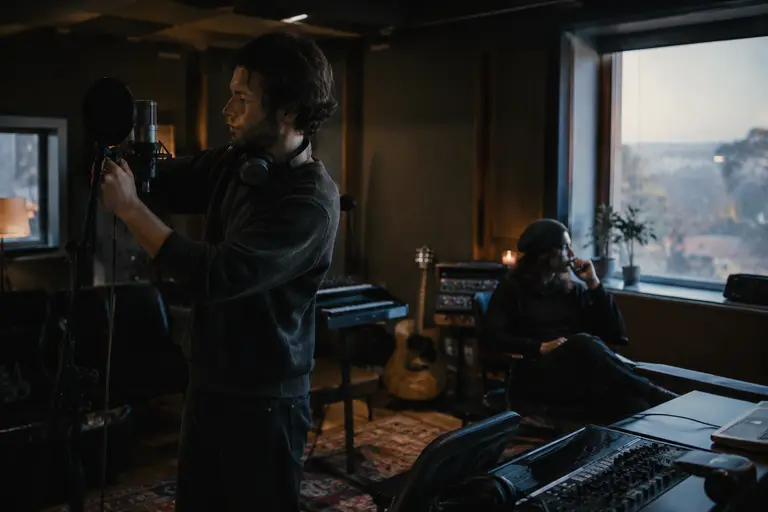
The research notes also point to differences in workspace and scale, including Krasner working under more constrained spatial conditions while Pollock had access to a barn studio. For modern producers, that comparison should be handled carefully; it is not a simple productivity lesson. Still, it raises a real studio question: how does the room shape the work?
A bedroom setup may push a producer toward headphones, close-mic textures, soft synths, and careful low-end referencing. A larger room may invite amplified instruments, re-amping, group recording, or more physical performance. Neither condition guarantees stronger music. The better question is what the space encourages and what it hides.
- Use a small setup for detailed editing, sample chopping, and quiet arrangement decisions.
- Use a larger room, when available, for movement, performance takes, and natural ambience.
- Print limitations into the project brief: one sampler, one drum kit, one room mic, or one collaborator per chapter.
- Review credits and permissions before treating old material as reusable release material.
Krasner Pollock Music Strategies In Practice
Krasner Pollock Music strategies are strongest when they stay specific: parallel structure, chaptered sequencing, catalog reuse, visible collaboration, respected silence, and honest attention to studio limits. These ideas do not require a producer to make art about painting. They invite producers to think about how work is presented, how influence moves, and how two creative identities can share space without one becoming a footnote.
For my own production brain, the most useful exercise is simple. Open a current project and divide it into chapters before adding more sounds. Name the sections by function: shared motif, solo voice, recycled fragment, gap, response, and return. Then listen for whether each section earns its place. That approach will not make a track better by theory alone, but it can expose weak sequencing, unclear collaboration, and unused material that deserves a second pass.
The exhibition’s value for music creators lies in its structure more than any one visual motif. It shows how a paired presentation can honor difference, how chronology can clarify change, and how older material can return with new force. Used carefully, those ideas can help producers build projects that feel considered without becoming over-explained.