
Mix depth is usually built from several separate decisions. A producer pans a guitar, adds reverb, rolls off some high end, adjusts compression, lowers the level, then repeats the process until the sound feels farther away.
Track 1 Audio’s Conductor Stage turns those decisions into something more visual: move the sound backward on a virtual stage and several depth-related parameters can change together.
Released on October 23, 2026, Conductor Stage combines stereo placement, room emulation, reverb, EQ, compression, and optional level falloff inside one visual workspace. Track 1 Audio founder Levi Brooks designed the plugin around the idea that producers often hear depth as one perceptual change even though DAWs force them to build it from several processors.
The result is a mixing tool where front-to-back distance can behave more like a position than a checklist.
Left And Right Are Only Half Of The Stage
Traditional panning answers one clear question: where is the sound between the left and right speakers?
Conductor Stage adds another dimension.
On the official Conductor Stage page, Track 1 Audio explains that moving a source left or right changes stereo placement, while moving it farther from the virtual microphone changes position-linked reverb, EQ, and compression.
Optional volume falloff can also make level decrease with distance.
That means one draggable position can represent several cues at once.
A vocal can sit near the microphone.
Supporting guitars can move farther back.
A synth can occupy a more distant position without requiring the producer to automate five separate processors manually.
The stage becomes a macro control for perceived perspective.
Distance Is Created From Several Cues At Once
There is no single “depth” parameter in ordinary mixing.
Listeners infer distance from combinations of level, direct-to-reverberant balance, frequency content, stereo relationships, and dynamic behavior.
Conductor Stage groups those ideas.
Move a source backward and the plugin can increase its wet/dry reverb relationship.
EQ can change with position.
Compression can also follow the movement.
Volume falloff can reduce level if the producer wants distance to affect loudness.
This is important because lowering volume alone does not necessarily make something sound far away.
A quiet close-miked vocal still contains close-microphone detail.
Likewise, adding a large reverb without changing anything else can make the vocal sound close but surrounded by a huge space.
Conductor Stage tries to coordinate several cues so the movement feels more like one spatial action.
The Microphone Position Establishes The Baseline
Track 1 Audio places a virtual microphone at the front of the stage.
That position acts as the baseline.
The producer first decides how the source should sound when it is closest. The baseline can begin dry, but it does not have to. Reverb, EQ, and compression each include baseline adjustments.
Once that close position is established, moving the source backward applies the chosen distance behavior relative to it.
This is a useful design choice because “close” does not mean the same thing in every production.
A dry intimate vocal may need almost no room at the microphone position.
A drum recording might already require some ambience.
A synth could begin with a deliberately wet close sound.
Conductor Stage keeps the producer responsible for that starting point instead of imposing one fixed acoustic definition of proximity.
The Room Stays Put While The Source Moves
One of the more important details in Conductor Stage is that moving the instrument does not change the selected room itself.
The room remains stable.
What changes is how the sound relates to that room.
This allows several instruments to appear to occupy one common environment while sitting at different depths inside it.
A lead vocal can remain forward.
Backing vocals can move behind it.
Guitars can sit farther toward the sides and rear.
A synth can become more distant without changing to an entirely different reverb character.
That consistency helps create a shared spatial perspective.
It also explains why the plugin is better described as room emulation than a literal acoustic simulator.
Track 1 Audio explicitly states that Conductor Stage does not calculate sound propagation through a measured building or recreate a named venue from physical geometry.
It uses processing cues creatively to suggest space.
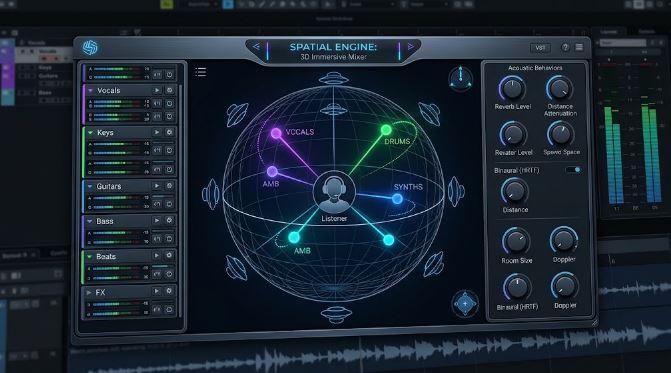
Conductor Stage Is Not Claiming To Simulate Real Physics
That limitation matters.
Conductor Stage links position to reverb, EQ, compression, panning, and optional level falloff.
It does not use HRTF binaural rendering.
It does not calculate reflections from measured wall dimensions.
It does not claim to reproduce the exact acoustics of a real scoring stage.
Track 1 Audio even notes that the compressor should not be interpreted as “air compressing the sound” as an object moves farther away.
Compression is an artistic mix treatment tied to position.
This makes Conductor Stage easier to understand as a production interface.
The visual stage does not promise a scientifically exact acoustic model.
It gives the producer one spatial metaphor for controlling several mix processes together.
Free And Premium Use The Same Basic Spatial Idea
Conductor Stage comes in Free and Premium editions.
The Free version handles one track at a time and includes stage placement, native reverb, EQ, compression, Mirror, optional volume falloff, presets, and other core positioning tools.
Premium expands the idea across a full mix.
Linked source instances can communicate with a multitrack master so several instruments appear together on one stage.
That changes the workflow considerably.
On one track, the visual position acts as a convenient macro.
Across many tracks, the stage can become a map of the mix.
The producer can see a lead vocal at the front, guitars positioned behind it, drums placed according to the intended room perspective, and supporting elements farther back.
This is where Conductor Stage’s visual design becomes more significant than a conventional channel insert.
Premium Makes The Stage A Shared Mix Map
The October 23 Conductor Stage release report describes Premium as a system where multiple linked sources can be managed from one shared view.
That gives the producer a different way to think about arrangement density.
Two sounds may occupy similar frequencies but feel less crowded if they also occupy different positions.
A backing guitar can move wider and farther back.
A lead part can stay forward.
Supporting synths can occupy more distant layers.
The stage does not solve frequency masking automatically, but it provides another organizational dimension beyond EQ and volume.
The mix becomes a scene rather than a stack of channel strips.
Position-Linked EQ Makes Distance More Than Reverb
Reverb is the obvious tool for creating depth, but Conductor Stage also ties EQ behavior to position.
This reflects a common mixing technique.
Distant sounds are often made darker or less immediate by reducing high-frequency presence.
That does not mean every real-world distant source loses frequencies in one identical way.
The technique works because brightness often contributes to perceived closeness in a mix.
When Conductor Stage moves a source backward, position-linked EQ can help reduce some of that forward character.
The value of the system is coordination.
Instead of remembering to adjust both reverb and tone every time the source moves, the stage position can control both relationships together.
The producer still decides the baseline and intensity.
Compression Can Also Follow Perspective
Compression is another unusual part of the positioning system.
At first glance, compression may seem unrelated to physical distance.
Track 1 Audio is careful not to claim otherwise.
Its purpose here is creative.
A producer may want distant elements to behave differently dynamically from foreground sounds.
A backing texture might become smoother as it moves deeper into the stage.
A lead source may preserve more transient detail near the microphone.
Linking compression with position lets the producer express that preference through the same spatial movement.
This is another reason Conductor Stage should be understood as a mix-design tool rather than a physics simulator.
It connects the controls producers already use to create depth.
Volume Falloff Is Optional For A Reason
Moving a sound farther away in the real world usually reduces its level.
Inside a mix, that may not always be desirable.
A producer could want a huge distant synth that remains loud.
An ambient guitar may need to feel far back without disappearing beneath the drums.
Conductor Stage therefore allows volume falloff to be reduced or disabled.
This keeps spatial depth separate from strict realism.
A source can become wetter, darker, and more compressed while maintaining approximately the same output level.
That choice is useful because mixing often depends on perceptual exaggeration.
A distant sound does not have to obey the exact loudness relationship of a real physical room.
It only needs to occupy the intended role in the record.
Visual Placement Can Simplify Automation
The stage metaphor also changes automation.
In a traditional workflow, moving a sound from foreground to background might require synchronized automation of panning, reverb send, EQ, compression, and volume.
Those lanes can become difficult to manage.
Conductor Stage groups much of that behavior around position.
A producer can automate movement instead.
The effect becomes conceptually simple:
move the source farther away.
The plugin translates that movement into the linked processing relationships already defined.
This can be especially useful for transitions.
A synth might recede during a verse and move forward into a chorus.
A guitar could travel sideways while becoming more distant.
An effect return could appear to move into the background without manually coordinating several automation lanes.
Conductor Stage Fits A Broader Effects-Chain Mindset
RobSonic’s guide to creative effects chains looks at how multiple processors can work together to change the perceived identity and role of a sound.
Conductor Stage uses a related idea but hides much of the complexity behind spatial position.
Reverb, EQ, dynamics, stereo placement, and level are still separate processes underneath.
The difference is that the producer can address them through one higher-level intention.
Instead of thinking, “add more reverb, cut some highs, compress slightly, reduce level,” the producer can think, “put this sound farther back.”
That shift from processor language to perceptual language is what makes the workflow interesting.
The Visual Stage Does Not Replace Listening
A clear interface can create its own trap.
If a guitar looks correctly positioned on the stage, that does not mean it is correctly positioned in the mix.
Recorded ambience already contained in the source affects depth.
Stereo widening from other plugins can change the result.
Compression or EQ later in the chain can alter the spatial impression.
Different speakers and headphones also change how depth cues are perceived.
Track 1 Audio itself recommends beginning with relatively dry sources when learning the system because strongly printed room sound already contains distance information the plugin cannot remove.
The stage should therefore be treated as a control surface, not proof that a mix is spatially correct.
The ears still decide whether the placement works.
Why Dragging A Sound Around A Room Changes The Mixing Mental Model
Conductor Stage’s most useful idea is not a new reverb algorithm or a new type of panner.
It is the decision to connect several familiar processes to one visual position.
Left and right control direction.
Front and back influence perceived depth.
Reverb changes the room relationship.
EQ affects tonal distance.
Compression can reshape dynamics.
Optional volume falloff changes level.
Premium then places several tracks into one shared stage.
That turns spatial mixing into something closer to arranging objects.
A producer can ask where the vocal belongs, where the guitars should sit behind it, and how far away a synth should feel.
The plugin still uses familiar audio processing underneath.
What changes is the language used to control it.
Instead of building distance parameter by parameter, Conductor Stage lets the producer drag the sound toward the place where it is supposed to live.