
Glitch processing in 2026 often arrives wrapped in spectral displays, machine-learning analysis, or elaborate modular interfaces. Inear Display’s Danaides takes a very different route. Its core idea comes directly from 2013: sequence destructive effects like notes in a pattern and let the incoming audio provide the raw material.
Inear Display revived Danaides as version 2.0 on September 19, 2026, rebuilding its audio engine and interface for modern systems while deliberately keeping the behavior close to the original plugin. Version 2.1 followed on October 18 with a new Driller sequence-lock switch, clearer visual cues inside the sequencers, macOS installer fixes, and a correction for potential glitches when resizing the interface.
The result is unusual precisely because Danaides does not try to disguise its age. It brings an older approach to rhythmic sound destruction into current VST3 and Audio Unit workflows.
Danaides Was Built Around Sequencing Effects, Not Notes
The defining idea in Danaides is simple: the sequencer does not primarily decide which note should play next.
It decides what should happen to the sound next.
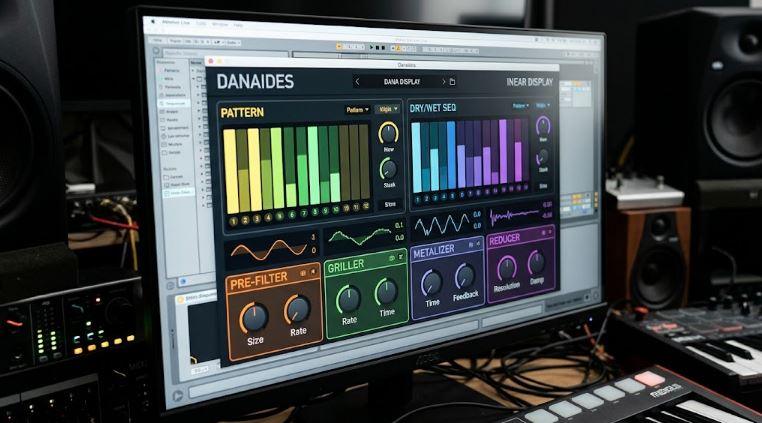
The official Inear Display release notes describe Danaides as a “sequenced sound mangler.” Incoming audio passes through filtering and three deliberately destructive processing engines.
Driller captures tiny pieces of the signal, loops them, and changes their pitch.
Metalizer introduces a metallic delay treatment.
Reducer lowers the sample rate to produce rougher digital textures.
Rather than leaving one processor active throughout the passage, Danaides can switch effects according to a tempo-linked sequence.
A sustained synthesizer can therefore become a pattern of micro-loops, metallic repeats, degraded steps, and cleaner gaps even though the source itself never changes notes.
The plugin turns effect selection into rhythm.
Driller Makes Micro-Loops Behave Like Musical Events
Driller is arguably the clearest expression of Danaides’ original glitch aesthetic.
Instead of processing an entire phrase evenly, it grabs extremely small pieces of incoming audio and repeats them. Repitching those fragments can turn a transient or sustained note into a buzz, stutter, digital chirp, or pitched rhythmic object.
The source can be almost anything.
Drums produce sharply defined repeated attacks.
Vocals can collapse into small phonetic fragments.
Pads provide smoother material that can become artificial pulses.
Full mixes can produce much less predictable results because several instruments may occupy each captured slice.
Version 2.1 adds a sequence-lock switch specifically for Driller. That may sound like a small update, but it fits the way Danaides is performed. Once a useful sequence appears, keeping its Driller behavior locked makes it easier to develop the surrounding processing without losing the pattern that made the effect work.
The plugin is still destructive, but the destruction can now become more repeatable.
Metalizer Turns Delay Into Rhythmic Texture
Danaides’ Metalizer is not presented as a conventional mixing delay.
Its role is to add metallic, resonant repetition that can become part of the programmed glitch phrase.
That distinction matters because Danaides does not treat effects as isolated destinations.
One sequencer step can invoke a Driller treatment.
Another can emphasize the metallic delay.
A later step can move toward sample-rate reduction.
The transitions between processors become part of the groove.
This is closer to sequencing a drum machine than inserting three separate effects and automating their bypass switches manually.
The source material supplies continuity, while the sequencer supplies transformation.
That workflow was strange in 2013 and still feels distinctive in modern DAWs because the plugin encourages producers to think in patterns of processing rather than chains of static effects.
Reducer Brings Digital Degradation Into The Pattern
Reducer lowers the sample rate of the incoming signal.
Used constantly, that type of processing can create familiar lo-fi digital roughness. Inside Danaides, it can appear only on selected steps.
That changes its function.
A clean drum loop can retain most of its original definition while individual hits suddenly collapse into coarse digital artifacts.
A synth sequence can alternate between intact notes and degraded fragments.
A vocal phrase can momentarily lose fidelity before returning to the dry signal.
The effect becomes punctuation.
This is one reason Danaides’ sequencing architecture remains useful despite its age. A processor that might become tiring as a permanent insert can become much more expressive when it appears for only a fraction of a bar.
Two Sequencers Control Different Parts Of The Destruction
Danaides uses separate sequencing systems for effect selection and dry/wet behavior.
The effect sequencer determines which processing character appears across the pattern.
The dry/wet sequencer controls how strongly the processed signal enters.
Those are separate musical decisions.
A step can choose an aggressive effect but blend only a small amount into the source.
Another can push the processing much further.
This lets Danaides create phrases with internal dynamics rather than simply cycling through effect names.
Version 2.1’s new visual cues make that system easier to follow. Inear Display specifically lists improved sequencer feedback among the update’s changes.
For a plugin whose identity depends on several moving stages, visual clarity matters. Producers need to understand which stage is currently active if they want to shape the pattern deliberately instead of treating the processor as a random glitch generator.
Morphing LFOs Add Movement Inside Each Step
Sequencing is only one level of motion.
Danaides also includes two Morph LFO systems, each built from two sub-LFOs. Their shapes can blend, producing modulation that is less static than a conventional single waveform.
Those modulation sources can address effect and filter parameters.
A slow LFO might move delay time.
Another can alter filter cutoff in sync with the host.
Morphing between modulation shapes can change the movement again without replacing the main effect sequence.
This produces two simultaneous timelines.
The sequencers determine which processing happens and how wet it becomes.
The LFOs change parameters inside that processing.
The outcome can range from repetitive rhythmic glitches to patterns that gradually mutate over several bars.
That layered movement is part of what made Danaides distinctive in its original form.
The Pre-Filter Changes What The Destruction Engines Receive
Before the destructive stages, Danaides provides a filter that can move between low-pass, band-pass, and high-pass behavior.
Filtering before a glitch processor creates different results from filtering afterward.
Feed Driller mainly low-frequency material and its micro-loops emphasize body and rhythm.
Push the filter upward and the captured fragments can become thinner and sharper.
Metalizer reacts differently depending on which spectral region reaches it.
Reducer also produces different artifacts as the source bandwidth changes.
The filter is therefore part of sound generation rather than only final tone correction.
When its parameters are modulated alongside the effect sequencers, a single source can produce much more varied material than its original spectrum would suggest.
Version 2.0 Was A Rewrite, Not Simply An Old Plugin Repackaged
The history matters to the appeal of Danaides 2.1.
Inear Display says the original Danaides appeared in 2013 and had been discontinued for some time. Eventually it no longer worked reliably—or at all—on contemporary operating systems.
Version 2.0 rebuilt the audio engine and user interface while attempting to stay close to the original behavior and feel.
That also required a break from the past.
Version 2 is not compatible with version 1 presets.
The tradeoff is a cleaner modern foundation.
Current Danaides runs as VST3 on Windows and as VST3 and Audio Unit on macOS, with Inear Display offering its plugin range on a pay-what-you-want basis.
The October 18 Danaides 2.1 update report confirms the new Driller sequence lock, sequencer visual cues, macOS installer fixes, and UI-resizing correction.
Old-School Glitch Processing Still Has A Different Feel
Modern sound-design plugins can analyze a source in extraordinary detail.
That does not automatically make older interaction models obsolete.
Danaides comes from a period when glitch effects often encouraged direct, destructive experimentation. The producer started with audio, selected a few extreme processors, sequenced them, randomized something, and listened for accidents worth keeping.
There is little pressure to identify the source perfectly.
Danaides does not need to know whether it is receiving a vocal, bass, kick drum, or guitar.
It reacts to the signal.
That makes it useful for exploratory processing because the same sequence can produce dramatically different results on different material.
A clean percussion loop may turn into tightly controlled stutters.
A sustained pad can become rhythmic.
A complete bus can fracture into much less predictable digital movement.
The processor provides a structure, but the source determines what that structure reveals.
Randomization Makes Accidents Part Of The Workflow
Danaides also includes sequence and global randomization.
Randomization is particularly suited to this type of processor because manually programming every effect step, wet level, modulation setting, and filter relationship can be slow.
A random state can create an unexpected starting point.
The producer can then keep the useful relationships and refine the rest.
This is less about allowing the plugin to “compose” a finished result and more about generating parameter combinations a producer might not have designed intentionally.
RobSonic’s guide to creative effects chains explores a related production idea: familiar source sounds can acquire entirely new identities when processors interact rather than operating as isolated utilities.
Danaides compresses much of that philosophy into one sequenced effect.
Instead of building a large chain and drawing automation for every processor, the plugin makes changing effects part of the pattern itself.
Why Danaides 2.1 Still Feels Useful In A 2026 DAW
The most interesting part of Danaides 2.1 is not that a plugin from 2013 has returned.
It is that its original workflow still offers something specific.
Driller turns tiny slices into repitched repetitions.
Metalizer produces metallic delay textures.
Reducer inserts digital degradation.
The effect sequencer decides when those characters appear.
The dry/wet sequencer decides how deeply they enter the source.
Morphing LFOs animate parameters inside the sequence.
Randomizers create alternate patterns.
Version 2.1 then adds a way to lock Driller sequencing and makes the active sequencing behavior easier to read visually.
None of these ideas requires a modern AI layer or source-separation engine.
Danaides works because it treats audio processing like step sequencing.
That approach gives an old plugin a reason to return beyond nostalgia.
Its 2013 logic still asks a useful production question in 2026:
What happens when the effects themselves become the rhythm?