
Yoko Ono mixing is not a preset chain or a fixed studio recipe. It is better understood as a way of listening: voice as event, silence as structure, environment as source, and audience participation as part of the work. That reading gained fresh context after Yoko Ono: Music of the Mind ran at The Broad in Los Angeles from May 23 to October 11, 2026. The exhibition was her first solo museum show in Southern California and traced work from the mid-1950s to the present across instruction pieces, performance, film, conceptual art, and music.
Yoko Ono Mixing As Conceptual Practice
For producers and mix engineers, Ono’s work is useful because it challenges the assumption that a mix should always smooth friction. A conventional pop or rock mix often pushes toward controlled tone, tidy edits, and a stable front-to-back image. Ono’s artistic practice points toward a different question: what if the unstable, exposed, or incomplete part is the meaning?
Yoko Ono Mixing And Instruction Scores
Ono’s instruction pieces are central to this approach. Her 1964 book Grapefruit included short text prompts that ask the reader to imagine, perform, or complete an action. Several tape pieces, including Snow Piece, directly involve recording and listening to environmental sound, as documented in the Getty transcript. For a producer, that is a strong cue: sound can be organized by attention as much as by arrangement.
For Yoko Ono mixing, the lesson is not to imitate a historical artifact. It is to ask whether the mix has made enough room for the idea. If the concept depends on distance, roughness, silence, or an uncomfortably close voice, then heavy polish may weaken the work. The mix should serve the piece’s emotional and conceptual pressure, not force every source into a standard commercial shape.
Negative Space As Arrangement
Ono’s early visual works also matter for audio thinking. Painting to Be Stepped On, dated 1960/1961 by MoMA, asks the audience to physically activate the work rather than only view it, as described in MoMA audio. In mix terms, that points toward space as an active element. Room tone, decay, and silence do not have to be empty. They can tell the listener where they are standing in relation to the piece.
What The Broad Show Clarified After October 2026
The Broad exhibition placed Ono’s sound, text, performance, and participatory works in close relation. Because the show has now closed, the useful angle is retrospective: it showed how consistent her cross-medium thinking has been across decades. The exhibition’s inclusion of instruction pieces, music, performance documentation, film, and participatory works made clear that Ono’s sound practice cannot be separated neatly from her visual or conceptual practice.
Participation Changes The Mix Problem
Works connected to participation, such as Cut Piece, first performed in 1964 according to the research notes, create a technical challenge that producers will recognize from documentary recording and live capture. The sound source is not fully controllable. Audience movement, clothing noise, breath, room reflections, and uneven vocal projection may all become part of the record.
That does not mean the engineer should leave everything untreated. It means the treatment has to respect the event. Noise reduction, gating, or aggressive spectral cleanup can erase the signs that a real action happened in a real space. If the work depends on vulnerability, then a little unevenness may carry information. This is close to the live-production problem discussed in Chicago live mixing lessons, where bleed, repeat playback, and spatial decisions affect how listeners perceive performance.
The same cross-sensory thinking also connects to fashion, costume, and visual culture. Readers interested in how creative presentation intersects with artistic expression can explore related themes at Fairytale Fashion, particularly in regards to how physical styling and performance influence the reception of an artwork.
Mix Moves From Music Of The Mind
Ono’s artistic vision suggests practical mix choices for producers working with experimental vocals, spoken text, found sound, field recordings, performance audio, or sparse rock instrumentation. These moves are not rules. They are options to test against the emotional goal of the piece.
Keep The Voice Unhidden
Research notes for Ono’s 1970 album Yoko Ono/Plastic Ono Band point to raw vocal presence, sparse arrangements, and texture-based editing. That matters because an extreme voice can tempt engineers to soften the edges too quickly. A more useful first move is to set the vocal level before building the rest of the mix. If the voice is the event, everything else should be balanced around it.
Compression can help, but it should not flatten the performance into a single emotional register. I would start with clip gain or automation before heavy compression, then use a compressor only to control the most disruptive peaks. Short ambience can provide depth without pushing the voice backward. If the vocal tone includes breath, strain, or sharp transients, EQ should remove only what blocks translation, not what makes the performance specific.
Let Field Texture Hold Its Place
The tape-piece logic behind works such as Snow Piece supports a field-recording mindset. In a standard mix, hiss, rumble, or room noise often gets treated as a defect. In an Ono-informed mix, those elements may carry setting and tension. The engineer still has to manage them, but the goal is not automatic removal.
- Use high-pass filtering with caution so environmental weight does not disappear.
- Automate noise reduction rather than applying one setting across the whole piece.
- Preserve small transients if they help the listener sense physical action.
- Keep reverb short or dry when intimacy matters more than scale.
- Check quiet passages on headphones and speakers so silence remains intentional.
The best Yoko Ono mixing lesson here is restraint. If a field recording sounds fragile, the producer should avoid processing that makes it feel generic. A slightly imperfect texture can be more informative than a cleaned file with no location left in it.
Mastering Choices For Raw Voice And Space
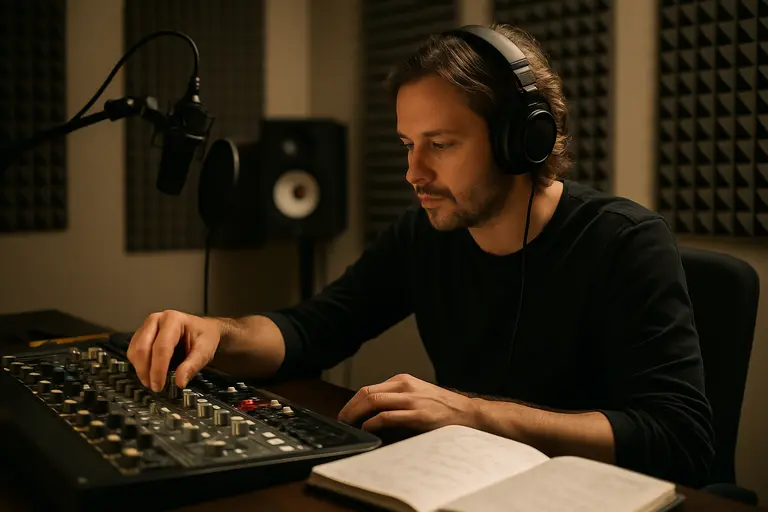
Mastering this kind of work calls for caution. Loudness, brightness, and stereo width can all damage the qualities that made the mix convincing. If a track depends on sudden vocal peaks, long quiet sections, or uneasy room tone, mastering should protect those contrasts rather than push every section toward the same density.
Clarity Without Cosmetic Shine
The research notes mention later remastering decisions around vocal clarity and reduced echo or slap effects on some material associated with the Plastic Ono Band period. Without overstating that into a universal rule, the principle is useful: clarity can serve emotional directness. Sometimes the strongest master is not the loudest or widest one. It is the one where the listener understands the voice, the room, and the tension between them.
For a mastering chain, that may mean a light EQ lift only where articulation is masked, conservative limiting, and careful control of harsh upper mids. Environmental material can become brittle if the top end is pushed too hard. Low-level details can vanish if broadband compression is too eager. A reference level that leaves headroom may make the piece feel more alive than a crushed master.
Silence Needs Translation Checks
Quiet passages are technical material. They need monitoring just like drums or bass. If silence carries room tone, tape noise, or distant movement, the mastering engineer should test how that information survives on earbuds, small speakers, and full-range monitors. The aim is not to make silence loud. The aim is to make the listener understand that the quiet is part of the composition.
Yoko Ono Mixing For Experimental Producers
Yoko Ono mixing, as a production lens, asks creators to stop treating rawness as a problem by default. Ono’s work suggests that a recording can carry meaning through instruction, action, weather, body, voice, and room. The producer’s job is to decide which of those elements must remain audible and which can be shaped without weakening the idea.
For beatmakers and experimental producers, the practical workflow is simple: start with the concept, not the plugin chain. If the track is built around a spoken phrase, mix the phrase first. If it is built around a field recording, decide how much of the location should survive. If the hook is a physical gesture, keep enough transient and room detail for that gesture to feel present. Processing is still welcome, but it should answer the work rather than decorate it.
The strongest takeaway from Ono’s artistic vision is that a mix can be clear without being sanitized. A vocal can be exposed. A room can be audible. A hiss can be meaningful. A pause can carry weight. For producers willing to listen that closely, those are not limitations. They are mix decisions.