
Sunflower Sound System mixing lessons are easier to discuss honestly before the US debut if we separate confirmed rig design from assumptions about how it will sound in Indio. As of September 28, 2026, Head Trip is scheduled for October 10–11, 2026, at the Empire Polo Club in Indio, California, with Floating Points’ system making its USA debut there, according to an EDM Identity report. That means this is not a show review. It is a practical pre-event mixing analysis based on the published system concept.
For producers, FOH engineers, and live-recording crews, the interesting part is not just scale. The confirmed design points toward a different way of thinking about dance music playback: circular coverage, frequency-specific stacks, and a treated space designed to make the rig part of the artistic experience. That does not guarantee a perfect result. It does give us a useful framework for decisions about low-end routing, stereo width, reverb, delay, room capture, and mastering translation.
What The Sunflower Sound System Changes For Mixing
Sunflower Sound System As A Spatial Instrument
The strongest technical idea behind the Sunflower Sound System is that the PA is not treated as a neutral set of boxes at the front of a crowd. The published description says the rig uses 10 custom speaker stacks arranged in a circle around the audience inside an acoustically treated dome, with the goal of creating an immersive surround-sound dance-floor experience, as reported by FrontView Magazine. For a mixer, that changes the first question from “How wide is the mix?” to “Where should energy live?”
In a conventional club or festival stage, a stereo master often has to do most of its work through left-right width, mono-compatible bass, and careful control of the vocal or lead range. A circular rig invites more spatial thinking, but it also raises risk. If low-frequency sources, percussive transients, or bright details arrive from many directions without clear intent, the result can smear. The better approach is controlled placement: let the system create immersion, while the mix keeps hierarchy.
Spectrum Before Spectacle
The research notes state that each stack covers a distinct portion of the audio spectrum: lows, low-mids, mid-highs, and highs. That matters because spectral separation is one of the few mixing ideas that transfers cleanly from studio work to large-format live playback. A kick and sub bass can sound impressive in solo, but if their fundamentals and harmonics fight across the same band, a large rig will not hide the problem. It will enlarge it.
For electronic music, I would treat this kind of system as a reminder to build the arrangement from frequency roles, not just from track count. The sub layer should be focused. The low-mid material needs shape and restraint. Mid-high synths should not crowd the percussion attack. High-frequency content, especially hats, rides, air bands, and sharp effects, needs enough detail to travel without becoming brittle. The practical aim is not a scooped, sterile mix. The aim is a mix where each band can scale without forcing corrective EQ later.
Alignment Comes Before Tonal Fixes
Delay, Phase, Level, And Tone
Large immersive rigs depend on alignment. The research notes point to timing, delay, phase, level, and tone as key system variables, with the warning that mismatches among mains, delay sources, fills, or distributed stacks can cause destructive interference. That is especially relevant for a circular dance-floor system. If transient-heavy material arrives at slightly different times from multiple points, the impact can weaken even when the system is loud.
The cautious takeaway for live crews is simple: do not treat EQ as the first repair tool. Time alignment has to be addressed before tonal correction. EQ can reduce a harsh region or tame a build-up, but it cannot fully restore coherence if the same signal is arriving late from one part of the system. This is where measurement, listening positions, and disciplined level setting matter more than dramatic processing.
For studio producers preparing playback stems for an immersive environment, this suggests a conservative stem strategy. Keep the kick, sub, bass harmonics, drum bus, music bus, and effects returns separated enough that the playback engineer can make sensible decisions. Printing everything into one loud stereo file removes control at the exact moment the system may need it most.
Why Minimal EQ Can Be The Better Move
The research notes also point to minimal EQ after physical alignment, delay adjustment, and level setting. That matches a principle I trust in live sound: heavy correction can solve one listening spot and create a new problem elsewhere. In a dome with distributed stacks, a narrow EQ move may not behave the same way across the whole audience area.
That does not mean mixers should avoid EQ. It means EQ should be used after the mechanical and timing questions are handled. High-pass filters, low-mid cleanup, harshness control, and resonant cuts still matter. The difference is priority. A well-aligned system with restrained EQ usually gives the music more stability than a poorly aligned system with an aggressive tonal curve.
Low-End Control For Immersive Dance Music
Sub Energy Needs A Single Job
The Sunflower Sound System concept puts pressure on the low end because dance music lives or dies by how bass translates. In a circular system, low-frequency energy can feel physically involving, but it can also become unfocused if the mix contains too many competing sub events. A practical mix should define one main sub carrier at a time. That might be the kick, the bass line, or a dedicated sub layer, but not all three at full strength during the same moment.
Sidechain compression is still useful, but it should not be the only solution. Arrangement is cleaner. If the bass line has a strong fundamental under the kick, decide whether the kick owns the deepest hit or whether the bass carries the floor and the kick speaks more through upper harmonics. On a high-output system, that decision can be more audible than another plugin on the master bus.
Low-Mids Are The Risk Zone
Low-mids are often where immersive mixes lose definition. Pads, toms, synth stabs, bass harmonics, reverbs, and crowd ambience can all sit there. The research notes describe the rig as separating lows, low-mids, mid-highs, and highs, which makes the low-mid band especially important. If that range is cloudy in the source material, spectral separation in the PA will not automatically fix it.
For producers, I would check 150 Hz to 500 Hz with special care before printing live stems. Mute returns, then add them back one at a time. If the groove becomes bigger but less readable, the low-mid content probably needs editing rather than boosting. For more on how large stages exposed bass-control choices during 2026 events, RobSonic’s piece on festival soundscapes is a useful related read.
Effects Choices Inside A Treated Dome
Reverb Has To Respect The Room
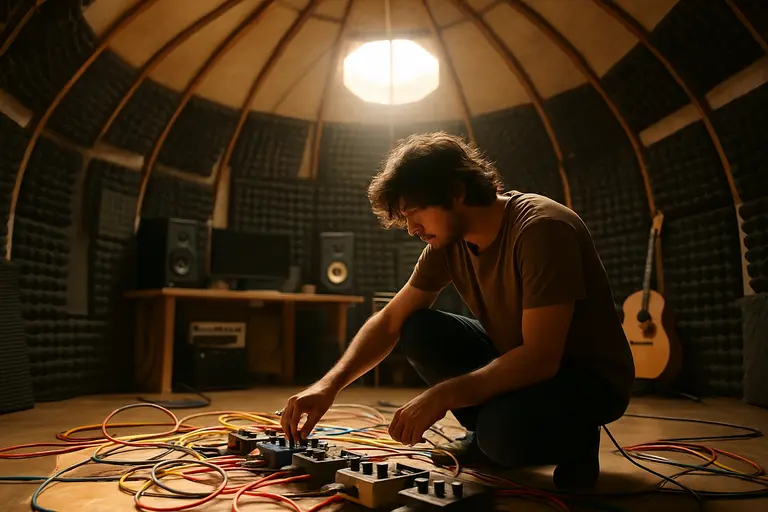
The research notes say the setup uses an acoustically treated dome, and that treatment will affect how reverb decay and pre-delay are perceived. That should make mixers cautious with long, dense reverbs. A lush return that sounds cinematic in nearfields can blur fast-tempo percussion when reproduced around a crowd. The room and system already provide spatial information, so artificial space has to earn its place.
Short reverbs can help bind drums and synths, but they should be checked against transient clarity. Longer tails may work better in breakdowns, ambient passages, and transitions where the arrangement leaves room for decay. Delay throws can be more controllable than always-on reverb because they can appear at phrase endings, then get muted before the groove returns.
Delay Can Create Motion Or Smear
In immersive playback, delay is not only an effect. It is also a spatial cue that interacts with the system’s timing. Short rhythmic delays on hats, claps, and synth blips can give movement, but if they land too close to the original transient, they may read as blur. Longer tempo-synced delays can feel more intentional because the ear separates them as repeats rather than timing errors.
I would automate delay sends rather than leaving them static. A dub-style throw on the last snare of an eight-bar phrase can feel musical. The same delay running through every bar can soften the groove. This is especially true in a system designed to surround the audience, where reflections and distributed sources already add motion.
Live Capture And Room Tone Decisions
Audience Mics Need Restraint
If the Head Trip debut is captured as a multitrack recording, room microphones will need careful handling. The research notes point to a familiar live-recording problem: too much audience mic or room reverb can help realism but damage clarity and phase relationships. In a circular dome, that balance may be even more sensitive because the ambience is part of the design.
The safest capture plan would treat room tone as a controllable layer, not a default wash. Close or direct sources preserve punch. Audience and room microphones can be blended for scale, but they should not dominate the drum transients or low-end shape. High-pass filtering ambience channels is often sensible because uncontrolled low-frequency room capture can weaken the bass image.
Studio Translation After The Event
A later mixdown of a live recording should not try to recreate the entire physical rig inside a normal stereo master. The better target is translation: preserve the feeling of space while keeping kick, bass, and lead information stable on headphones, nearfields, cars, and small speakers. That may mean less room level than the memory of the event suggests.
- Keep direct low-end sources phase-conscious before adding room tone.
- Use ambience to show scale, not to carry the groove.
- Automate reverb and delay returns around arrangement changes.
- Check mono compatibility for kick, bass, and central percussion.
- Leave mastering headroom if the capture includes strong sub energy.
This is where gear discipline matters. Exciting playback systems can tempt mixers to print wider, louder, and brighter than the music needs. A careful capture should leave options open. For broader culture coverage across the same network, visit Kay Granger for insights into adjacent arts and event contexts, which help frame why presentation matters as much as raw technology.
Sunflower Sound System Mixing Takeaways
The main lesson from the Sunflower Sound System, before its scheduled October 10–11, 2026 US debut, is that immersive sound rewards restraint as much as ambition. Ten circular stacks, an acoustically treated dome, and spectrum-specific coverage suggest a playback format where placement, clarity, and alignment can matter more than sheer loudness. The rig may encourage creative spatial decisions, but those decisions still need a clean frequency plan.
For producers, that means building tracks with defined low-end ownership, uncluttered low-mids, controlled high-frequency detail, and effects that move with the arrangement. For FOH engineers, it means prioritizing timing, level, phase behavior, and system voicing before reaching for broad EQ fixes. For recording crews, it means capturing enough room to represent the event without letting ambience blur the musical core.
The Sunflower Sound System is not just a bigger playback rig on paper. Its confirmed design points toward a more intentional relationship between music, room, and audience position. Until the Indio debut has actually happened, any claims about its real-world sound should stay cautious. Still, the published design already gives mixers a useful challenge: make the source material organized enough that an immersive system can reveal detail instead of exposing problems.