
Festival Mixing Expectations for the 2026 iHeartRadio Music Festival should start with the facts that are already public, not guesses about individual artist rigs. iHeartMedia announced that the festival is scheduled for Friday, September 18, 2026, and Saturday, September 19, 2026, at T-Mobile Arena in Las Vegas, with a lineup spanning BTS, Cardi B, Kenny Chesney, Lainey Wilson, Major Lazer, Muse, Snoop Dogg, Weezer, Zara Larsson, and others iHeartMedia announcement. That range matters because the audio team will not be mixing one genre aesthetic for two nights. They will be managing fast contrasts in vocal density, low-end weight, drum impact, guitars, synths, and broadcast consistency.
Festival Mixing Expectations For Two Arena Nights
Festival Mixing Expectations Start With Genre Contrast
The lineup creates a practical engineering problem: each act likely arrives with a defined sonic identity, but the festival presentation has to feel coherent for the room, livestream, and radio audience. A country set from Kenny Chesney or Lainey Wilson will usually benefit from intelligible lead vocals, controlled acoustic or electric guitar presence, and enough drum weight to carry a large arena without burying lyric detail. A rap or dance-leaning set from Cardi B, Snoop Dogg, or Major Lazer puts more pressure on sub-bass translation, vocal-forward monitoring, and transient control. Rock sets from Muse or Weezer raise different priorities: guitar midrange, cymbal control, snare energy, and vocal intelligibility when the arrangement is dense.
Those Festival Mixing Expectations are not a claim about any one artist’s technical rider. The safer read is that the bill pushes engineers toward flexible preparation. Console scenes, input lists, playback stems, vocal effects, and monitor snapshots must be ready to change quickly while keeping the main mix stable. A festival of this scale also rewards restraint. If every set is pushed to the same apparent loudness and the same low-end shape, the character of the genres can flatten. The better target is consistency without sameness.
Changeovers Are A Mix Discipline
Fast changeovers are often treated as stage logistics, but they are also a mixing discipline. The first moments of a set decide whether the audience hears a balanced performance or a repair job. Engineers need quick confidence in gain staging, lead vocal placement, kick and bass relationship, and any playback material. A pop or K-pop performance may carry dense tracks and choreographed vocal handoffs. A rock performance may depend more on amp sources, drum microphones, and stage bleed control. A hip-hop set can require firm vocal presence over tracks that already contain substantial low end.
For producers studying live work, the lesson is useful in the studio too: a mix that only works after several minutes of adjustment is not ready for pressure. Templates, routing, stem labeling, and conservative gain decisions reduce the chance that a high-energy opener turns into a scramble. RobSonic readers who want a related live-sound angle can compare these ideas with our notes on mixing live sound in Nashville, where vocal priority and low-end control were also central themes.
Broadcast Loudness And Live Mastering Choices
Loudness Matching For Disney+, Hulu, And Radio
The 2026 festival is set to be livestreamed on Disney+ and Hulu and broadcast across more than 150 radio markets, according to the iHeartMedia announcement. Festival Mixing Expectations therefore cannot stop at the arena PA. A broadcast mix has a different job from front-of-house. It needs to preserve impact while translating through televisions, soundbars, earbuds, car systems, and mobile speakers. That means the broadcast team has to manage loudness changes between acts without stripping the sets of their natural dynamics.
For mastering engineers, this is where caution matters. Heavy limiting can make a track feel impressive in isolation, but live festival audio exposes overly static masters. If a studio single has been limited so hard that the live version suddenly feels more open and exciting, the contrast can be obvious. That does not mean every release should be quiet. It means the master should leave enough punch and headroom for drums, bass movement, and vocal expression to remain believable next to a live performance.
Audience Mics And Arena Energy
Broadcasts also depend on audience and ambient microphones. Crowd sound gives scale, but too much arena wash can blur lead vocals and rhythmic detail. Too little crowd sound can make a live performance feel disconnected from the room. The likely target is controlled atmosphere: enough audience reaction to show the scale of T-Mobile Arena, but not so much that consonants, snare transients, and bass articulation lose focus.
This is especially relevant for multi-genre programming. A dance drop, a rock chorus, and a country singalong all use crowd response differently. Broadcast engineers may have to ride ambience in ways that match the arrangement rather than leaving it static. The same principle applies to reverbs and delays. Effects that work for a solo vocal moment may need to pull back when full-band instrumentation or dense playback enters.
Release Timing Before September 18, 2026
Runway Dates That Have Already Passed
Release timing is one of the more concrete areas where producers can draw a practical lesson. Venia Mastering’s festival-season planning model recommends locking mixes roughly 10 weeks before a festival, booking mastering roughly eight weeks before, and releasing music roughly two weeks before the performance window festival release planning. Applied to the September 18, 2026, opening date, that would place a mix-lock target around early July 2026, mastering preparation around late July 2026, and a release target in early September 2026.
Because today is August 24, 2026, the earliest mix-lock and mastering-booking targets in that model have already passed. That does not prove what any iHeartRadio artist did. Major artists often have their own release schedules, label timelines, touring constraints, and broadcast requirements. Still, the model is useful for independent producers watching from the outside. A festival performance is not only a show date. It is a deadline that affects mix revisions, master delivery, clean edits, instrumental versions, vocal-up alternates, playback stems, and promotional timing.
Why Live Versions Need Headroom
Festival Mixing Expectations also need to account for the relationship between studio releases and stage versions. If a song is tied to a major live slot, the studio master should not fight the live arrangement. A little space in the master can help kick drums breathe, bass notes speak, and vocals remain expressive. In a live broadcast, the performance may include extended intros, crowd sections, band breaks, shortened arrangements, or transitions that differ from the released version. A master that keeps musical movement intact tends to sit better beside that kind of performance than one built only for maximum short-term loudness.
For producers, the practical takeaway is to check a festival-targeted master against live-style references, not only commercial playlists. Print a full mix, a vocal-up version, an instrumental, a clean version when needed, and any show stems requested by the performance team. Those files should be named clearly and checked for start points, endings, and sample-rate consistency before they leave the studio.
Practical Gear Notes For Producers Studying The Bill
Console Scenes, Stems, And Gain Discipline
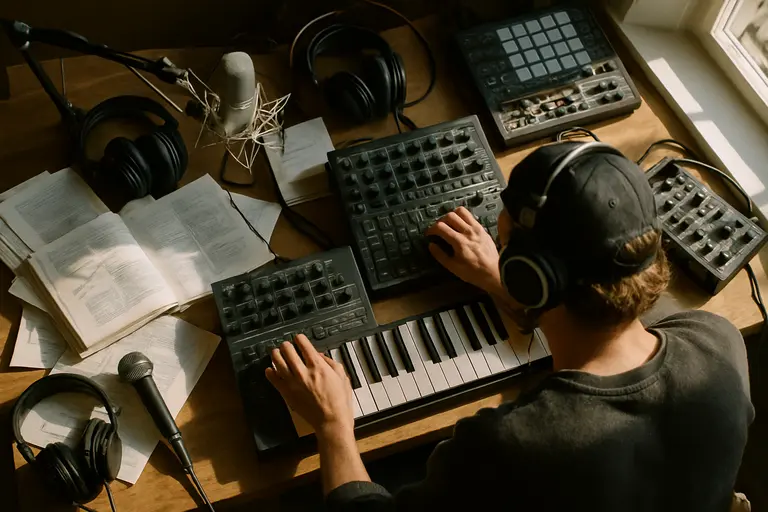
From a gear perspective, the iHeartRadio bill is a strong reminder that live audio reliability often comes from preparation rather than flashy hardware. Digital console scenes can recall routing, EQ, dynamics, effects sends, and mute groups quickly, but they only help if the input list and stage plan are accurate. Playback stems can give a broadcast team control over drums, bass, music, backgrounds, and effects, but they can also create problems if they are overprinted or poorly labeled. Gain discipline remains the unglamorous center of the job.
Independent artists can borrow this mindset without owning an arena rig. A small show can still use organized stems, clear session exports, test playback files, and documented vocal effects. A livestream from a club or studio can still benefit from separate vocal, track, and room-mic control. Readers comparing broader creator and culture coverage across our network can also visit Shimply, where music presentation overlaps with creator commerce and event culture.
Monitoring Without Losing Performance Feel
Monitoring is another area where expectations should stay cautious. Large acts may use in-ear systems, wedges, side-fills, or some combination, but the exact setup depends on artist preference and technical riders that are not public in the supplied research. The engineering aim is easier to state: performers need timing, pitch reference, vocal confidence, and enough room energy to perform naturally. Too much isolation can make a stage feel detached. Too much open stage volume can compromise clarity and broadcast control.
For studio producers preparing backing tracks for live use, that means leaving space for the vocal. A track that sounds finished in headphones may be too crowded once live vocals, crowd mics, and arena reflections enter the picture. Arrangement choices matter before the first fader moves. Pads, doubles, ad-libs, risers, and sub drops should support the performance rather than compete with the lead vocal.
iHeartRadio 2026 Set Expectations
What Can Be Known Before The Show
What can be said before September 18, 2026, is limited but still useful. The public lineup supports an expectation of wide genre contrast across two nights at T-Mobile Arena. The announced Disney+ and Hulu livestream plus radio distribution supports an expectation of careful broadcast loudness management. The festival-season release planning model suggests that artists using a traditional pre-festival release runway would already have passed key mix and mastering preparation points by August 24, 2026.
What cannot be known from the research is the exact console choice, PA tuning, artist monitor setup, stem count, mastering chain, or broadcast processing for each performance. Those details depend on production decisions that have not been provided here. The most responsible Festival Mixing Expectations are therefore practical rather than speculative: protect vocals, manage low end by genre, keep changeovers organized, preserve enough dynamics for live energy, and prepare masters and stems early enough that the performance team is not fixing avoidable studio problems on show week.