
SFMOMA Mixing Techniques are worth studying now that RM x SFMOMA: Between You and Me has already opened. The exhibition opened to the public on October 3, 2026, after member previews from October 1 to October 3, 2026, and it runs through February 7, 2027. For producers, the useful angle is not a claim that SFMOMA has published a live concert mix or detailed speaker plot. The supported facts point to a bilingual audio guide narrated by RM, an in-gallery playlist curated by RM, and a visual presentation of works that shapes how visitors pause, move, and listen.
SFMOMA describes the project as a partnership with RM and the first exhibition of its kind centered on his collection, featuring 200 works of Korean art and international contemporary art SFMOMA’s announcement. That matters to audio people because a gallery is not a neutral playback box. It is a public listening environment where narration, music, foot traffic, wall text, room tone, and visitor behavior all become part of the perceived mix.
SFMOMA Mixing Techniques After RM’s Opening
SFMOMA Mixing Techniques For Gallery Playback
The most practical reading of SFMOMA Mixing Techniques starts with translation: not language translation alone, but translation between a private listening habit and a shared public room. RM’s bilingual audio guide in English and Korean gives the exhibition a voice-led layer. His in-gallery playlist gives it a music-led layer. Those two layers do different jobs, so they cannot be treated like one stereo master pushed louder until it feels present.
Voice needs intelligibility. Music needs emotional continuity without masking the artworks or the room. In a studio, I would think of that as the difference between a lead vocal bus and an atmosphere bus. The lead has to land clearly. The atmosphere can sit wider, softer, and more slowly. In a museum, the same idea becomes more sensitive because visitors are not locked between two monitors. They walk, turn, stop, read, speak quietly, and enter the room at different points in the program.
Why This Is Not A Concert Mix
It is tempting to talk about the exhibition as if it were a live performance rig, but the public research does not support detailed claims about FOH consoles, microphone choices, speaker models, SPL targets, or real-time engineering staff. A cautious approach is better. The exhibition gives producers a strong case study in fixed playback under live audience conditions. The content may be preselected and prebalanced, but the room changes every minute because people move through it.
That is the same problem many producers face after a track leaves the studio. The mix is fixed, but the listening situation is not. Earbuds, cars, clubs, galleries, phone speakers, and public rooms all expose different weaknesses. These SFMOMA Mixing Techniques point toward restraint: leave space, preserve vocal clarity, and assume the room will add noise you did not print into the master.
Audio Guide, Playlist, And Headroom
Narration Clarity Before Loudness
RM’s narrated bilingual guide puts speech at the center of the visitor experience. For a producer, that makes the audio guide a useful reminder that loudness is not the same as clarity. A voice can be loud and still hard to understand if midrange masking, sibilance, low-mid buildup, or excessive room reflection gets in the way. In gallery conditions, clear consonants and steady level may matter more than dramatic compression.
Because no public SPL or mastering data for this exhibition is included in the cited material, the safest lesson is conceptual rather than technical. I would not infer exact LUFS, limiter settings, or EQ curves. Still, the situation suggests a familiar workflow: control peaks, keep speech natural, avoid harshness, and leave enough headroom so the voice does not feel pinned to the ceiling. That approach protects the listener over a longer visit.
Playlist Balance In A Shared Room
The in-gallery playlist curated by RM raises a different mix question. A playlist in a museum is not the same as a playlist in a car or studio. It has to coexist with footsteps, HVAC noise, conversations, guards giving directions, and people entering at different moments. If the playlist is too forward, it can dominate the art. If it is too low, it becomes vague room wash.
For beatmakers and mix engineers, the parallel is arrangement discipline. A gallery playlist should not need every frequency band filled at every second to feel intentional. The same applies to beats. If a sample, pad, or percussion loop carries too much midrange, it can crowd the vocal or lead sound. If the low end is too wide or too constant, it can make the room feel smaller. The gallery context makes that obvious because every extra layer competes with real acoustic activity.
- Keep voice-led material clearer than mood-led material.
- Leave low-end space when playback happens in an uncontrolled room.
- Use repetition carefully, since visitors may hear only fragments of a sequence.
- Check whether ambience supports the main idea or masks it.
Curatorial Flow As Mix Arrangement
Track Order And Visitor Pacing
Art Collector Homes reported that RM’s collection has developed over nearly a decade and discussed his handwritten wall texts and labels as part of the exhibition experience its exhibition analysis. For producers, those handwritten elements matter because reading changes pacing. A visitor who stops to read creates a different acoustic rhythm than a visitor who walks straight through. Small clusters form. Silence opens, then closes. The gallery breathes.
That has a direct mixing parallel. Track order is not only a playlist decision; it is a dynamics decision. A dense song placed after another dense song can cause fatigue. A sparse interlude can reset the ear. In an exhibition, a quiet work, a handwritten note, or a spatial gap can act like negative space in an arrangement. It gives the audience time to recalibrate before the next strong visual or sonic moment.
Contrast Without Masking
The exhibition brings Korean art into conversation with international contemporary art, according to SFMOMA’s description. That kind of pairing can teach producers about contrast without collision. In a beat, contrast does not mean every sound should fight for attention. A dry drum loop can sit beside a wide pad. A close vocal can sit over a distant texture. A bright accent can appear only when the midrange clears enough for it to be heard.
Curatorial placement works in a similar way. Each artwork has its own density, scale, material presence, and emotional weight. If every piece is treated like the hook, the room becomes tiring. If the sequence gives each piece a defined role, the whole presentation can feel coherent without making everything sound, or look, the same.
Live-Room Lessons For Producers
Movement Changes The Mix
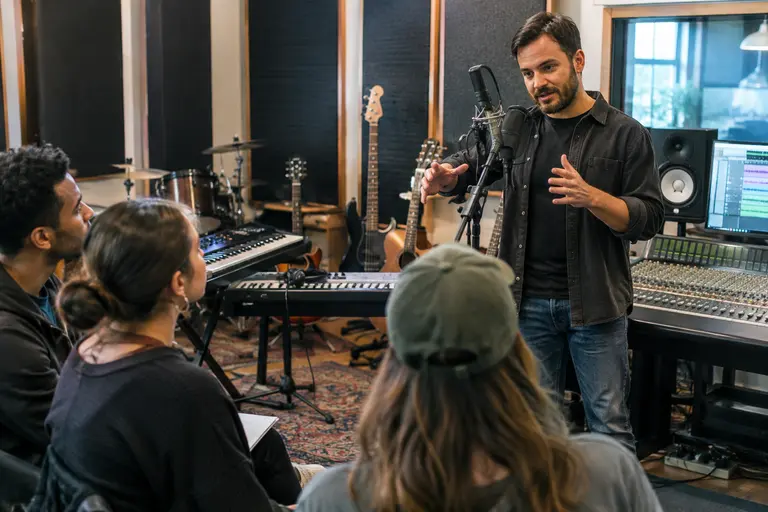
For producers, SFMOMA Mixing Techniques become most useful when we think about movement. A person standing near a speaker hears a different balance than someone across the room. A visitor listening to the audio guide through personal playback hears narration differently from a visitor hearing the playlist in open space. The mix is not one fixed experience; it is a set of possible experiences shaped by position.
This is why I like checking a mix away from the desk. Walk to the side of the room. Step into the hallway. Play it softly. Listen from a phone. These checks do not replace accurate monitoring, but they reveal whether the core idea survives imperfect conditions. Museum playback pushes the same question: does the work still communicate when the listener is moving?
Mastering For Translation
Mastering for a public room rewards patience. Heavy limiting can feel impressive for a minute, then tiring over repeated exposure. A gallery setting usually asks for the opposite instinct: controlled peaks, stable tonal balance, and enough dynamic life that the ear does not shut down. Since the public sources do not provide technical mastering notes for the exhibition, any exact processing chain would be speculation.
Still, producers can borrow the listening method. Print a mix, then ask how it behaves as background, foreground, and partial attention. That test is especially useful for ambient, hip-hop interludes, installation scores, and sample-based beats built around mood. RobSonic readers interested in related gallery playback problems may also find the site’s piece on museum sound mixing useful, since it approaches spatial balance and safe loudness from another museum context.
Readers tracking adjacent art-and-culture coverage in the same network can compare how Next Clues frames collector-led cultural stories, but the audio takeaway here stays grounded in the public exhibition details rather than fan speculation.
RM’s Collection And SFMOMA Mixing Techniques
What Producers Can Take Away
RM’s personal collection at SFMOMA gives beatmakers and mix engineers a useful reference point because it connects selection, sequence, space, and listening behavior. The exhibition’s confirmed audio elements are modest but meaningful: a bilingual guide narrated by RM and an in-gallery playlist curated by him. Those elements sit inside a larger curatorial frame of 200 works, public movement, written interpretation, and cross-context visual pairing.
SFMOMA Mixing Techniques here are best understood as principles, not presets. The public information does not justify claims about exact compressors, limiters, room correction, speaker arrays, or SPL readings. What it does support is a careful production lesson: voice should remain legible, music should respect the room, contrast should be arranged rather than forced, and playback should be judged by how real people encounter it.
That is a strong reminder for music creators. A beat may begin on a grid, but it ends in a listener’s space. If the vocal disappears when the room gets noisy, the mix needs work. If the ambience masks the emotional center, the arrangement needs subtraction. If the master wins on loudness but loses on repeat listening, it is not serving the material. RM’s exhibition gives producers a clean way to think about those choices without pretending that gallery playback is the same as a club, studio, or concert stage.