
Fractured Skies Sound is not a documented soundtrack, and that distinction matters. Nilima Sheikh: Fractured Skies opened at MoMA on September 27, 2026, and is scheduled to run through June 13, 2027, as a visual exhibition centered on Sheikh’s layered works, not as a dedicated sound-art installation. For producers, the value is interpretive rather than literal: the show’s audio guide, double-sided formats, hand-painted text, and site-responsive presentation offer a set of disciplined prompts for synthesis, spatial thinking, and narrative pacing.
Fractured Skies Sound As An Exhibition Prompt
MoMA describes the exhibition as bringing together three major bodies of work: Each Night Put Kashmir in Your Dreams (2003–14), Home, Land (2023–25), and Shahid/Witness (2025–26). The newest series, Shahid/Witness, was commissioned by the Kiran Nadar Museum of Art in New Delhi and is described as site-responsive to MoMA’s gallery architecture on the MoMA exhibition page. That site-responsive fact gives sound artists a useful starting point: do not begin with a preset mood. Begin with position, scale, and movement.
What Fractured Skies Sound Can Borrow From The Guide
The exhibition also has a dedicated MoMA audio guide with four tracks: an introduction and artist-voiced entries connected to Construction Site (recto) 2009–10, Home, Land 2 (2024), and Surveillance (recto) from Shahid/Witness (2025–26). The same MoMA audio guide notes support from Bloomberg Philanthropies. For producers, the audio guide suggests a restrained model: the human voice can frame visual density without needing to dominate it. A spoken layer can act like a soft foreground, while synthesis handles pressure, distance, and memory.
This is where Fractured Skies Sound becomes a practical studio idea. Instead of scoring an image in a direct illustrative way, a producer can build a piece around changing attention. The first layer might be close and dry, like a voice in a small room. The second might be a filtered drone that expands slowly. The third might be a granular texture that enters only when the listener’s focus would shift from text to image or from one side of a hanging work to the other.
Listening To Scrolls, Text, And Movement
Research around the show notes Sheikh’s use of double-sided scroll formats, with text and imagery arranged so that viewers physically move to see both sides. Sound design can learn from that without claiming the exhibition itself uses spatial audio. The core idea is simple: a work can reveal different information depending on the viewer’s position. In a studio, that can become a spatial mix where meaning changes through pan, depth, filtering, and reverb length.
Turning Two-Sided Viewing Into Two-Sided Audio
A two-sided sound structure does not need to be theatrical. One side can be made from legible material: voice fragments, bowed tones, or restrained melodic notes. The other side can be made from less stable material: noise grains, reversed tails, low-frequency tremors, and narrow-band resonances. The producer can crossfade between them in response to imagined movement around a scroll.
A useful session method is to create two buses named “recto” and “verso,” not as an art-historical claim about Sheikh’s process, but as a production reminder. The recto bus holds recognizable gestures. The verso bus holds traces, shadows, and residue. Automation then becomes the viewer’s walk. A slow pan is not only a stereo effect; it becomes a compositional cue that says the listener has changed position.
Accessible Depth Without Overwriting The Artwork
Sheikh has been quoted in research comparing the experience of art to music, with different levels of access for general audiences and more trained viewers. A cautious producer can treat that as a design principle: make the first layer readable, then let deeper layers reward closer listening. This does not mean simplifying difficult subject matter. It means organizing the sound so that the listener is not punished for entering gradually.
One practical arrangement is a three-depth mix. The front layer uses a clear pulse or voice-like tone. The middle layer uses harmonic friction, such as clustered sine tones or bowed-metal samples. The rear layer uses long, low movement, barely changing across several minutes. The listener can stay with the front layer and still understand the piece, while repeated listening reveals the inner motion.
Synthesis Methods Drawn From Layered Viewing
Fractured Skies Sound should stay interpretive, not imitative. The goal is not to “sound like” Sheikh’s work or convert it into a decorative cue. The stronger method is to borrow structural ideas: layering, partial visibility, movement between sides, and text-image tension. For producers working in experimental electronic music, gallery-adjacent composition, or film sound, these ideas translate cleanly into synthesis choices.
Spectral Layers Instead Of Literal Illustration
Start with a limited palette. Use one sustained oscillator, one sampled texture, and one short transient family. Then separate them by spectral role. The oscillator can occupy the low-mid band, the texture can live in the high band, and the transient family can mark shifts in attention. This keeps the mix from becoming crowded while still allowing density over time.
Filter automation can stand in for visual reveal. A low-pass filter opening slowly can suggest the appearance of detail. A high-pass filter removing body can suggest loss or distance. Ring modulation, if used lightly, can create unstable edges around a tone without turning the piece into an effect demonstration. The point is to let each technical choice answer a structural question: What is close? What is hidden? What is remembered?
Environmental Texture With Clear Limits
Research notes that Shahid/Witness extends Sheikh’s focus toward climate change, displacement, and environmental rupture, including references such as melting glaciers and floods. A sound designer might respond with field-recording methods, but the source material should be chosen with care. Water, wind, room tone, and processed air sounds can be effective, yet they can also become generic if used only as background atmosphere.
A better approach is to process environmental recordings as structure. For example, a water recording can control a gate on a synth pad. Wind noise can feed a sidechain compressor. A room tone can be stretched into a slow harmonic bed. In each case, the field recording is not decoration; it becomes the timing source or modulation source. Readers interested in related exhibition-based methods may also find RobSonic’s analysis of current sound design across U.S. art shows useful, especially where it discusses embodied listening and cautious use of generative systems.
Rights-Aware Production Around Museum Audio
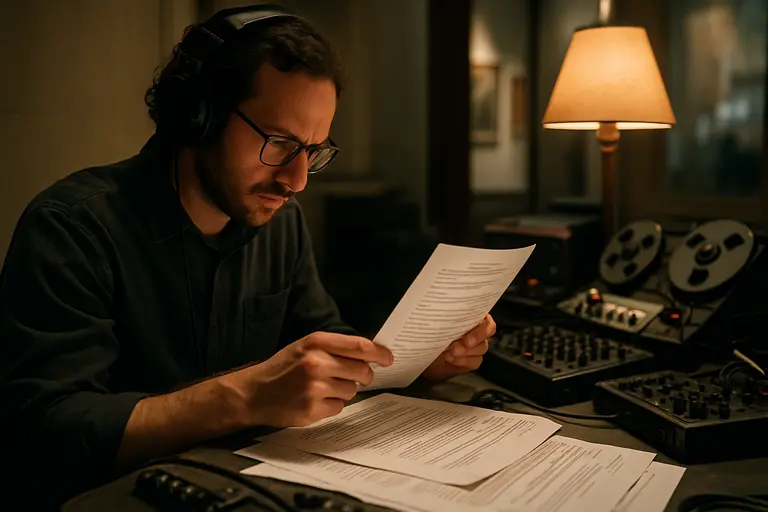
Because MoMA provides an audio guide with the artist’s voice, it may be tempting for producers to sample it directly. That should not be treated casually. Museum audio, artist interviews, and exhibition recordings can involve rights held by multiple parties. This article is not legal advice, but a practical studio rule is safer: use the guide for study, timing analysis, and structural inspiration unless permissions are clear.
Study The Cadence, Rebuild The Material
A rights-aware method is to listen for cadence without copying audio. Producers can map the rhythm of speech into MIDI notes, then replace the actual voice with a synth, tuned noise, or performed instrument. The result can carry the pacing of guided attention without reusing protected material. Another method is to write new narration or text with proper permissions from collaborators, then process that original recording through the same spatial structure.
This approach also respects the artist and the communities connected to the work. Sheikh’s exhibition deals with conflict, home, displacement, surveillance, and environmental rupture. Those themes do not benefit from extractive sampling or aesthetic shortcuts. Producers can respond with restraint: fewer layers, clearer intent, and careful crediting of influences where appropriate.
For broader explorations in culture and related topics within the same network, Kay Granger’s site provides additional insights. However, sound designers should prioritize grounding their research in museum pages, artist materials, and primary exhibition information where possible.
Fractured Skies Sound Design Practice
A practical Fractured Skies Sound session can begin with five tracks: a voice-like lead, a low drone, a high granular texture, a short transient layer, and an environmental modulation source. Keep the session sparse at first. Assign each track a viewing role rather than a genre role. One track represents approach. One represents distance. One represents text. One represents interruption. One represents unstable ground.
- Use automation to create the feeling of walking around a double-sided work.
- Keep one layer accessible so the listener has a clear entry point.
- Let deeper layers reveal detail through filtering, not constant volume increases.
- Use environmental recordings as modulation sources rather than generic ambience.
- Avoid sampling museum audio unless rights and permissions are clear.
The strongest lesson from this exhibition for sound design is not a new plugin chain or a dramatic sonic effect. It is a disciplined way of thinking. Fractured Skies Sound asks producers to treat image, text, place, voice, and movement as connected but not interchangeable. A mix can hold beauty and fracture without overstating either one. That requires patience, source awareness, and a willingness to let silence carry part of the structure.