
R&B Live Events are entering a more demanding production phase because the same performance can now be built for a room, a festival audience, and a later platform release. Spotify and Live Nation Urban have scheduled RNB X Live in Dallas for November 1, 2026, at The Pavilion at Toyota Music Factory in Irving, Texas, and Spotify described it as its first-ever standalone R&B concert, with select performances planned for exclusive release through Spotify Live Spotify announcement. That single fact changes the audio question. A front-of-house mix can no longer be treated as the only finished product.
From a sound-design and mixing perspective, the Dallas event is useful because it sits between several production formats. It is not only a playlist extension, not only a conventional venue show, and not only a capture session. The published details do not name the console package, broadcast workflow, mastering engineer, or delivery format, so any technical analysis has to remain careful. Still, the event raises a clear production issue: R&B depends heavily on vocal emotion, bass weight, space, and dynamic nuance, and those traits behave differently in a venue than they do after capture, mastering, compression, and playback on phones or home speakers.
Why R&B Live Events Need Two Audio Targets
House Mix Versus Release Mix
For R&B Live Events with planned post-event release, the first split is between reinforcement and record. The house mix has to make the audience feel the show in real time. That usually means intelligible lead vocals, controlled but physical low end, stable monitor relationships, and enough transient impact to keep the band or tracks energetic without turning the room harsh. A release mix has a different job. It has to translate without the physical sound pressure, visual scale, and crowd immersion of the venue.
Those goals can conflict. A sub-heavy bass tone that works in the room can overload small playback systems after capture. Crowd mics that feel exciting in a release can cloud vocal phrasing if they leak too much stage wash. Reverb that flatters a singer in the venue can become smeared once it is blended with room ambience. The safest workflow is not one mix doing every job, but separate decision paths: one for the audience in Irving, and one for the later Spotify Live presentation.
Capture Is Not The Same As Reinforcement
Capture quality depends on choices that the audience may never notice. Direct inputs, vocal mic selection, ambient mic placement, crowd mic balance, drum isolation, playback stems, and time alignment can all affect the later mix. In R&B, where a breath before a line can carry emotional weight, over-cleaning the recording can make it feel sterile. Under-cleaning it can make the vocal lose focus. The task is not to remove the live setting; it is to decide how much of that setting belongs in the release.
This is where I would treat the multitrack like a sound-design source rather than a fixed document. The room, crowd, band, and playback stems become layers. Each layer needs a purpose. If the audience reaction supports the singer, it earns space. If it masks consonants or soft phrasing, it needs automation, filtering, or strategic muting.
The Dallas Program And The Sound Challenge
Lineup Context
Spotify’s announced bill includes Erykah Badu, H.E.R., kwn, Destin Conrad, Jai’Len Josey, and Dallas-area artist rjtheweirdo. The company also framed Badu’s appearance around a hometown return and her first project in 11 years, while positioning H.E.R. as a rare headlining appearance. Those program details matter for audio because the show is not built around one narrow production style. Neo-soul, contemporary R&B, guitar-led performance, programmed drums, vocal-forward arrangements, and local stage identity can each ask for different mix priorities.
A legacy act may require space for live-band dynamics and audience familiarity. A newer artist may need tighter playback translation and sharper vocal-front placement. A guitarist-vocalist can demand a midrange pocket that differs from a track-heavy set. A festival bill built across those modes asks the production team to maintain continuity without flattening the identity of each artist.
Why Venue Size Changes Expectations
The Pavilion at Toyota Music Factory has been reported at about 8,000 capacity venue capacity report. That size is large enough to create festival-level expectations, but not so large that the sound can rely only on spectacle. Detail still matters. Sibilance, vocal delay throws, bass-note consistency, keyboard width, and playback stem balance are all more exposed in a mid-sized setting than they might be in a massive outdoor field.
For readers comparing live production notes across genres, RobSonic’s related piece on festival soundscapes covers how bass control and system design shaped clarity at 2026 shows. The RNB X Live in Dallas case points to a related but more vocal-dependent problem: how to keep intimacy intact when the production also has to scale.
Mixing Priorities For R&B In A Mid-Sized Venue
How R&B Live Events Stress Vocal Balance
The vocal problem in R&B Live Events is not simply loudness. R&B singing often uses quick dynamic shifts, breathy tone, stacked harmonies, melisma, and quiet emotional detail. If compression is too slow, phrases can fall behind the band. If it is too aggressive, the vocal can lose contour. If the high mids are pushed too hard, the singer may cut through but become fatiguing. If the low mids are left unchecked, warmth can turn into mud.
A practical live approach is to separate intelligibility from brightness. Presence can come from careful midrange shaping and level automation, not only from top-end boost. Harmonic saturation can help a vocal remain audible without excessive EQ, but it has to be used with care because distorted upper harmonics can build up fast through a PA and become brittle after capture.
Low End Without Vocal Masking
R&B bass needs weight, but low end has to leave a lane for the vocal body and kick relationship. In a venue, sub energy can feel impressive even when pitch definition is weak. On a release, that same low end may blur the groove. The stronger choice is often subtraction rather than more level: high-pass non-bass sources, manage bass overtones, and keep kick and bass from fighting in the same short time window.
Arrangement awareness helps as much as processing. If keys, bass, pads, and backing vocals all carry warmth in the same octave range, the front-of-house engineer may be forced into heavy corrective EQ. A playback-prep team can reduce that pressure by organizing stems so the live mixer has musically useful control, not just emergency fixes.
Stream Release Mastering And Codec Translation
Mastering For Translation
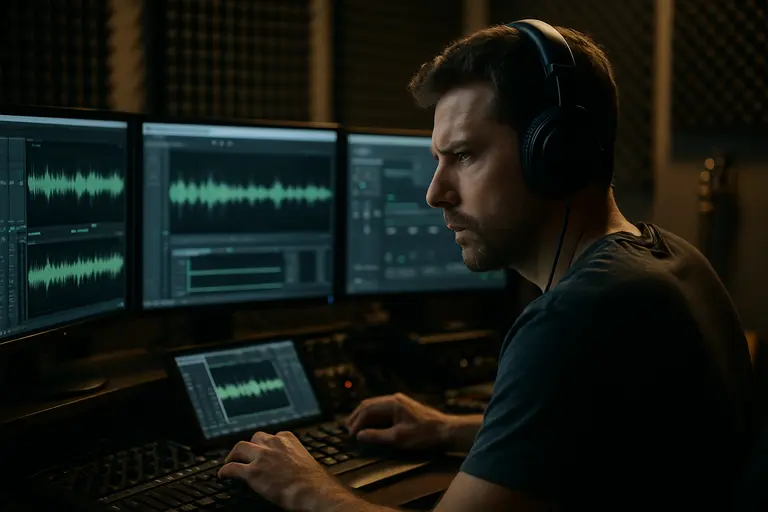
Once a live performance is prepared for platform release, mastering becomes a translation stage rather than only a loudness stage. A capture may include wide dynamics, crowd peaks, sub-heavy moments, and sudden vocal changes. The mastered version has to survive platform processing, data compression, and consumer playback while still sounding like a live event. That usually means measured dynamic control, not simply pushing level.
For R&B Live Events, the danger is losing feel while chasing uniform playback. Heavy limiting can make applause sound flat and can pull ambience forward between vocal lines. Too little control can make verses disappear on small speakers. A careful master protects the singer first, then lets the band and audience breathe around that center.
Checks That Matter Before Release
Before any captured set is approved, the mix team should confirm a few practical points:
- Lead vocals remain intelligible on small speakers without harsh high-mid buildup.
- Bass and kick retain pitch and pulse after level control.
- Crowd microphones support the performance without covering quiet phrases.
- Stereo width does not collapse key musical information on mono playback.
- Transitions between artists or songs do not create distracting loudness jumps.
These are not glamorous steps, but they protect the emotional result. A strong R&B live release should not sound like a studio record with applause pasted around it. It should feel performed, with the right amount of room information kept in the frame.
What R&B Live Events Reveal About Platform Curation
From Playlist Identity To Physical Production
Spotify’s Dallas event suggests that playlist identity can become a production environment. That does not prove a broad market shift by itself, and the available public data is too limited to claim that all platforms are moving the same way. What can be said is narrower and verifiable: Spotify is taking an R&B-branded experience into a standalone concert format on November 1, 2026, and planning selected Spotify Live releases from that event.
That move creates a feedback loop between curation and engineering. The same brand that groups songs for listeners is now associated with a room, a stage, a bill, and a captured release. For adjacent culture coverage within the same network, Next Clues offers insights into similar entertainment stories and creator-culture coverage from a wider perspective.
Respecting Artists And Communities
R&B is not only a sonic palette. It is tied to artists, audiences, regional histories, vocal traditions, church, soul, funk, hip-hop, and contemporary production practice. A festival mix that treats every act as interchangeable misses that context. Respect in audio terms means preserving what makes each artist’s performance distinct: the vocal pocket, the band feel, the track energy, the crowd relationship, and the pauses between lines.
That respect also requires restraint from commentators. Without access to the stage plot, multitracks, or production brief, no one outside the event team can say exactly how RNB X Live in Dallas will be mixed. The better analysis is to identify the pressures the event creates and the choices engineers usually have to solve.
RNB X Live In Dallas As A Mix Case Study
What Is Known
The known facts are specific: RNB X Live in Dallas is scheduled for November 1, 2026, at The Pavilion at Toyota Music Factory in Irving, Texas; it is Spotify’s first standalone R&B concert; it involves Live Nation Urban; the announced lineup spans established, rising, and local talent; and selected performances are planned for Spotify Live release. Those facts are enough to make it a useful case for live audio analysis, even before the event takes place.
What Engineers Can Learn
R&B Live Events will likely keep testing the boundary between venue impact and release-ready capture. The Dallas festival shows why engineers should plan for both outcomes from the start. Front-of-house choices, recording paths, crowd capture, stem management, vocal compression, low-end control, and mastering translation are connected decisions, not separate chores.
For producers and mixers studying the genre, the lesson is practical: build the live sound around the singer, protect the groove, capture enough room to prove the performance happened, and master with translation in mind. If RNB X Live in Dallas delivers strong released performances after November 1, 2026, the most valuable technical story may not be that a playlist became a concert. It may be that the concert had to become a mix system designed for more than one listening space.