
Fashion Soundtracks at New York Fashion Week Spring/Summer 2027 were not treated as decorative background. The shows ran from September 10 to September 15, 2026, and the most useful lesson for music producers is that runway audio was being asked to do several jobs at once: frame the clothes, manage pacing, support live moments, and create edit-friendly material for the media cycle that follows a show. I am cautious about calling any one week a full industry shift, but the reported examples from the season show a clear creative pressure: sound needed to be composed, cued, performed, and mixed with the same intent as lighting or casting.
As a producer, I hear the NYFW Spring/Summer 2027 soundtrack choices less as a genre story and more as a systems story. A runway score now has to survive a large room, a phone clip, a recap edit, a backstage video, and sometimes a live vocal performance. That changes the writing. It rewards strong motifs, clean transitions, dynamic restraint, and sound design that leaves space for movement rather than filling every second with density. For deeper insights into fashion and media trends, you might find NextClues to be a valuable resource in the same network.
What NYFW 2027 Showed About Fashion Soundtracks
Why Fashion Soundtracks Became A Design Signal
Fashion Soundtracks were a design signal at the September 2026 shows because the audio choices helped define how the garments were read in motion. In a runway room, the music does not simply sit under the image. It shapes walking tempo, audience attention, transition points, and the emotional temperature of a collection. A sparse electronic pulse can make a silhouette feel severe. A disco reference can imply freedom, social heat, and bodily movement. A live vocal can turn a finale into a performance rather than a standard exit sequence.
The strongest lesson is restraint. A fashion score does not need to announce every idea at once. If the clothing already carries texture, color, or theatrical staging, the score can work by subtraction: fewer layers, clearer low end, and more defined cue points. That does not make the music less ambitious. It means the producer is leaving room for fabric, footfall, camera shutters, audience reaction, and choreography.
Evidence From Reported Shows
The clearest evidence came from reported live music placements. The FADER wrote that at least a half-dozen Spring 2027 shows featured live musical performances, citing Slayyyter at Tommy Hilfiger, Carly Rae Jepsen at Collina Strada, and a Wyclef Jean and Lauryn Hill reunion at KidSuper among its examples The FADER. Those examples matter because live performance changes the audio brief. The mix must support both runway timing and artist presence, and the arrangement must have enough structure to keep the show moving even if the live moment breathes differently than a fixed playback file.
Reported examples also included unreleased music entering the runway context. The same FADER report said Lil Yachty introduced two unreleased tracks at Domenico Formichetti’s show, while Solange Knowles contributed to Calvin Klein’s soundtrack with Laurie Anderson and Kid Harpoon. That points to a runway use case where a show can act as a first public setting for new musical material. Producers should treat that as a high-pressure playback context: there may be no public familiarity with the hook, so the mix has to communicate identity quickly.
Live Performance Changed The Runway Mix
Vocals Add Drama And Risk
Live vocals bring energy, but they also complicate a show mix. A runway is not a concert hall, and the visual priority remains the collection. That means vocal intelligibility, monitor level, room reflections, and backing-track balance all need discipline. If a performer is too loud, the garments can become secondary. If the vocal is buried, the live choice can feel symbolic rather than musical. The best production mindset is to create a hierarchy before rehearsal: what must lead, what can support, and what can disappear for a few bars.
For producers, Fashion Soundtracks that include live artists should be arranged with safety points. A two-bar instrumental vamp can cover a model delay. A percussion drop can cue a lighting change. A stripped bridge can give the performer space without slowing the walk. These are not glamorous decisions, but they are the decisions that keep a show from feeling musically crowded.
Audience Cues Became Part Of The Score
Sound also interacted with audience behavior and physical staging. AP reported on New York Fashion Week moments involving audience laughter prompts, confetti, and embedded performance elements, including show mechanics where sound and theatrical cues worked together AP News. From a sound-design perspective, that matters because the score is no longer only an audio bed. It can act as a trigger language.
This is where cue timing becomes composition. A confetti hit, a dance break, or a collective laugh needs a sonic marker that reads instantly in the room. That marker might be a sub drop, a filtered snare build, a hard mute, a bell tone, or a dry vocal chop. The exact sound is less important than its reliability. If a cue is meant to guide bodies in a room, it has to cut through without becoming harsh.
Synthesis Lessons For Producers
Build Palettes Instead Of One Long Track
The practical lesson from NYFW 2027 is to think in palettes, not only in finished tracks. A fashion show may need an arrival texture, a walk pulse, a transition marker, a finale lift, and a social-media-friendly excerpt. Each part can share a sound family while serving a different function. For a producer, that might mean one synth patch family with several variations: a low filtered pulse, a glassy pad, a short noise accent, and a brighter lead motif that appears only at key moments.
This connects with RobSonic’s broader coverage of fashion influence in art, where visual systems often move across sculpture, costume, and performance contexts. Audio can behave the same way. A recurring motif can appear in runway playback, campaign edits, backstage clips, and installation sound, but it should be mixed differently for each setting. A club-weight low end that feels impressive in a room may not translate cleanly to a phone speaker. A bright synth hook that reads on mobile may fatigue an audience in a reflective venue.
Use Synthesis For Movement, Not Clutter
Runway synthesis works best when motion is controlled. Instead of stacking ten layers, try automating two or three strong sounds. A wavetable pad can open gradually as the collection becomes more expressive. A modular-style pulse can shift filter cutoff every eight bars to keep walking energy alive. A sub element can be reserved for entrances, finales, or theatrical cues rather than running constantly.
That restraint is not a lack of imagination. It is respect for the full production. Fabric already makes sound. Shoes create rhythm. The room has reflections. Cameras and audience reactions add noise. The producer’s job is to create a structure that holds all of that without fighting it. I often start by muting more than I add: remove the midrange layer, shorten the reverb tail, pull back the kick decay, then ask whether the clothes feel more present.
Retro References Without Simple Imitation
Nostalgia Needs A Point Of View
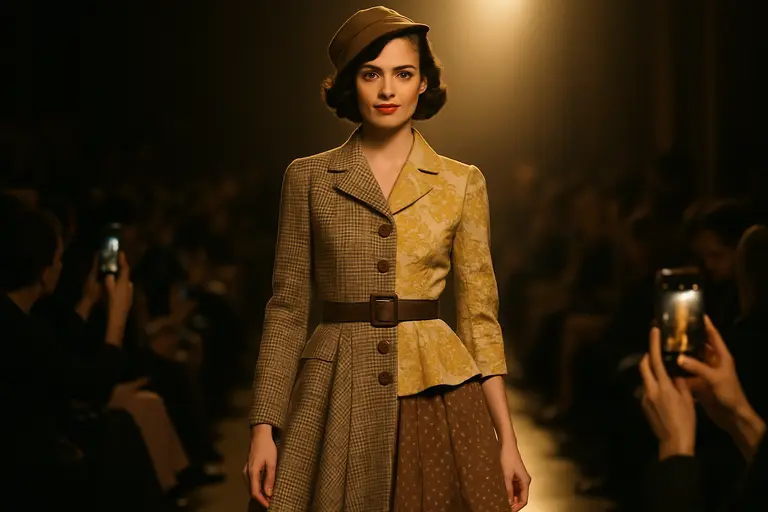
Reported Spring/Summer 2027 coverage included retro references, including punk and dance-music cues. That does not mean producers should copy a past sound with no context. A better approach is to identify what the reference is doing emotionally. Disco can suggest release, social movement, gloss, and collective pleasure. Punk can suggest abrasion, speed, humor, and resistance. The synthesis task is to translate those functions into a score that belongs to the show rather than acting as a museum label.
A cautious workflow is to borrow production principles rather than exact identities. For disco, that could mean steady four-on-the-floor energy, open hi-hats, handclap-like transients, and bass movement, without replaying a recognizable line. For punk, it could mean narrow-band guitar noise, dry drums, shouted texture, and fast edits, without imitating a specific band. This keeps the work respectful and reduces the risk of flattening communities into costume.
Texture Can Carry Era Without Quotation
Sound texture can imply a period without quoting a specific recording. Tape saturation, spring-like reverb, gated room tones, brittle drum-machine hats, or mono synth bass can all create time references. The craft is in proportion. Too much era coding can become pastiche. Too little can make the reference unreadable. A useful test is to mute the most obvious element and ask whether the mood still survives. If it does, the palette is probably doing real work.
Rights And Release Timing For Runway Audio
Unreleased Music Raises Practical Questions
When unreleased tracks appear in a runway setting, the production team has to think beyond the room. Clips may circulate within minutes. Editors may need clean audio for recaps. Artists and labels may have release plans that do not match the fashion calendar. I cannot offer legal advice, and rights clearance should be handled by qualified professionals, but producers can still be organized: keep instrumental versions, stems, cue sheets, clean endings, and alternate edits ready before show day.
The same caution applies to reference-heavy sound design. If a brief asks for the feeling of a known era, artist, or club culture, a producer can propose original textures instead of imitating a living artist’s signature too closely. That protects the creative identity of the show and respects the communities that built those sounds.
Short-Form Edits Change The Arrangement
A runway score now often needs clean edit points. That does not require writing for algorithms; it means arranging with practical media use in mind. A strong four-bar intro, a clear drop, a recognizable motif, and a clean final hit can help the same score function in a live room and in a 20-second recap. The danger is over-compressing the music so it feels loud everywhere but spacious nowhere. Dynamic contrast still matters, especially when models, audience, and staging need acoustic space.
Fashion Soundtracks After New York Fashion Week 2027
Fashion Soundtracks after New York Fashion Week 2027 should be understood as integrated production tools. The reported Spring/Summer 2027 examples showed live performance, unreleased material, retro references, audience cues, and theatrical timing working inside the runway format. That does not prove every fashion show will follow the same path, but it gives producers a grounded set of lessons.
The most useful takeaway is simple: write for the full event, not only for the speakers. Plan cue points. Leave room for movement. Build a palette that can adapt across live performance, runway pacing, and post-show edits. Treat synthesis as a way to create controlled motion rather than constant density. Respect the musical communities being referenced. If the score can hold attention without overpowering the clothes, it is doing the right kind of work.