
The Suno copyright case gives producers a useful, cautionary study in how AI music tools can affect training data, authorship, licensing, and creative trust. As of August 27, 2026, the dispute was no longer a simple argument about whether AI can make songs. It had become a practical rights question for labels, independent artists, platforms, and everyday music makers deciding how to use generated audio without weakening their own standards.
On June 24, 2024, Universal Music Group, Sony Music Entertainment, Warner Music Group, and related entities sued Suno in the U.S. District Court for the District of Massachusetts. The complaint alleged that Suno trained its system on decades of popular sound recordings without authorization, including claims involving post-1972 and pre-1972 recordings, according to the case reference. Suno later answered that its model had been exposed to tens of millions of recordings, while asserting fair use and other defenses. Those positions sit at the center of the dispute: what counts as copying for training, what counts as fair use, and what evidence should decide the answer.
Why The Suno copyright case Matters To Sound Design
Training Data Is A Creative Input
Sound designers already know that every source changes the finished work. A field recording, a synth patch, a vocal chop, or a drum break brings history into the session. AI training data works at a much larger scale, but the same creative principle applies: the source material shapes what the tool can generate. That is why the legal dispute matters beyond court filings. It asks whether a system trained on protected recordings can become part of a commercial music workflow without permission from the people and companies connected to those recordings.
For producers, this is not a reason to panic or reject every AI tool. It is a reason to slow down and ask better questions. What material may have been used to train the model? What does the platform say about user ownership? Are there limits on commercial use? Can the tool generate outputs that resemble existing recordings, voices, artist names, or recognizable musical traits? These are workflow questions as much as rights questions.
The Suno copyright case Timeline
The timeline shows how quickly this dispute expanded. The original 2024 complaint focused on alleged unauthorized use of 560 recordings. By mid-2026, reporting said the labels had amended the complaint to allege more than 61,000 songs were used without permission in Suno’s training set. On June 3, 2026, TechCrunch reported that Suno raised $400 million in Series D funding, valuing the company at about $5.4 billion, while it still faced copyright lawsuits and after a November 2025 settlement and licensing partnership with Warner Music Group reported by TechCrunch.
That combination is striking but should be read carefully. Funding does not prove legal safety. Litigation does not prove liability before final judgment. A settlement with one rights holder does not settle every claim from every creator. For artists, the more useful reading is practical: AI music companies are trying to build licensing, safety, and commercial structures while courts are still testing core copyright questions.
What Courts And Plaintiffs Have Focused On
Fair Use Remains The Main U.S. Question
In the U.S. case, Suno’s answer argued that any copying tied to model training was fair use. The plaintiffs rejected that view and framed the alleged training as large-scale copying of protected recordings. That makes the Suno copyright case a central example of a broader conflict: whether ingesting music into an AI training system should be treated like analysis, copying, licensing use, or some mixture of all three.
There was also a separate independent-artist class-action filing on June 14, 2025, known in the research notes as Justice v. Suno. The claim alleged that Suno copied tens of millions of songs, including works outside major-label catalogs, and generated low-cost sound-alike tracks that could harm less powerful creators. On August 20-21, 2026, the research record states that U.S. District Judge F. Dennis Saylor IV denied Suno’s motion to dismiss Copyright Act and DMCA claims in that case, while dismissing Tennessee Consumer Protection Act claims. A denial at that stage does not decide the merits, but it means the surviving claims continued past the dismissal phase.
Germany Added A Different Signal
The research record also notes a German dispute filed by GEMA in January 2025. On July 31, 2026, the Munich Regional Court found that Suno violated copyrights under German law, agreed with GEMA that the training-data use was infringement, and ordered Suno to disclose revenues, with damages still not quantified. Because copyright rules differ by jurisdiction, that German result should not be treated as a direct prediction of what a U.S. court will do. It does show that creators and platforms cannot assume one global answer.
For working producers, the lesson is simple: location matters, license terms matter, and platform policy is not the same thing as a court ruling. A beat maker in Berlin, a sync composer in Los Angeles, and a sample-pack seller serving global customers may face different practical risks even when using the same tool.
How Licensing And Controls Changed The Debate
Private Deals Are Becoming Part Of The Model
The November 2025 Warner Music Group settlement and licensing partnership, as described in the research, marked a move from pure conflict toward controlled commercial use. The deal reportedly allowed licensed use of WMG’s catalog and included controls over likenesses and artist names in AI-generated content. WMG exited litigation with Suno and Udio at that time. That does not resolve claims from all other parties, yet it suggests one possible path: licensing systems that define permitted training, output controls, attribution rules, or compensation structures.
For artists who release sound packs, vocal libraries, stems, or sample-based products, this is familiar territory. The question is not only whether a sound can be made. The question is whether the chain of permissions is clean enough for the intended use. RobSonic’s related guide to AI music licensing is useful here because producers need a repeatable way to check permissions, not just a feeling that a tool is popular.
Watermarking Is Helpful But Limited
The research notes say that on August 6, 2026, Suno announced tools to watermark and fingerprint AI-generated tracks, limit downloads, and update community standards to reduce misuse and address concerns about tracks resembling existing works. Those controls may help identify generated material and discourage some abuse. They do not, by themselves, answer whether the training process was lawful or whether a specific output creates a rights problem.
That distinction matters in the studio. Watermarking can support traceability. Fingerprinting can help platforms compare files. Community rules can set user expectations. But a producer still needs judgment. If a generated hook seems too close to a known song, or if a vocal texture suggests a living artist’s identity, the safer creative choice is to revise, rebuild, or avoid using it commercially until the rights position is clearer.
Producer Workflow Lessons From The Dispute
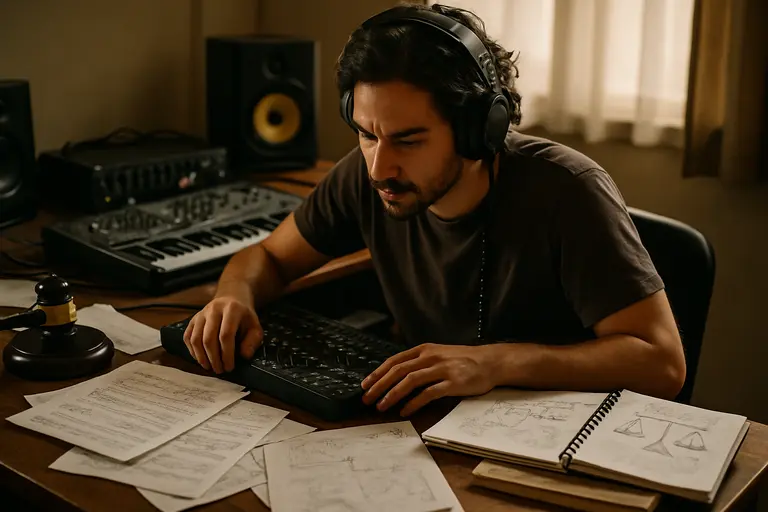
Use AI As Sketch Material, Not A Substitute For Taste
My producer view is cautious but not anti-technology. AI can be useful for sketching harmonic movement, testing lyrical directions, roughing out timbral contrasts, or generating material that you later replace with your own performance and sound design. The risk grows when the output becomes the finished record without meaningful human authorship, rights review, or sonic distance from existing works.
Suno’s published plan-tier policy, as described in the research, said that Pro or Premier subscribers own rights to tracks they generate and receive commercial-use licenses even after the subscription ends, while free Basic users do not own the songs and receive non-commercial use rights. The same research notes also caution that fully AI-created songs may not qualify for U.S. copyright protection because copyright law requires human authorship. That is not legal advice, but it is a serious production warning: platform ownership language and copyright registration standards are not identical.
- Keep dated notes on which AI tool, plan tier, prompts, and outputs were used in a session.
- Do not prompt for living artists, celebrity likenesses, protected characters, or recognizably branded material.
- Replace generic generated parts with your own synth patches, recorded performances, edits, and arrangement decisions.
- Run similarity checks by ear against obvious references before sending a track to clients, distributors, or libraries.
- For commercial releases, ask a qualified rights professional rather than relying only on platform marketing copy.
Creators also work across more than streaming. Sample sellers, cosplay makers, visual artists, and handmade-commerce communities all face permission questions when tools make copying easy. A related site within the same network, Shimply, offers resources that can aid in understanding how rights awareness spans different creative marketplaces.
What The Suno copyright case Means For Producers
Build A Rights-Aware Sound Practice
The Suno copyright case should push producers toward clearer habits, not fear-based silence. Keep the experimental spark. Test new tools. Print strange textures. Resample, edit, mangle, and arrange with intention. But treat provenance as part of sound design. The origin of a sound is now as relevant as its waveform, especially if the track is headed for sync, label release, sample sales, or client work.
A rights-aware practice can still be creative. Build your own training-safe libraries from recordings you made. Design percussion from modular noise, household objects, or licensed packs. Use AI ideas as rough clay, then shape the final identity through synthesis, performance, arrangement, mixing, and human decision-making. That keeps your work connected to your own ear, which is still the part no tool can replace.
The case also reminds us to respect the communities behind recordings. Catalogs are not abstract datasets to the artists, engineers, songwriters, vocalists, producers, and labels connected to them. Until courts and licensing systems give clearer answers, the strongest creative posture is disciplined curiosity: experiment, document, credit where required, avoid deceptive imitation, and make choices you can explain when the session leaves your hard drive.