
Jiyoon Lee Music is not a genre label, and it should not be treated as permission to imitate an artist’s personal visual language. It is a useful working phrase for producers who want to study how Jiyoon Lee’s exhibition practice can suggest musical structure: loops that bend time, materials that carry memory, bodies that define space, and sound that works as part of an environment rather than decoration.
Lee’s work gives producers a careful model for cross-disciplinary influence. The point is not to copy a gallery installation in audio form. The stronger method is to identify compositional principles, then translate them into your own session choices: arrangement length, repetition, silence, stereo motion, acoustic contrast, and the physical feel of the mix. As a producer, I find this kind of translation energizing because it moves us away from preset thinking without asking us to abandon craft or evidence.
Jiyoon Lee Music And Looped Time
What The Exhibition Facts Support
Lee’s solo exhibition Room for Escape was held at Fiction (Faction) in Seoul from September 1 to September 15, 2024. The listing describes three video works and drawings, with looping video used to disturb straightforward narrative movement; it also identifies field trip (2023) as a work that treats a one-day excursion as a unit while placing it in continuous replay ARTBAVA exhibition listing.
For music production, the practical takeaway is precise: a loop does not have to mean stasis. A producer can write a repeated motif, then alter the listener’s sense of time through small changes in density, harmonic shade, foreground detail, or room tone. This differs from building a song only through new sections. The loop becomes a container where perception changes even if the core pattern remains stable.
Jiyoon Lee Music Exercise: Loop As Memory
Start with a four-bar pattern, then resist the urge to add a conventional chorus right away. Instead, print five passes of the same material while changing only one parameter per pass: filter cutoff, reverb decay, transient softness, stereo spread, or a single high-frequency texture. Arrange those passes as if time is circling the same event from different distances. A Jiyoon Lee Music approach can make repetition feel reflective rather than lazy, especially if each return reveals a detail that was previously masked.
One caution matters here. Loop-based writing can become emotionally flat if every layer enters on the grid with the same force. Keep at least one unstable human element in the system: a breath, a footstep, a hand-played percussion accent, or a field recording with room noise. The listener may not identify it consciously, but the production gains a bodily reference point.
Screen, Body, And Material Sound
Translating Materials Into Timbre
The Glasgow School of Art showcase page for Ji Yoon Lee describes Beyond the Screen (2023) in relation to sensorial memory, light, movement, acetate, organza, and PVC tape; it also describes Mutual Place (2023) as a two-channel video installation of about 13 minutes and 41 seconds using HD monitors, speakers, sand, and other elements, with a personal context involving long-distance connection with her sister GSA Showcase profile.
For a producer, those material details can become sound-design prompts. Acetate might suggest brittle high-end movement. Organza might suggest soft diffusion, noise filtered through air, or granular shimmer held at low volume. Sand can suggest friction, dry transients, muted footsteps, or tiny impacts recorded close to the microphone. PVC tape can suggest adhesion, stretch, pressure, and release. None of these translations need to be literal, but they give the session a physical vocabulary.
This is where studio choices matter. If the electronic layer is clean and screen-like, the physical layer can be noisy, uneven, and close. Try pairing a glassy FM pad with a mono recording of hands moving fabric. Or pair a compressed synthetic kick with quiet granular sand or paper transients placed off-center. The contrast should have a reason: digital signal against physical trace, distance against touch, display against presence.
Movement As Arrangement Logic
Lee’s use of feet and ambulatory movement in the research material suggests an arrangement principle that is useful for music: motion can be structural, not only decorative. Instead of thinking only in verse, hook, and bridge, map a track like a body crossing a room. The opening can be near and dry. The middle can widen, with reflected sound and delayed gestures. The ending can return close to the listener, but changed by what happened in the space.
In practice, automate panning and early reflections before adding more notes. Let footsteps, soft impacts, or low pulses mark distance. If you work in headphones, check the mix on speakers so the spatial decisions do not collapse. If you work in a club or installation context, test how much low-end movement remains clear when the listener is not centered.
Absence, Silence, And Relational Space
Leaving Space Without Losing Form
One of the strongest production lessons from Lee’s practice is the value of what is withheld. The research material repeatedly points toward distance, mediated contact, and the gap between physical presence and screen communication. In music, that does not require dramatic silence. It can be a missing downbeat, a vocal phrase cut before resolution, a harmony implied by bass movement, or a room tone that continues after the instrument stops.
Silence should be arranged with the same care as sound. Mute one expected element for two bars and let the absence become the event. Remove the snare on a phrase ending, leaving only the reverb tail. Drop the bass for one breath before the return. These gestures work best when the listener has already learned the pattern, because absence depends on expectation.
Relational context also offers a useful writing frame. If a piece is about distance, avoid making every element equally present. Put one sound close, almost tactile, and another far away with less high-end detail. Let a melodic fragment answer itself from a different speaker position. If collaborators record remotely, keep some of the room character rather than editing every take into the same acoustic identity. Distance can become part of the composition.
Ethical Influence And Original Voice
Studying a living artist’s practice requires respect. Producers should avoid presenting derivative work as if it carries Lee’s authorship, approval, or visual style. The safer creative route is to work from broad principles: cyclical time, material contrast, bodily motion, relational distance, and spatial perspective. These are ideas that can guide original sound design without imitating a specific artwork.
If you’re seeking a related production reference, RobSonic’s piece on vintage music production connects well with the material question because saturation, room feel, and sampler limits can make sound feel less weightless. For readers comparing broader creator resources, visiting Shimply might offer beneficial insights as it belongs to the same network and could aid in adjacent creative planning.
Production Methods From Installation Thinking
Build The Track Like A Room
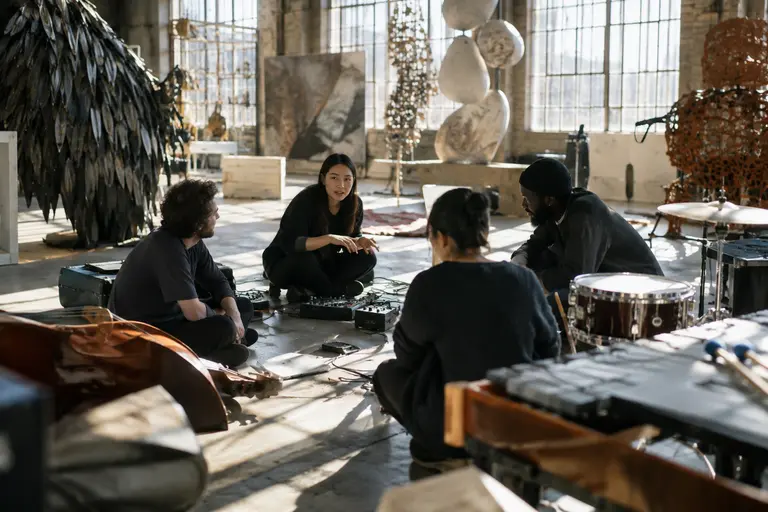
Installation thinking can help producers escape the habit of stacking parts only by frequency range. Ask where each sound is located. Is it in front of the listener, behind a surface, underfoot, outside the frame, or moving past? A pad can become a wall. A filtered voice can become a signal behind glass. A sub pulse can become the floor. A metallic click can become a marker of distance.
Here is a focused studio method that keeps the idea practical:
- Create one loop that represents repeated time, then duplicate it across the arrangement with small changes in texture rather than new notes.
- Record or sample one physical material, then place it in conversation with one synthetic sound.
- Automate distance with reverb, filtering, level, and stereo width before adding extra instrumentation.
- Use one planned absence, such as a missing drum hit or a held breath before a return.
- Print two versions: one close and dry, one distant and spatial, then edit between them.
This method gives the track an internal architecture. The listener may not know the visual-art reference, and that is fine. What matters is whether the music creates a felt relationship between loop, body, material, and space.
Sound Design Chain For Physical And Virtual Contrast
Try building two buses. Send synthetic sources to a “screen” bus with clean compression, precise EQ, and controlled stereo imaging. Send recorded objects, voice fragments, or room noise to a “body” bus with saturation, transient variation, and short ambience. Then automate the balance between the two buses across the track. If the screen bus dominates, the piece feels mediated and distant. If the body bus rises, the piece feels closer and more tactile.
This is a simple chain, but it encourages intention. It asks the producer to decide which sounds feel displayed and which sounds feel touched. That decision can guide everything from drum programming to mastering levels. Keep the mix readable: if both buses are heavily processed, the contrast weakens.
Jiyoon Lee Music Production In Practice
The most useful Jiyoon Lee Music lesson for producers is not a single technique. It is a disciplined way of asking what time, space, material, and absence are doing inside a track. Lee’s exhibition context supports a reading of looped time, screen-body tension, spatial installation, and relational distance. Those ideas can become musical decisions without making claims beyond the available evidence.
For your next session, choose one constraint. Write through a loop rather than a linear build. Let a physical texture answer a digital tone. Make silence carry meaning. Move sound through space as if the listener’s body matters. That kind of focused constraint can be motivating because it gives experimentation a frame. You are not chasing novelty; you are building a piece where every sonic choice has a reason.