
Creator commerce tech is not studio gear in the usual sense, but I read Macy’s Fall 2026 campaign the same way I would assess a production tool: what problem does it solve, what evidence supports the claim, and where can artists or sellers use the lesson without overstating it? Macy’s September 2026 fashion push connected limited capsule collections, AI-assisted discovery, creator-led sales behavior, and in-store events. For musicians, merch sellers, stylists, and visual creators, the useful part is not the department-store scale. It is the structure: content, recommendation tools, and purchase paths are being wired closer together.
Macy’s launched its Fall Fashion campaign, Find Us At Macy’s: Celebrate American Designers, on September 8, 2026. The campaign featured six limited-edition capsule collections from Tommy Hilfiger, Donna Karan New York, Michael Kors, Jonathan Cohen, LaPointe, and Theophilio, available at Macy’s online and in select stores. On September 26, 2026, Macy’s also held Celebration Saturday, a one-day in-store event from 1 p.m. to 5 p.m. at select locations, with styling moments, entertainment, gift-with-purchase offers, and the capsule collections. Since today is October 3, 2026, those launch and event dates are already past, so the more useful angle is a readout rather than a preview.
Why Creator Commerce Tech Matters Here
Creator Commerce Tech And Buying Intent
The clearest signal from Macy’s 2026 activity is that discovery is being treated less like a separate marketing stage and more like part of the transaction path. That matters for independent artists because the same pressure shows up at smaller scale: a track snippet, a fit check, a tour outfit, a handmade drop, or a limited merch piece may need to inform and sell in the same moment. Macy’s has far more infrastructure than an artist-run shop, but the core design question is familiar. Does the tool reduce hesitation, or does it add another layer between the audience and the purchase?
Creator commerce tech can help only if it gives shoppers clearer context. Macy’s Style Crew affiliate activity, as described in the research notes, involved more than 600 influencers and a stated plan to grow to 1,000 members. The same notes say top creators in the program saw 30–40% conversion growth in 2025, while the program posted 315% revenue growth and 327% traffic growth year over year. Those figures are useful, but they should be read as program results, not a guarantee that every creator campaign will perform that way.
A Music Producer’s Read On Retail Signals
From a gear-review mindset, I would compare this to choosing a controller or sampler because of workflow rather than hype. A tool is valuable when it makes a repeatable task faster, clearer, or more expressive. Macy’s Fall 2026 campaign gives artists a retail example of how content and commerce can sit in the same chain: designer capsules create scarcity, creators add human styling context, AI assists discovery, and stores supply tactile proof.
For musicians and live-event sellers, the parallel is straightforward but should stay grounded. A producer selling sample packs, a DJ selling capsule merch, or a cosplay maker selling handmade accessories can study the structure without copying the scale. The lesson is to reduce friction between inspiration and checkout while keeping the product, rights, and presentation honest.
Ask Macy’s As A Shopping Interface
AI Discovery Needs Evidence
Macy’s released Ask Macy’s on March 23, 2026, as an AI conversational shopping assistant powered by Google’s Gemini Enterprise platform, with virtual try-on, “complete the look,” and image or text prompts. During beta testing, shoppers who used the assistant generated 4.75 times more revenue per visit than shoppers who did not, according to Corlen’s Ask Macy’s report. That is one of the stronger data points in the research because it connects a feature to revenue per visit rather than stopping at novelty.
Still, the number needs caution. A shopper who chooses to use an assistant may already have higher intent. The reported lift does not, by itself, prove that the assistant caused all of the extra revenue. For creators, that distinction matters. AI styling, recommendation prompts, and image-based search can support a sale, but they do not replace audience trust, clear product pages, or accurate sizing and fulfillment information.
From Customer Tool To Staff Tool
Macy’s digital activity also has a broader channel context. In fiscal Q2 2026, digital sales, including online and app sales, accounted for 31% of net sales, and Macy’s was expanding Ask Macy’s beyond customers so store colleagues could use it for product discovery and recommendations, according to Zacks’ coverage of Macy’s digital push. That staff-facing use is worth watching because it frames AI as an assistive layer inside the selling process, not only a customer-facing chatbot.
For creators, the comparable move is not building a retail AI stack. It is building a reliable decision aid. A size guide, a fit video, a short demo, a clear returns statement, or a curated bundle can perform a similar job at smaller scale. Creator commerce tech works best when it answers a buyer’s real question at the moment the buyer asks it.
Fall 2026 Capsules And Physical Retail
Limited Capsules Give The Tech A Reason To Exist
The Fall 2026 capsules matter because technology needs merchandise with a clear story. The six listed collections put established American fashion names beside newer labels. That gave Macy’s a campaign structure with recognizably different design identities, rather than a generic promotion. For artists, the lesson is practical: commerce tools do not create meaning on their own. The product still needs a point of view.
That point of view also helps creators talk about the product without turning every post into a direct sales pitch. Styling content, behind-the-scenes construction, stage-wear references, fabric notes, or fit comparisons can provide context. In music culture, this can connect to merch drops, tour capsules, DJ wardrobe, fan-made accessories, or handmade items tied to a release cycle. Rights and likeness issues should be handled carefully, especially around fan merchandise, copyrighted characters, celebrity references, or living artists’ visual styles.
In-Store Events Add A Check Against Pure Automation
Celebration Saturday on September 26, 2026, is useful because it showed Macy’s pairing digital and creator-oriented selling with a physical event. The event included styling moments, entertainment, gift-with-purchase activity, and capsule displays at select stores. That does not prove that every retail activation needs entertainment, but it does show that Macy’s treated the store as part of the media path.
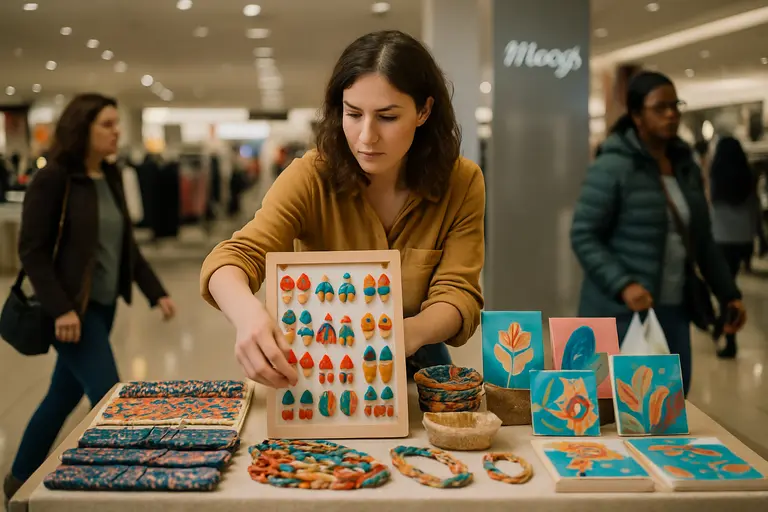
For performers, that idea is familiar. A merch table after a set often converts because the audience has just had a direct experience with the artist. The same logic can apply to pop-ups, listening parties, gallery nights, fashion drops, and rave-adjacent vendor events. The caution is cost. A physical activation can add labor, inventory pressure, travel, and staffing demands. Smaller creators should test small before assuming that a live retail moment will justify the spend.
What Artists And Sellers Can Use Carefully
Useful Tactics Without The Corporate Budget
The actionable part of Macy’s case is not that every seller needs a chatbot or virtual try-on. The stronger takeaway is that buyers respond when product context, recommendation, and purchase access are close together. A creator with a limited run can use simpler tools: short-form fit videos, creator codes, linked product cards, email drops, product bundles, or appointment-style livestreams.
For readers tracking the overlap between shoppable media and artist storefronts, RobSonic’s earlier read on shoppable UGC strategy pairs well with this Macy’s example because both topics ask how human-led content can support owned commerce without pretending that every post is a guaranteed conversion engine. For broader civic and network coverage outside this gear-and-commerce lane, visit Kay Granger, a related site in the same network.
- Use AI or automation only where it answers a real buyer question, such as sizing, styling, product comparison, or bundle selection.
- Keep creator claims specific: show how the item fits, sounds, wears, ships, or pairs with other items.
- Test one drop, event, or affiliate group before scaling inventory.
- Keep rights clearance conservative around names, images, characters, music, and fan references.
Where The Evidence Is Still Limited
Some of the research points are promising but incomplete from an analyst’s view. A 4.75-times revenue-per-visit lift for Ask Macy’s users is notable, but without more detail on shopper intent, product mix, and attribution, it should not be treated as a universal AI benchmark. The Style Crew growth figures show strong program performance, but creator programs often depend on commission structure, product-market fit, audience quality, and how much support the retailer gives participants.
That is why creator commerce tech should be judged like a piece of production gear. The spec sheet matters, but the session result matters more. If a tool shortens the path from interest to purchase while preserving clarity and trust, it earns its place. If it only adds novelty, it may become another plugin in the folder that never makes the record.
Macy’s Fall Campaign 2026 Technology Readout
What The Campaign Shows After Launch
After the September 8 launch and September 26 store event, Macy’s Fall 2026 campaign reads as a combined test of fashion storytelling, AI-assisted discovery, creator participation, and physical retail. The most defensible claim is not that one technology won the season. The defensible claim is that Macy’s used several tools in one connected selling system: capsule collections gave the campaign content, Ask Macy’s supported discovery, creator programs supplied human context, and store events gave shoppers a physical point of contact.
For artists, producers, and sellers, the practical read is measured. Creator commerce tech is most useful when it supports a real creative product and respects the buyer’s need for proof. Macy’s had scale, brand access, and store infrastructure that most independent creators do not have. Even so, the campaign points to a workable pattern: make the item clear, let trusted people show it in use, answer buying questions quickly, and avoid treating automation as a substitute for taste.